
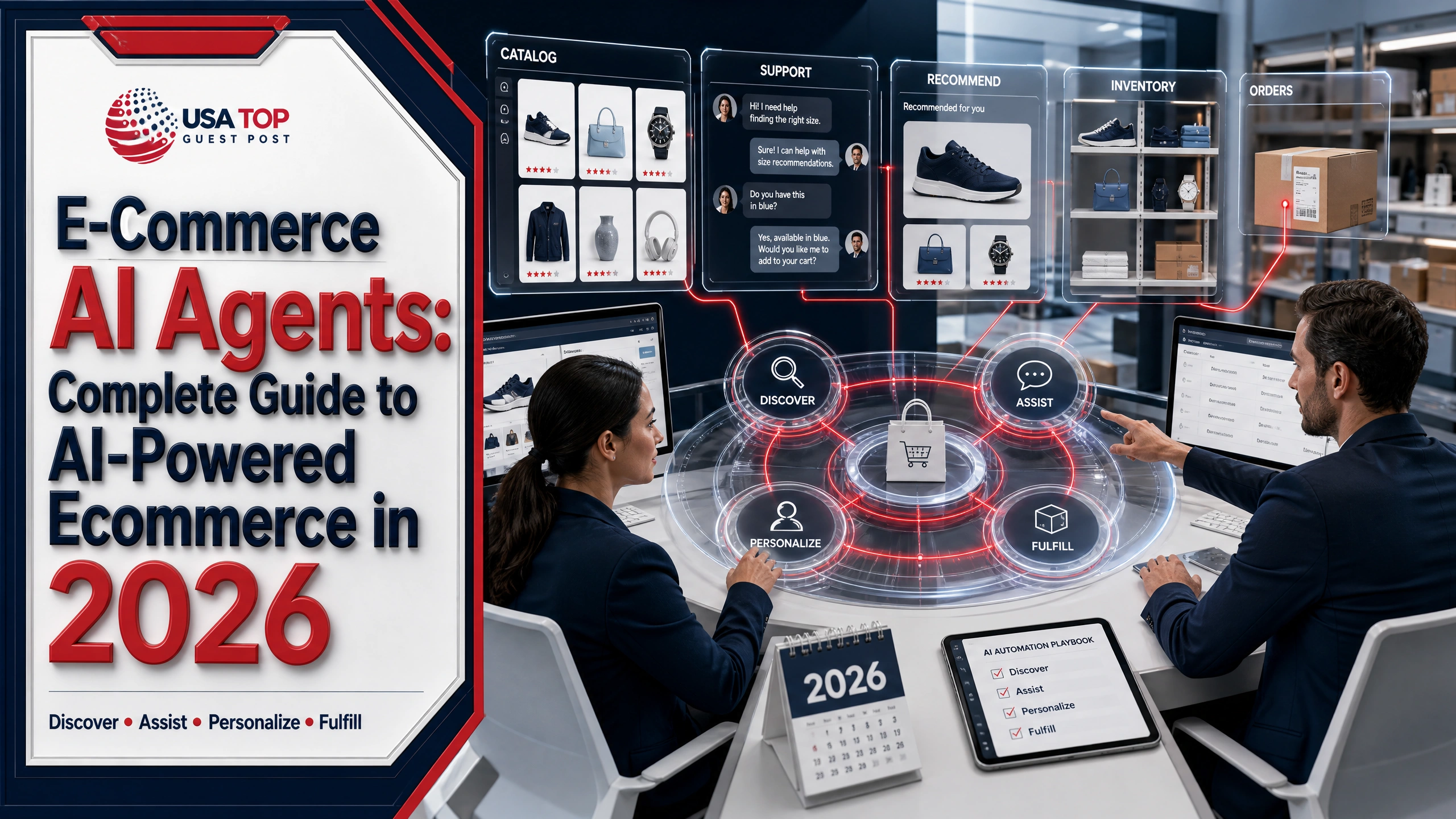
E-commerce AI agents are intelligent software systems that can understand customer or business goals, analyze relevant information, use connected tools, and complete approved actions across online shopping workflows. Unlike traditional chatbots that mainly answer predefined questions, e-commerce AI agents can support multi-step tasks such as product discovery, personalized recommendations, order tracking, customer support, inventory management, cart recovery, pricing workflows, and e-commerce operations.
The technology is also changing how customers discover products. Instead of relying only on traditional search and category navigation, shoppers can increasingly interact with AI shopping assistants, conversational commerce systems, ChatGPT, Gemini, and other AI-powered search experiences.
For ecommerce businesses, this creates two related opportunities. The first is using AI agents to automate and improve internal workflows. The second is making products, brands, and product information easier for search engines and AI systems to understand and discover.
This guide explains how e-commerce AI agents work, what they can do, how businesses can implement them, how agentic commerce is changing online shopping, how to evaluate AI agent platforms, and how e-commerce brands can prepare for AI search, AI Overviews, AEO, GEO, and broader AI visibility.
What Are E-Commerce AI Agents?
E-commerce AI agents are AI-powered systems designed to understand goals, process information, make context-aware decisions, and take actions through connected tools or business systems.
A basic chatbot might answer a question such as, “Where is my order?” using a predefined response. An ecommerce AI agent can potentially understand the request, retrieve the relevant order information, check shipping status, and provide an answer based on current data.
More advanced AI agents for ecommerce can work across multiple steps. Depending on their integrations and permissions, an agent may recommend products, compare products, check inventory, support returns, assist with refunds, recover abandoned carts, analyze customer behavior, or coordinate other ecommerce workflows.
The important distinction is that an agent is not simply a text-generation interface. It combines an AI model with context, business data, tools, APIs, instructions, permissions, and workflows.
How Do E-Commerce AI Agents Work?
An ecommerce AI agent generally follows a goal-oriented process:
User or business goal → Context and data → AI reasoning → Decision → Tool or API → Action → Result → Human escalation when needed
For example, imagine a customer asks:
“I need a lightweight laptop for college, under $1,000, with good battery life.”
An AI shopping agent may need to understand the customer’s requirements, search the product catalog, compare specifications, check current availability, identify suitable products, and explain why the recommendations fit the request.
The AI model is only one part of this process. The quality of the final result also depends on the accuracy of product catalog data, API access, business rules, system permissions, and the reliability of connected ecommerce platforms.
This is why successful AI agents in ecommerce require more than a powerful language model. They require a well-designed workflow around that model.
What Does an E-Commerce AI Agent Architecture Look Like?
A practical AI agent architecture can contain several connected layers.
Customer or Business Goal
The process starts with a goal. This could be finding a product, checking an order, recovering a cart, forecasting inventory, or completing another business task.
AI Reasoning Layer
An AI model interprets the request and determines what information or action is required.
Context and Business Data
The agent may need product information, customer context, inventory data, order information, pricing, shipping details, or company policies.
Tools and APIs
Tools allow the agent to retrieve information or perform approved actions. These may connect the AI system with an e-commerce platform, CRM, inventory system, payment system, shipping service, or knowledge base.
Action Layer
The agent can then complete an approved action, such as retrieving an order status, recommending products, updating information, or initiating a workflow.
Monitoring and Human Escalation
A reliable system also needs monitoring, permissions, testing, and human escalation for situations where the AI should not act independently.
This architecture makes autonomous AI agents more useful than isolated AI chat interfaces because the system can connect reasoning with real business workflows.

What Is the Difference Between an AI Agent, Chatbot, and Traditional Automation?
These technologies overlap, but they are not identical.
| Feature | Traditional Automation | Chatbot | AI Agent |
| Main approach | Rule-based | Conversational | Goal-oriented |
| Natural-language understanding | Limited | Stronger | Strong |
| Multi-step workflows | Limited | Usually limited | Strong |
| Decision-making | Predefined rules | Limited | Context-aware |
| Tool/API use | Possible | Possible | Core capability |
| Autonomous actions | Limited | Usually limited | Possible |
| Adaptability | Low | Moderate | Higher |
| Human escalation | Optional | Common | Important |
Traditional ecommerce automation might follow a rule such as:
If a customer abandons a cart, send an email.
A chatbot might answer:
“Your order is currently in transit.”
An AI agent could potentially interpret a broader goal, access multiple systems, compare information, and complete several connected actions.
That does not mean an AI agent should operate without controls. The more access an agent has, the more important permissions, monitoring, testing, and human oversight become.
Why Are E-Commerce AI Agents Important in 2026?
The growth of AI-powered e-commerce is being driven by customer expectations, increasing product catalogs, operational complexity, personalization requirements, and the expansion of AI-driven search.
Customers increasingly expect faster support, relevant product recommendations, convenient shopping experiences, and immediate answers.
Businesses, meanwhile, need to manage customer service, product information, inventory, pricing, marketing, fulfillment, and other workflows at scale.
AI agents can connect these requirements through ecommerce automation.
Potential benefits include:
- Faster customer support
- Personalized shopping experiences
- Improved product discovery
- Reduced repetitive workload
- More efficient ecommerce operations
- Better workflow automation
- Faster decision-making
- Improved customer experience
- Greater operational scalability
- Potential cost efficiency
The actual business impact depends on the quality of the implementation, data, integrations, workflow design, and human oversight.
What Are the Main Types of E-Commerce AI Agents?
Different AI agents can focus on different parts of the ecommerce customer journey and operational workflow.
Customer Support AI Agents
Customer support agents can handle repetitive questions involving orders, shipping, returns, exchanges, product information, and FAQs.
They can support ecommerce customer service automation while escalating complex issues to human representatives.
AI Shopping Assistants
An AI shopping assistant helps customers discover and compare products through natural-language conversations.
Instead of requiring customers to search for exact product names, the assistant can interpret needs and help narrow suitable options.
Product Recommendation Agents
Product recommendation agents use product attributes and relevant customer context to support personalized product recommendations.
They can help shoppers discover products based on preferences, purchase history, browsing behavior, and current shopping intent.
AI Inventory Management Agents
These agents can support inventory management, inventory forecasting, demand forecasting, stock optimization, and automated reordering.
Dynamic Pricing Agents
Dynamic pricing systems can analyze pricing signals, demand, inventory levels, and business rules to support pricing optimization.
Cart Recovery Agents
Cart recovery agents can identify abandoned shopping sessions and support personalized abandoned cart recovery workflows.
Fraud Detection Agents
Fraud detection agents can analyze transaction and behavioral signals to identify potentially suspicious activity and support ecommerce fraud prevention.
Content and Marketing Agents
Marketing agents can assist with product description generation, content creation, campaign workflows, customer behavior analysis, and personalization.
Businesses building a broader digital content workflow can also explore this AI content generation guide for related content automation concepts.
Supply Chain AI Agents
Supply chain agents can support demand forecasting, purchasing workflows, stock management, logistics coordination, and supply chain optimization.
What Can E-Commerce AI Agents Actually Do?
The practical value of AI agents comes from their ability to support real workflows.
Depending on their access and permissions, they can:
- Answer product questions
- Compare products
- Recommend products
- Check product availability
- Track orders
- Support returns
- Assist with refunds
- Handle exchanges
- Update inventory
- Support pricing workflows
- Recover abandoned carts
- Analyze customer behavior
- Support fraud detection
- Automate repetitive customer service tasks
- Coordinate ecommerce workflows
For example, an ecommerce AI agent could help a customer identify suitable products, compare relevant specifications, check availability, and guide the shopper toward checkout.
Another agent could work internally with inventory data to identify products approaching a stock threshold and recommend an approved reordering action.
The more advanced the workflow becomes, the more important system permissions and human intervention become.

How Do AI Shopping Agents Improve the Customer Experience?
AI shopping agents can make product discovery more conversational and personalized.
Traditional ecommerce search often requires shoppers to know what keywords to enter. Conversational commerce allows customers to describe their needs naturally.
For example:
“I need a waterproof backpack for a three-day hiking trip with enough space for a laptop.”
An AI shopping assistant can interpret those requirements, identify relevant product attributes, ask clarifying questions if needed, compare products, and provide purchase guidance.
This can improve:
- Product discovery
- Conversational shopping
- Personalized recommendations
- Product comparison
- Purchase guidance
- Checkout assistance
The objective is not simply to provide more information. It is to reduce the effort required for customers to find an appropriate product.
How Can AI Agents Personalize Online Shopping?
Personalization depends on the quality, relevance, and permissions associated with customer data.
Depending on the system, an AI agent may use:
- Customer behavior
- Browsing history
- Purchase history
- Product preferences
- Current shopping context
- Product attributes
- Real-time availability
For example, a shopper who frequently purchases running equipment may receive different recommendations from a shopper who primarily buys hiking products.
However, personalization should be handled responsibly. Businesses should use appropriate privacy controls and avoid treating customer data as unrestricted input for AI systems.
How Do AI Agents Help With Customer Support?
Customer service is one of the strongest practical use cases for AI agents.
An AI customer service agent can assist with repetitive requests involving:
- WISMO requests
- Order tracking
- Returns
- Refunds
- Exchanges
- Shipping information
- Product questions
- FAQs
- Basic account assistance
A traditional chatbot may provide a generic answer. A more capable AI agent can potentially connect to order management systems and provide information based on current customer data.
However, effective AI-powered customer support should include human escalation. Complex complaints, unusual transactions, sensitive cases, or situations requiring judgment should be routed to an appropriate human representative.
Can AI Agents Manage Inventory and Ecommerce Operations?
Yes. AI agents can support several areas of ecommerce operations when connected to reliable business data.
An AI inventory management workflow can support:
- Demand forecasting
- Inventory forecasting
- Stock optimization
- Automated reordering
- Inventory monitoring
- Order management
- Supply chain optimization
For example, an agent can monitor inventory levels, identify products approaching a predefined threshold, review relevant demand signals, and recommend an appropriate action.
Automation should still operate within business rules. Inventory decisions can affect cash flow, fulfillment, customer experience, and supplier relationships, so uncontrolled automation can create unnecessary risk.
Can AI Agents Increase E-Commerce Sales and Conversion Rates?
AI agents can support e-commerce sales by reducing friction during product discovery and purchase decisions.
Potential applications include:
- Upselling
- Cross-selling
- Personalized recommendations
- Product comparison
- Cart recovery
- Personalized offers
- Purchase assistance
- AI-powered sales automation
For example, an AI shopping assistant might recommend a compatible accessory after a customer selects a primary product.
However, personalization should be useful rather than aggressive. Irrelevant recommendations can reduce trust and create a poor customer experience.
What Is Agentic Commerce?
Agentic commerce is an emerging ecommerce model in which AI agents participate more actively in product discovery, decision-making, shopping, and potentially transactions.
Traditional ecommerce generally looks like:
Customer → Search → Website → Product → Checkout
An agentic commerce journey can move toward:
Customer → AI Agent → Product Discovery → Comparison → Decision Support → Transaction
The important change is that the AI system can potentially understand a broader goal, evaluate options, coordinate multiple steps, and take approved actions.
This creates the possibility of autonomous shopping, where AI becomes an active participant in the customer journey.
How Is Agentic Commerce Different From Traditional Ecommerce Automation?
Traditional automation is generally trigger-based and rule-based.
For example:
If the cart is abandoned → send a recovery message.
Agentic commerce is more goal-oriented.
For example:
Customer wants the most suitable product within a specific budget → evaluate available products → compare relevant attributes → recommend a suitable option → assist with the next action.
The difference can be summarized as:
| Traditional Automation | Agentic Commerce |
| Trigger-based | Goal-oriented |
| Rule-based | Context-aware |
| Predefined workflows | Adaptive workflows |
| Limited decision-making | More advanced decision-making |
| Usually task-specific | Can coordinate multi-step tasks |
| Fixed conditions | Dynamic context |
| Limited autonomy | Controlled autonomy |
Agentic systems still require business rules and permissions. Autonomy should be designed around the level of risk associated with each action.
Can AI Agents Make Purchases on Behalf of Customers?
Potentially, depending on the technology, ecommerce platform, payment infrastructure, customer authorization, and permissions granted to the agent.
This is one of the most important developments associated with agentic commerce and AI checkout.
An AI agent may potentially identify a product, compare options, confirm requirements, and assist with or complete parts of a transaction.
However, autonomous purchasing introduces additional considerations around:
- Customer consent
- Payment security
- Fraud prevention
- Transaction authorization
- Refunds
- Order changes
- Accountability
- Human approval
For high-value or sensitive transactions, requiring customer confirmation or human approval can provide an additional layer of control.
What Are the Benefits of E-Commerce AI Agents for Businesses?
The business case for AI agents usually comes from improving efficiency, customer experience, revenue opportunities, or scalability.
Operational Efficiency
AI agents can automate repetitive tasks and reduce the amount of manual work required for predictable workflows.
Customer Experience
Faster responses and more relevant assistance can improve the shopping experience.
Personalization
AI agents can use relevant customer and product context to provide more tailored interactions.
Scalability
An automated workflow can potentially handle higher customer volume without requiring the same increase in manual resources.
Sales Support
Product discovery, recommendations, cross-selling, and cart recovery can support conversion optimization.
Cost Efficiency
Automating repetitive work can reduce operational workload, although the total cost of implementation and maintenance should always be considered.
Businesses that want to connect AI with broader customer acquisition can also review this marketing funnel guide to understand how AI-assisted interactions can fit into different stages of the customer journey.

How Should You Measure the ROI of an E-Commerce AI Agent?
AI agent performance should be measured using business outcomes rather than the number of conversations the system handles.
Important metrics can include:
| Metric | What It Measures |
| Automation rate | Percentage of eligible tasks handled without manual intervention |
| Resolution rate | Percentage of customer issues resolved successfully |
| Escalation rate | Percentage of cases transferred to humans |
| Cost per resolution | Operational cost associated with resolving a request |
| Response time | How quickly customers receive useful assistance |
| Conversion rate | Percentage of relevant visitors who complete desired actions |
| Cart recovery rate | Percentage of abandoned carts recovered |
| Customer satisfaction | Customer perception of the interaction |
| Operational savings | Reduction in manual workload or related costs |
A high automation rate is not automatically a positive result.
If an agent resolves many conversations incorrectly, the apparent automation gain may create more customer service problems.
The goal should therefore be useful automation, not maximum automation.
Businesses that want a broader framework for setting measurable business objectives can also review their marketing strategy guide when connecting AI initiatives with wider growth goals.
What Are the Best E-Commerce AI Agents and Platforms?
There is no universal best AI agent platform for every ecommerce business.
The right option depends on the workflow, technology stack, data requirements, business size, security requirements, and desired level of automation.
A useful evaluation should consider:
| Evaluation Factor | What to Look For |
| Best for | The primary business problem the platform solves |
| Main capability | Customer service, shopping, marketing, inventory, or another use case |
| Ideal business | Small business, growing brand, enterprise, or specialized operation |
| Integration | Ecommerce platform, CRM, APIs, inventory, order systems |
| Real-time data | Ability to access current business information |
| Actions | Whether the system can execute approved workflows |
| Human control | Approval and escalation options |
| Monitoring | Ability to evaluate agent performance |
| Security | Permissions, data controls, and governance |
| Limitation | Tasks the platform cannot safely or effectively perform |
This approach is more useful than choosing a platform only because it appears frequently in AI agent lists.
How Should You Choose the Right AI Agent for Your Ecommerce Store?
Start with the business problem, not the AI brand.
What Business Problem Are You Trying to Solve?
Define the specific workflow first.
Examples include customer support volume, product discovery, abandoned carts, inventory forecasting, or order management.
Does the AI Agent Integrate With Your Ecommerce Platform?
Check whether it can work with the technology stack you already use.
Depending on the platform and solution, this may include Shopify AI agents, WooCommerce AI agents, BigCommerce integrations, Magento AI integration, CRM integration, and ecommerce API integration.
Can It Access Real-Time Data?
If an agent needs to provide current product availability, order status, pricing, or inventory information, it needs reliable access to relevant real-time data.
Can It Take Actions Instead of Only Answering Questions?
Determine whether the system can actually perform approved tasks or whether it only generates recommendations and text.
How Much Human Control Do You Need?
Decide which actions can be automated and which require human approval.
How Will You Measure ROI?
Define the performance metrics before deployment so you can compare results against the original business objective.
What Data Do E-Commerce AI Agents Need to Work Effectively?
AI agents depend heavily on the quality and accessibility of business information.
Depending on the workflow, an agent may need:
- Product catalog
- Product attributes
- Inventory data
- Customer data
- Order data
- CRM information
- Shipping data
- Returns policy
- Pricing information
- Knowledge base
- Product availability
A strong product catalog is particularly important for AI shopping systems because product names, specifications, variants, categories, compatibility, pricing, and other attributes need to be clear.
Poor or outdated product data can lead to poor recommendations even when the underlying AI model is capable.
Which Ecommerce Platforms Can AI Agents Integrate With?
Integration depends on the specific AI solution, available APIs, applications, and business workflow.
Common ecommerce ecosystems include:
- Shopify
- WooCommerce
- BigCommerce
- Magento
However, a platform being “supported” does not necessarily mean that every workflow is available.
Businesses should ask:
Can the agent read product data?
Can it access inventory?
Can it retrieve order information?
Can it connect with CRM systems?
Can it use ecommerce APIs?
Can it perform approved actions?
Can the business monitor those actions?
These questions provide a more accurate picture of integration depth.
How Do You Implement AI Agents in an Ecommerce Business?
A practical implementation can follow an eight-step framework.
Step 1: Identify Repetitive Workflows
Find tasks that consume significant employee time and follow reasonably predictable patterns.
Step 2: Define the Business Goal
Decide what the agent should improve.
The objective could be faster customer support, better product discovery, inventory optimization, improved cart recovery, or reduced operational workload.
Step 3: Prepare Your Ecommerce Data
Organize the product, customer, order, inventory, and knowledge information required for the workflow.
Step 4: Choose the AI Platform
Select an AI platform based on capability, integrations, security, scalability, and business requirements.
Step 5: Connect Your Systems
Connect the agent with relevant ecommerce platforms, APIs, CRM systems, inventory systems, order management tools, or knowledge bases.
Step 6: Test the Workflows
Test normal situations, unusual cases, incorrect inputs, edge cases, and failure scenarios before giving the agent meaningful permissions.
Step 7: Monitor Performance
Measure accuracy, resolution quality, escalation rates, response times, customer satisfaction, and business outcomes.
Step 8: Improve Over Time
AI agent deployment should be an ongoing process. Update workflows, permissions, data sources, instructions, escalation rules, and evaluation criteria as the business learns more.
For businesses already working with broader digital optimization, this SEO service guide demonstrates a related principle: strategy should connect search intent, content, technical foundations, authority, internal linking, and measurable outcomes rather than treating each task as an isolated activity.
What Are the Risks and Limitations of E-Commerce AI Agents?
AI agents can create significant value, but giving AI access to business systems also introduces risks.
Common concerns include:
- Incorrect decisions
- AI hallucinations
- Inaccurate product recommendations
- Data privacy problems
- Security vulnerabilities
- Poor automation
- Incorrect refunds
- Incorrect order changes
- Brand voice problems
- Customer trust issues
- Excessive automation
- Insufficient human escalation
The more important the action, the more carefully the workflow should be controlled.
For example, answering a general product question may have relatively low risk. Issuing a high-value refund or changing a sensitive customer record requires stronger authorization.
Businesses dealing with connected software systems can also review this SaaS security checklist for broader security concepts around access controls, data protection, integrations, monitoring, and incident readiness.
How Can Ecommerce Businesses Keep AI Agents Secure and Reliable?
Security should be considered before deployment rather than added after an agent is already connected to business systems.
Important safeguards include:
Access Controls
Give the agent only the permissions required for its assigned workflow.
Data Permissions
Separate sensitive customer or business information from data that the agent does not need.
Human Approval
Require approval for high-risk or high-value actions.
Testing
Test the system against normal and abnormal situations.
Monitoring
Track actions, failures, escalations, and unusual behavior.
Escalation Workflows
Provide a clear path from AI to human support when the agent cannot confidently complete a task.
Auditability
Maintain appropriate records of important automated actions so businesses can investigate problems and improve workflows.
Businesses should also consider privacy, data retention, API security, authentication, and third-party integrations when evaluating an AI agent.
For another practical security-focused resource, readers can explore this guide on how to secure SaaS applications when reviewing broader application security principles.
How Are AI Agents Changing Product Discovery and Ecommerce Search?
Ecommerce search is expanding beyond traditional keyword-based discovery.
A conventional journey may look like:
Google search → Website → Product page → Checkout
An AI-driven journey can look more like:
ChatGPT or Gemini → AI product discovery → Product recommendation → Brand discovery → Product page
This change makes AI product discovery and product discoverability increasingly important.
Ecommerce brands need to think about whether their products are clearly described, accurately categorized, supported by useful attributes, and connected with trustworthy information.
A product page should help both people and search systems understand:
- What the product is
- Who it is for
- What problem it solves
- Which features matter
- How it differs from alternatives
- What specifications apply
- Whether it is currently available
How Can Ecommerce Brands Prepare for ChatGPT, Gemini, and Google AI Search?
There is no secret keyword that guarantees visibility in ChatGPT, Gemini, Google AI Overviews, or another AI search experience.
A stronger approach is to build information that is useful, accurate, structured, context-rich, and easy to understand.
Important areas include:
- Clear product detail pages
- Accurate product attributes
- Product catalog data
- Structured product data
- Product schema
- Ecommerce schema
- Customer reviews
- First-party information
- Helpful comparisons
- Strong internal linking
- Consistent brand and product entities
- Accurate pricing and availability
- Clear answers to conversational questions
This approach complements traditional SEO rather than replacing it.
For readers interested in the wider relationship between AI and modern search, this SEO speaker resource provides additional context around AI-powered SEO, technical SEO, search trends, and ecommerce SEO.
What Is AI Search Optimization for Ecommerce?
AI search optimization for ecommerce focuses on making product, category, brand, and supporting content easier for modern search and AI systems to understand.
The process can include:
- Search intent alignment
- Semantic SEO
- Entity optimization
- Product catalog optimization
- Structured product data
- Product schema
- Ecommerce schema
- Helpful product content
- Customer reviews
- Internal linking
- Clear product attributes
- Consistent brand information
- Conversational question coverage
The objective is not to create separate pages for every possible AI query.
Instead, one strong resource can answer multiple related questions when the content provides sufficient context and topical coverage.
How Does GEO Help E-Commerce Brands Get Discovered in AI Search?
Generative Engine Optimization (GEO) focuses on making content useful and understandable within generative search and AI answer experiences.
For e-commerce, useful GEO considerations include:
- Clear product entities
- Strong topical context
- Factual consistency
- Authoritative information
- Useful comparisons
- Product attributes
- Customer reviews
- Brand consistency
- Clear answers
- Citation-worthy information
GEO should not be treated as a separate list of keywords.
For example, repeatedly inserting phrases such as “GEO ecommerce,” “AI visibility ecommerce,” and “ChatGPT ecommerce SEO” without adding useful information would not make a page genuinely stronger.
Instead, those concepts should appear naturally when the content explains how ecommerce brands can improve their discoverability in AI search.
How Can E-Commerce Content Support AEO and AI Overviews?
Answer Engine Optimization, or AEO, focuses on making information easier for answer-oriented search experiences to understand and use.
A strong structure is:
Question → Direct answer → Explanation → Example or factors → Practical takeaway
For example:
What are e-commerce AI agents?
E-commerce AI agents are AI-powered systems that can understand e-commerce goals, access relevant information, use connected tools, and complete approved actions across customer service, shopping, sales, inventory, and other workflows.
The answer should come first. The deeper explanation can follow.
This structure helps readers find answers quickly while making the relationship between questions, answers, entities, and supporting context clearer.
AI Overview visibility cannot be guaranteed by this structure, but clear answer architecture can make information easier for search systems and users to understand.
How Can Products Become More Discoverable to AI Shopping Systems?
AI systems need enough reliable information to understand a product’s identity, attributes, use cases, relevance, and differences from alternatives.
Ecommerce brands should maintain clear:
- Product names
- Categories
- Specifications
- Attributes
- Variants
- Pricing
- Availability
- Reviews
- Product descriptions
- Comparison information
- Structured data
Product catalog optimization is therefore an important part of AI-driven product discovery.
The goal is to make the product understandable rather than merely adding more keywords to the page.
How Does Structured Product Data Support AI Visibility?
Structured product data can communicate important information in machine-readable formats when implemented correctly and aligned with visible page content.
Relevant concepts can include:
- Product schema
- Ecommerce schema
- Product attributes
- Pricing
- Availability
- Product identifiers
- Reviews
- Offers
Structured data should accurately represent what users can see on the page.
It should not be treated as a shortcut for ranking or AI inclusion.
Instead, it is part of a broader technical and content foundation that helps systems understand product information.
How Do Customer Reviews Support AI-Driven Product Discovery?
Customer reviews provide real-world information about how products are experienced by buyers.
Reviews can reveal:
- Product strengths
- Common problems
- Customer expectations
- Use cases
- Product quality perceptions
- Shopper sentiment
Authentic reviews can provide useful context around a product that a standard description may not communicate.
Businesses should avoid manufacturing or manipulating reviews. Genuine customer feedback is more useful for long-term trust and product understanding.
What Is an AI Visibility Readiness Checklist for Ecommerce?
Before focusing heavily on AI-driven discovery, an ecommerce business can review these areas:
Product Information
Are product names, specifications, attributes, variants, and use cases clear?
Product Data
Is pricing, availability, and catalog information accurate?
Structured Data
Is relevant product structured data implemented correctly?
Reviews
Does the site provide genuine customer feedback?
Entity Consistency
Is the brand, product, category, and company information consistent across important pages?
Internal Linking
Do related product, category, educational, and comparison pages connect logically?
Conversational Content
Does the site answer the questions customers naturally ask?
First-Party Information
Does the site provide useful information that is not simply copied from generic sources?
Technical Accessibility
Can search engines access, crawl, and understand the important pages?
Content Quality
Does each important page provide a useful reason for the reader to choose it over competing results?
This checklist is more useful than trying to optimize for a fixed set of “AI keywords.”
How Can Ecommerce Businesses Use AI Agents and AI Visibility Together?
Internal AI agents and external AI search systems represent two different sides of the ecommerce AI ecosystem.
Internal AI Agents
Businesses can use AI agents for:
- Customer support
- Inventory
- Sales
- Marketing
- Product recommendations
- Operations
- Workflow automation
External AI Systems
Customers may use:
- ChatGPT
- Gemini
- AI shopping assistants
- AI search
- Conversational product discovery
The two can work together strategically.
For example, a business can use an internal AI agent to improve customer support while simultaneously improving product information so external AI systems can better understand its products.
This creates broader AI visibility for ecommerce strategy.
What Is the Role of Product Catalog Data in AI Visibility?
Product catalog data provides a foundation for product understanding.
A well-organized catalog can clearly communicate:
- Product name
- Product type
- Category
- Brand
- Specifications
- Size
- Color
- Material
- Compatibility
- Price
- Availability
- Product variants
When these details are incomplete or inconsistent, AI systems may have less reliable information from which to understand a product.
Product catalog optimization should therefore be treated as part of both ecommerce operations and AI search readiness.
Can AI Agents Replace Human Customer Support?
AI agents can automate many repetitive customer support tasks, but they should not automatically be treated as replacements for human employees.
AI is particularly useful for:
- FAQs
- Order tracking
- Basic product questions
- Routine returns
- Simple account requests
- Repetitive support workflows
Humans remain important for:
- Complex complaints
- Sensitive situations
- High-value customers
- Unusual transactions
- Exceptions
- Escalations
- Cases requiring judgment or empathy
A strong AI + human support model uses automation where it is appropriate and human intervention where it adds value.
How Much Do E-Commerce AI Agents Cost?
The cost of an AI agent depends on several factors:
- Platform
- Usage
- Number of users
- Customization
- API integrations
- Data requirements
- Workflow complexity
- Security requirements
- Monitoring
- Maintenance
- Human oversight
A simple FAQ or customer support implementation can have a very different cost from a custom AI system connected to inventory, CRM, order management, payment, shipping, and multiple APIs.
The better question is not simply:
“How much does the AI agent cost?”
It is:
“What business outcome can the AI agent produce, and what will it cost to implement and maintain?”
What Should Ecommerce Businesses Do Before Implementing AI Agents?
Before deployment, document the existing workflow.
A practical preparation process is:
- Identify repetitive tasks.
- Document the current workflow.
- Define the desired outcome.
- Identify required data.
- Review available integrations.
- Determine which actions require approval.
- Establish security controls.
- Define performance metrics.
- Test real-world scenarios.
- Monitor results after launch.
This prevents businesses from purchasing an AI tool first and only later trying to discover what problem it should solve.
What Are the Most Important E-Commerce AI Agent Best Practices?
Start With the Business Problem
Choose the workflow before choosing the technology.
Use Reliable Data
AI agents cannot compensate for inaccurate product, inventory, customer, or order information.
Give Limited Permissions
Agents should have only the access necessary to perform their assigned tasks.
Keep Human Oversight
High-risk decisions should have appropriate human approval.
Measure Business Outcomes
Track resolution quality, automation, customer satisfaction, conversion, cost, and other relevant metrics.
Test Before Scaling
Start with a controlled workflow, evaluate the results, and expand gradually.
Monitor Continuously
AI agent performance can change as products, customers, workflows, and business rules change.
Improve the Knowledge Base
Keep product information, policies, FAQs, and operational documentation accurate and current.
What Are the Biggest Mistakes Businesses Make With E-Commerce AI Agents?
Several implementation mistakes can reduce the value of AI automation.
Automating a Bad Workflow
AI can make an inefficient workflow faster without making it better.
Using Poor Data
Incorrect product or inventory data can lead to incorrect AI decisions.
Giving Too Much Access
An agent should not have unrestricted permissions simply because it technically can perform an action.
Ignoring Human Escalation
Customers need a clear path to human support when the AI cannot resolve an issue.
Measuring Only Automation
A high automation rate is meaningless if resolution quality is poor.
Treating AI as a Complete Replacement
AI is most useful when its strengths and limitations are understood.
Ignoring Security
Connected AI agents can create new access and data risks if integrations are not carefully controlled.
Chasing AI Keywords
Adding large numbers of AI-related keywords without adding useful information does not create genuine AI visibility.
What Is the Future of E-Commerce AI Agents?
The future of e-commerce AI is likely to involve deeper integration between AI agents, e-commerce platforms, product catalogs, customer data, payment systems, and operational workflows.
Important developments include:
- Agentic commerce
- Autonomous shopping
- AI shopping assistants
- AI checkout
- Multi-agent systems
- AI-powered product discovery
- Autonomous ecommerce operations
- AI-powered sales automation
- Intelligent inventory workflows
- Conversational commerce
As these systems become more capable, businesses will need to balance automation with security, privacy, customer consent, reliability, and human oversight.
The competitive advantage will not come simply from having an AI agent.
It will come from connecting the right AI capabilities with reliable data, useful workflows, strong customer experiences, and measurable business outcomes.
E-Commerce AI Agents FAQ
What are e-commerce AI agents?
E-commerce AI agents are AI-powered systems that can understand ecommerce goals, use relevant data and tools, make context-aware decisions, and complete approved actions across customer service, shopping, sales, inventory, and other workflows.
How do AI agents work in ecommerce?
They combine an AI model with business context, data, tools, APIs, instructions, and permissions. The system interprets a goal, determines what information or action is needed, and completes an approved workflow.
What is the difference between an AI agent and a chatbot?
A chatbot primarily provides conversational responses, while an AI agent can potentially handle multi-step tasks, access business systems, use tools, make context-aware decisions, and execute approved actions.
Can AI agents recommend products?
Yes. AI shopping agents and product recommendation agents can use product information and relevant customer context to help shoppers discover and compare suitable products.
Can AI agents manage inventory?
Yes. AI agents can support inventory management, demand forecasting, inventory forecasting, stock optimization, and automated reordering when connected to appropriate data and systems.
Can AI agents recover abandoned carts?
Yes. AI cart recovery workflows can identify abandoned shopping sessions and support personalized recovery interactions.
What is agentic commerce?
Agentic commerce is an emerging model where AI agents can participate more actively in product discovery, comparison, shopping, decision-making, and potentially transactions.
Can AI agents make purchases for customers?
Potentially. Depending on customer authorization, platform capabilities, payment infrastructure, and permissions, AI agents may assist with or complete parts of a transaction.
What is the best AI agent for ecommerce?
There is no single best AI agent for every business. The right choice depends on the specific use case, integrations, data access, security requirements, workflow capabilities, scalability, and expected ROI.
How much do ecommerce AI agents cost?
Costs vary according to platform, usage, integrations, customization, data requirements, workflow complexity, and maintenance. Businesses should evaluate total cost against expected business value.
Do AI agents work with Shopify?
Many AI agent solutions can integrate with Shopify through applications, APIs, or other integrations. The depth of functionality depends on the specific solution and workflow.
Can AI agents work with WooCommerce?
AI agents can potentially integrate with WooCommerce through available applications, APIs, plugins, or custom integrations, depending on the selected solution.
Can AI agents work with BigCommerce?
AI agent functionality can be integrated with BigCommerce depending on the specific platform, APIs, applications, and workflow requirements.
Can AI agents work with Magento?
Magento-based ecommerce businesses can potentially connect AI systems through available integrations, APIs, and custom development, depending on the required workflow.
How do AI agents use customer data?
They may use customer behavior, browsing history, purchase history, preferences, and current context to personalize interactions. Businesses should apply appropriate privacy and access controls.
Are ecommerce AI agents secure?
AI agents can be designed with access controls, data permissions, human approval, testing, monitoring, and escalation workflows. Security depends heavily on implementation and governance.
Can AI agents replace customer support teams?
They can automate many repetitive tasks, but human support remains important for complex, sensitive, unusual, and escalated cases.
How can ecommerce brands improve AI visibility?
Brands should maintain clear product information, accurate catalog data, structured product data, useful product pages, authentic reviews, consistent entities, strong internal linking, and helpful content that answers real customer questions.
Can SEO guarantee inclusion in Google AI Overviews?
No. There is no guaranteed SEO or AI keyword formula that ensures inclusion in Google AI Overviews or another AI search result.
How can ecommerce brands prepare for ChatGPT and Gemini?
Brands should focus on accurate product information, useful content, clear entities, structured data, customer reviews, product discoverability, strong technical foundations, and information that clearly answers customer questions.
What is GEO for ecommerce?
GEO, or Generative Engine Optimization, is a broader approach to making content useful and understandable within generative search and AI answer experiences. It emphasizes information quality, context, entities, authority, factual consistency, and useful answers rather than a separate keyword list.
What is AEO for ecommerce?
AEO, or Answer Engine Optimization, focuses on structuring information so answer-oriented search systems can more easily understand and surface direct answers to user questions.
What should businesses measure after launching an AI agent?
Businesses should measure automation rate, resolution rate, escalation rate, response time, customer satisfaction, conversion rate, cart recovery, operational savings, and other KPIs relevant to the original business goal.
Final Thoughts
E-commerce AI agents are becoming an important part of modern online retail because they can connect artificial intelligence with real ecommerce workflows.
The technology can support customer service, product discovery, personalization, inventory management, pricing, cart recovery, sales automation, fraud detection, supply chain workflows, and other operational tasks.
At the same time, the rise of agentic commerce and AI shopping is changing how customers may discover and purchase products.
For ecommerce brands, this means the strategy should not stop at implementing an AI agent.
Businesses should also make their product information easy to understand, maintain accurate catalog data, strengthen structured product information, provide authentic customer reviews, build clear internal relationships between related content, and create useful answers around real customer questions.
The strongest approach combines SEO, semantic SEO, entity optimization, AEO, GEO, AI visibility, E-E-A-T, structured product data, ecommerce automation, human oversight, and measurable business outcomes.
Most importantly, there is no guaranteed “AI ranking keyword.” Repeating e-commerce AI agents or related phrases excessively would not make a page more authoritative. The better strategy is to use the primary keyword naturally, cover the surrounding entities and search intents comprehensively, add original practical frameworks, explain limitations honestly, and give readers information that is genuinely more useful than a generic summary.
That combination creates a stronger foundation for Google Search, AI-powered search, conversational discovery, and the evolving world of agentic commerce.


