
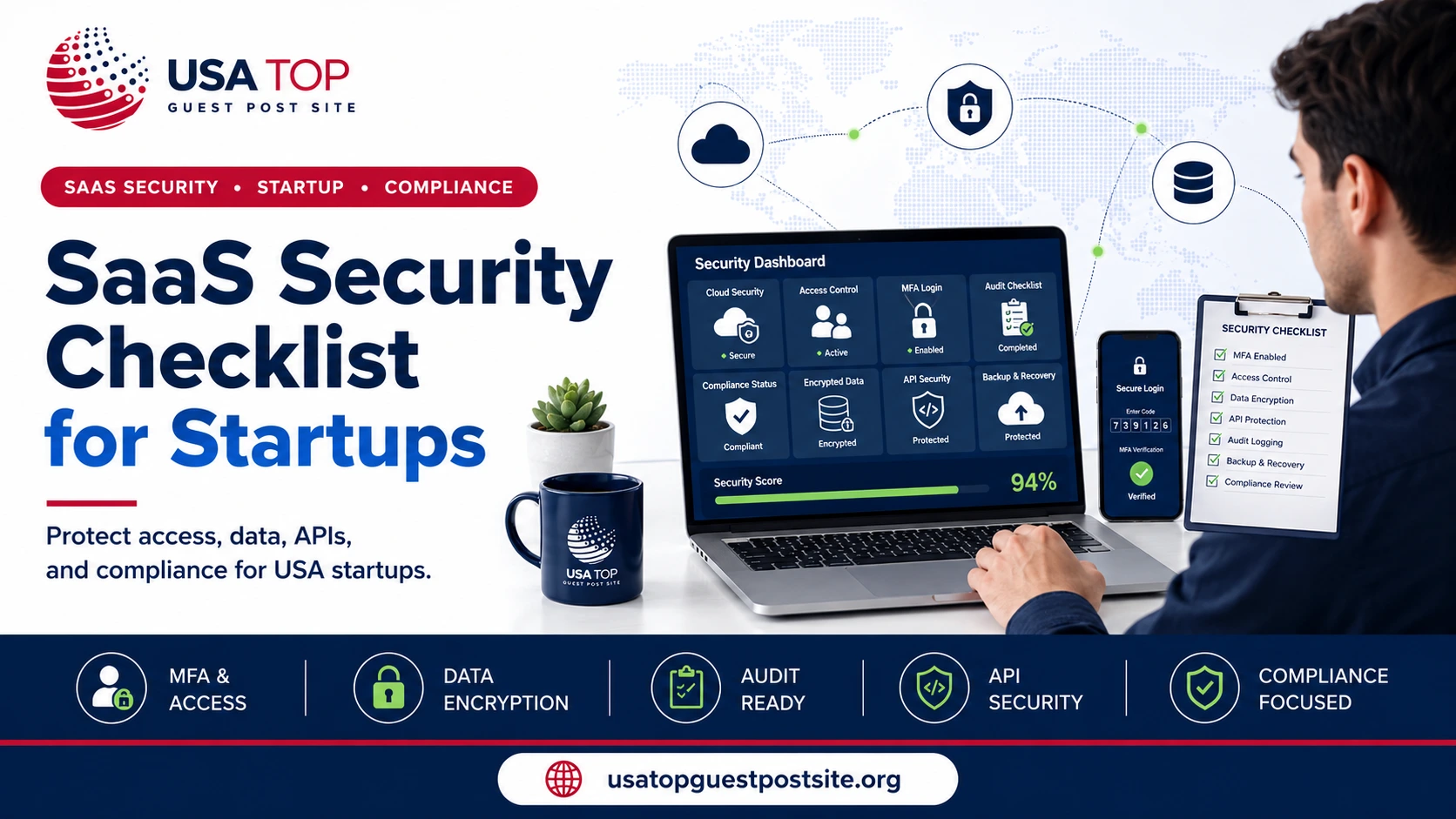
SaaS security checklist planning helps startups protect customer data, user accounts, cloud applications, business files, payment information, admin dashboards, and connected third-party tools before security problems become expensive. For a SaaS startup, security is not only a technical task. It is a trust signal, a sales requirement, a compliance need, and a long-term business foundation.
In New York, across the USA, and worldwide, many startups build fast. They launch MVPs, add users, connect tools, hire remote teams, use APIs, and collect customer information early. That speed is useful for growth, but it can also create security gaps. Weak passwords, missing MFA, over-permissioned users, untested backups, poor logging, and unclear data policies can turn a promising SaaS product into a risk.
At USA Top Guest Post Site, we publish helpful, business-focused content for startups, SaaS companies, agencies, and digital brands that want to build trust through clear information. This guide explains what a SaaS startup should check, why it matters in the USA market, how to create a security workflow, and how to improve SEO, AEO, GEO, EEAT, and AI Overview visibility with useful cybersecurity content.
What Is a SaaS Startup Security Checklist and Why It Matters in the USA?
A SaaS startup security checklist is a practical list of security controls that helps a company review its application, users, data, cloud tools, integrations, policies, and recovery process. It gives founders, developers, IT managers, and business owners a simple way to identify weak points before customers, attackers, or compliance reviewers find them.
For USA startups, this matters because SaaS products often serve customers across different states and industries. A New York-based startup may sell to finance teams, healthcare providers, eCommerce brands, law firms, agencies, schools, or remote companies. Each customer may have different data expectations. Even when a startup is small, it may still store emails, passwords, business documents, invoices, API keys, user activity, or billing-related information.
Local business conditions also make security important. Many USA SaaS startups use remote work, contractors, cloud hosting, shared tools, and third-party software. A founder may work from one city, developers may work from another location, and customers may log in from different countries. Because access happens online, SaaS companies need identity protection, role-based permissions, monitoring, and backup planning.
This is where a SaaS security audit becomes useful. An audit helps review whether security settings, access rules, policies, logs, data protection, and compliance readiness are strong enough for current business needs.
CISA describes zero trust as a model focused on reducing uncertainty and enforcing accurate, least-privilege access decisions, which fits SaaS environments where users, devices, apps, and integrations constantly change.
For a beginner explanation, read what is SaaS security in the USA. If you want to understand ongoing SaaS posture monitoring, visit what is SaaS security posture management.
SaaS Startup Security Planning Table for Stronger Protection
SaaS startup security planning should begin before growth becomes difficult to control. Many founders wait until they have enterprise customers, but security basics should be built earlier. A startup may not need a large security department on day one, but it does need clear rules for login, access, data, backups, vendors, and incident response.
A useful checklist turns security into visible action. Instead of saying “we need better security,” the team can assign specific tasks such as enabling MFA, reviewing admin access, encrypting sensitive data, checking connected apps, and testing backup recovery.
| Security Area | What to Check | Why It Matters |
| Login protection | MFA, strong passwords, secure sessions, SSO readiness | Reduces account takeover risk |
| User permissions | Role-based access, least privilege, admin review | Prevents over-permissioned accounts |
| Data protection | Encryption, secure storage, data classification | Protects customer and business information |
| API security | Secure tokens, validation, rate limits, logging | Reduces integration abuse |
| Secure development | Code review, dependency scanning, vulnerability checks | Reduces application flaws |
| Logging and monitoring | Login logs, admin actions, export activity, alerts | Helps detect suspicious behavior |
| Vendor risk | Review third-party apps, contracts, and data access | Reduces supply chain exposure |
| Backup and recovery | Backup schedule, restore testing, disaster plan | Helps recover from incidents |
| Compliance readiness | Policies, audit evidence, privacy notices, user rights | Supports customer trust and sales |
NIST Cybersecurity Framework 2.0 organizes cybersecurity outcomes into six core functions: Govern, Identify, Protect, Detect, Respond, and Recover. This structure is useful for startups because it shows that security is not only protection; it also includes governance, detection, response, and recovery.
For a SaaS startup, the table above can be used as a first internal review. It does not replace professional testing, but it helps the team understand priorities. For example, if admin accounts do not use MFA, that should be fixed quickly. If backups exist but were never tested, the company does not truly know whether it can recover.
Security becomes easier when it is reviewed in small pieces. A startup can begin with identity and access, then move to data, then APIs, then monitoring, then compliance. This makes the process manageable and less overwhelming.
For deeper risk education, visit SaaS security risks in the USA.
Tips for Building a Startup SaaS Security Policy That Works
A good SaaS startup security plan needs more than tools. It needs rules that people understand and follow. A written policy helps employees, contractors, developers, and managers know what is expected. Without clear rules, security becomes informal, and informal security often breaks as the company grows.
A SaaS security policy should explain how the company manages users, passwords, MFA, admin access, sensitive data, device security, code changes, vendor tools, backups, incident response, and customer communication. It does not need to be complicated at the beginning. It should be simple, clear, and practical.
Practical Startup Security Tips
- Turn on MFA for all admin and developer accounts.
- Remove inactive users and former team members quickly.
- Use role-based access instead of giving everyone full access.
- Keep customer data only as long as needed.
- Review third-party integrations before connecting them.
- Test backups before an emergency happens.
- Create a simple incident response contact list.
OWASP recommends strong authentication practices, including avoiding arbitrary password changes and encouraging strong passwords and MFA. This is especially important for SaaS platforms with customer portals, admin panels, dashboards, and private business data.

A useful policy also helps sales. Many B2B customers ask security questions before signing a contract. If your startup can explain its security process clearly, it builds confidence. A policy also helps your content marketing because you can create helpful blog posts, security FAQs, and product pages that answer buyer questions before a sales call.
For more advanced comparison content, read SaaS security posture management vs CSPM.
SaaS Startup Compliance Checklist for Customer Trust
A SaaS startup compliance checklist helps a company understand which security and privacy requirements may apply to its product, customers, and market. Compliance can include privacy notices, access control documentation, audit logs, vendor review, data retention, incident response planning, employee training, and evidence that security controls are actually working.
A SaaS security compliance checklist is especially useful for startups that sell to USA businesses, enterprise customers, healthcare organizations, finance teams, legal companies, education providers, or public sector clients. These customers may ask about data handling, encryption, access control, user deletion, admin permissions, backups, and breach response.
Compliance should not be treated as paperwork only. A startup may have a policy document, but if old employees still have access, the real risk remains. A startup may promise data protection, but if sensitive data is stored without encryption or monitoring, trust can break. Real compliance requires action, evidence, review, and improvement.
FTC business guidance encourages companies to build security into products and services, manage authentication and access control, handle data securely, and communicate clearly with users. These ideas are highly relevant for SaaS startups because customers expect platforms to protect their information from the beginning.
A practical compliance workflow should include:
- Identify what data is collected.
- Know where data is stored.
- Limit access to sensitive information.
- Document who can approve admin access.
- Review connected third-party vendors.
- Keep logs for important actions.
- Prepare a response plan for security incidents.
- Update policies when product features change.
For startups, compliance readiness can also improve conversion. If a buyer asks whether your SaaS platform uses MFA, keeps audit logs, or has a data deletion process, your team should not panic. A prepared answer can help the sales process move faster.
To connect this topic with a broader company-level guide, visit SaaS security best practices for companies.
Access Control, Data Protection, and Monitoring Table for Startups
Access control is one of the most important parts of SaaS security. Many problems happen because users have more access than they need. A developer may have production access forever. A contractor may keep access after a project ends. A customer support user may see more customer data than necessary. A founder may share one admin account with the team. These habits may feel convenient, but they create risk.
A secure startup should follow least privilege. That means users only get the access required for their role. Access should be reviewed regularly, especially for admin users, contractors, support teams, and third-party tools.
| Control Area | Startup Best Practice | Business Benefit |
| Admin access | Give admin rights only to trusted users who need it | Reduces high-risk account exposure |
| MFA | Require MFA for admins, developers, and sensitive users | Blocks many password-based attacks |
| Role-based access | Create roles such as admin, manager, support, user | Prevents unnecessary data access |
| Data encryption | Encrypt sensitive data in transit and at rest | Protects customer information |
| API access | Use scoped tokens, expiration, validation, and rate limits | Reduces API abuse |
| Audit logs | Track login, permission changes, exports, and admin actions | Supports investigation and trust |
| Offboarding | Remove access when users leave the company | Prevents old accounts becoming risk |
| Backup testing | Test restore process, not only backup creation | Confirms recovery ability |
OWASP notes that MFA is a strong defense against common password-related attacks such as brute-force, credential stuffing, and password spraying. That makes MFA one of the most practical startup security improvements.
A startup should also monitor user behavior. If someone logs in from a new country, downloads a large amount of data, creates an unusual admin account, or connects a new third-party app, the team should know. Logging does not prevent every problem, but it helps detect issues earlier and respond faster.
A table like this is useful for founders because it turns security into daily operations. Instead of waiting for a security incident, the team can review access monthly, check logs weekly, and test backups regularly.
Common SaaS Security Mistakes Startups Should Avoid
Startups move quickly, but fast growth can create security mistakes. The first common mistake is using shared accounts. Shared admin accounts make it hard to know who changed what, who accessed data, and who should be responsible. Every team member should have a unique account.
The second mistake is delaying MFA. Many teams say they will enable MFA later, but attackers often target weak logins first. Admin accounts, developer accounts, and billing accounts should be protected early.
Mistakes to Avoid
- Using one shared admin login.
- Giving everyone full access.
- Forgetting to remove old users.
- Ignoring third-party app permissions.
- Storing sensitive data without clear rules.
- Not testing backup restoration.
- Having no incident response process.
Another mistake is ignoring third-party tools. SaaS startups often use analytics platforms, CRM tools, payment systems, email software, customer support apps, cloud hosting, and automation tools. Each connected tool can create risk if it has broad permissions or weak account security.
A fourth mistake is writing vague security claims on the website. Saying “we take security seriously” is not enough. Customers want to know what you actually do. Do you use MFA? Do you encrypt data? Do you review access? Do you monitor logs? Do you have backup recovery steps? Clear answers build trust.
A fifth mistake is not updating security as the product changes. New features can create new data flows. New integrations can create new permissions. New team members can create new access risks. Security should grow with the product.
For SaaS founders, avoiding these mistakes is often cheaper than fixing them later. A simple security review every month can prevent many issues.
SaaS Access Control Workflow for Better Startup Protection

SaaS access control best practices help startups reduce risk by making sure the right people have the right access at the right time. Access control is not only about passwords. It includes user roles, admin permissions, MFA, session security, API tokens, connected apps, employee offboarding, and approval workflows.
The first step is identity. Every user should have a unique account. Shared accounts should be avoided because they hide accountability. If something goes wrong, the company needs to know who performed the action.
The second step is authorization. A customer support user may need to view limited account information, but they may not need billing settings or database access. A developer may need staging access, but not always production access. A contractor may need temporary access that expires after the project.
The third step is monitoring. When a user changes permissions, exports data, creates an API token, or logs in from a new device, the system should record that activity. These logs are important for audits, troubleshooting, and incident response.
The fourth step is regular review. Startup teams change quickly. People join, leave, switch roles, and work with contractors. Access that was correct three months ago may be unnecessary today. A monthly or quarterly access review can remove risk before it becomes serious.
FTC guidance for protecting personal information recommends controlling access to data sensibly and using protections such as encryption and multi-factor authentication where remote access is involved.
For SaaS companies, access control also supports sales confidence. If enterprise customers ask how user permissions are managed, a clear access workflow helps your team answer with confidence. It also supports content quality because your website can explain real security practices instead of using generic claims.
Frequently Asked Questions About SaaS Startup Security in the USA
A startup SaaS security FAQ helps readers get direct answers quickly. It also supports AEO and featured snippet visibility because search systems can understand clear question-and-answer content. These answers cover price, timeline, process, requirements, and USA-specific business concerns.
How much does SaaS security cost for a startup?
SaaS security cost depends on product size, number of users, data sensitivity, compliance needs, integrations, and testing depth. Basic improvements such as MFA, access review, and backup testing may be low-cost. A full audit, penetration test, or compliance readiness project costs more.
How long does it take to secure a SaaS startup?
Basic security improvements can start within days. Deeper work such as secure development changes, API review, vendor review, compliance documentation, and audit preparation may take weeks or months. The timeline depends on the current security maturity of the product.
What is the first step in a SaaS startup security checklist?
The first step is to identify what data the SaaS app collects, where it is stored, who can access it, and which third-party tools are connected. After that, review MFA, user roles, admin accounts, logs, backups, and data protection.
What should a startup prepare before a security review?
A startup should prepare system architecture, user roles, admin account list, API documentation, third-party integrations, data flow notes, access policies, backup process, incident response plan, and compliance requirements.
Why does SaaS security matter for USA startups?
USA startups often sell to customers who expect strong data protection, secure access, privacy awareness, and vendor accountability. Security helps reduce business risk, support sales, protect customers, and build trust in a competitive market.
Is SaaS security only needed for large companies?
No. Small startups also need SaaS security because they may collect customer emails, passwords, payment-related data, documents, and business records. Early security planning is usually easier and cheaper than fixing problems after growth.
How often should SaaS access and security settings be reviewed?
Startups should review high-risk access monthly or quarterly, especially admin users, contractors, integrations, API tokens, and inactive accounts. Security should also be reviewed after major feature launches, new vendors, or team changes.
Get In Touch
USA Top Guest Post Site
New York, USA
For SaaS security content publishing, guest post planning, cybersecurity blog strategy, and content marketing support, visit USA Top Guest Post Site or contact the team through the contact page.


