
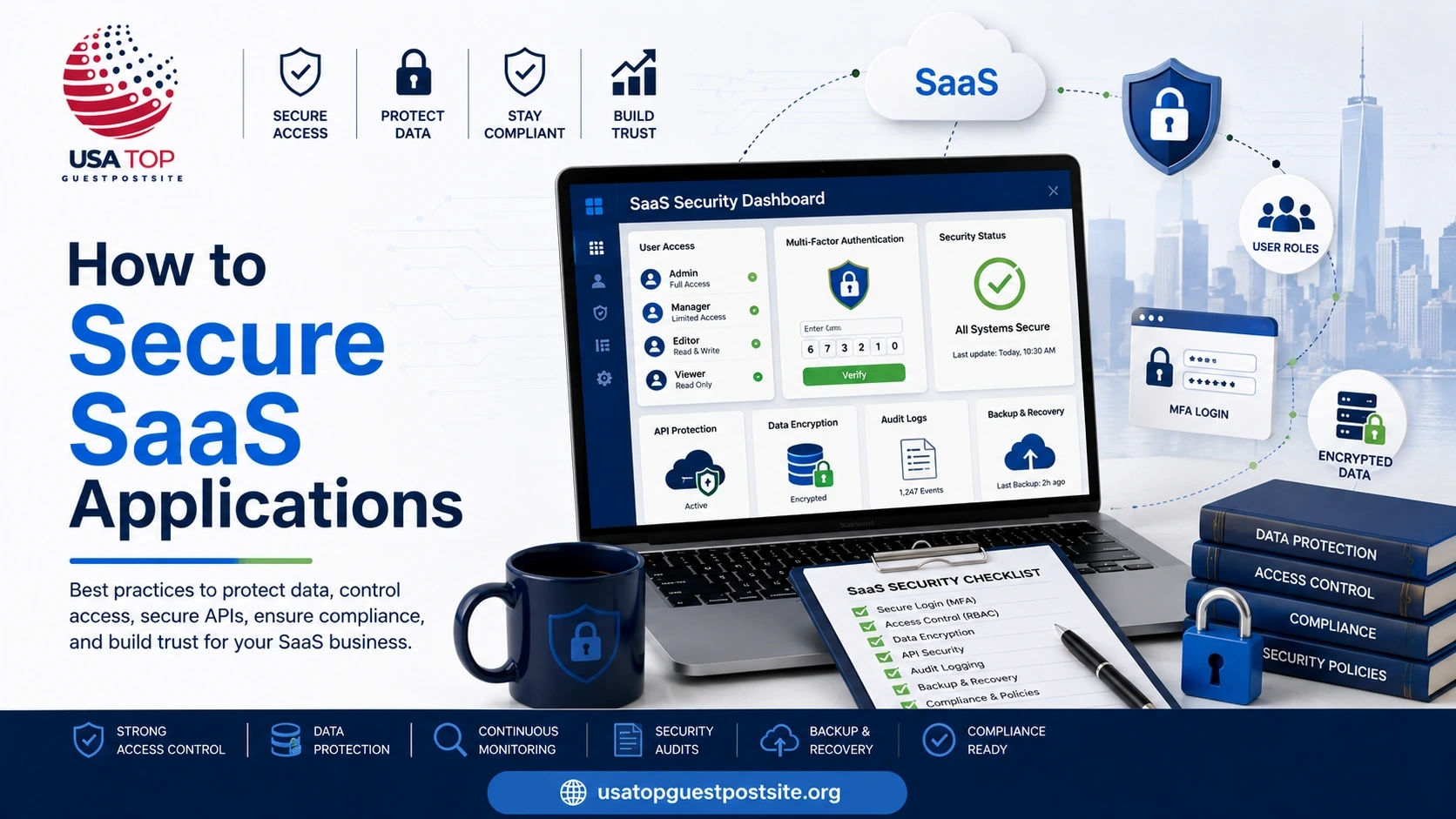
How to secure SaaS applications is one of the most important questions for startups, software companies, agencies, IT teams, and digital businesses that depend on cloud-based platforms. A SaaS application may store customer profiles, payment-related data, user activity, business documents, API keys, support tickets, analytics, and private company information. If the app is not protected properly, one weak login, exposed API, wrong permission, or missing backup process can damage customer trust.
For businesses in New York, across the USA, and worldwide, SaaS security is now a business growth issue, not only a technical issue. Customers want to know that their data is safe. Enterprise buyers often ask about access control, encryption, audit logs, vendor risk, compliance, and recovery plans before they sign up. Search users also want simple, direct guidance that explains what to secure first and how to build a safe SaaS workflow.
At USA Top Guest Post Site, we publish helpful business, SaaS, cybersecurity, and content marketing resources for readers who want practical information. This guide explains SaaS application security in a clear way, with checklists, tables, tips, workflows, FAQs, and trusted references for better Local SEO, AEO, GEO, EEAT, and AI Overview visibility.
What Is SaaS security best practices and Why It Matters in the USA?
SaaS security best practices are the security methods, controls, policies, and workflows used to protect cloud software from unauthorized access, data leaks, account takeover, API abuse, misconfiguration, insider risk, and service disruption. These practices usually include multi-factor authentication, role-based permissions, encryption, secure coding, logging, vendor review, backup testing, incident response, and compliance readiness.
In the USA, SaaS security matters because many companies now run daily operations through cloud applications. A New York startup may use SaaS tools for sales, HR, customer support, finance, legal documents, marketing automation, and project management. A SaaS provider may serve customers from different states and countries. That means the application may be accessed by remote teams, contractors, mobile users, API integrations, and third-party vendors.
Local business conditions also make security more important. USA companies often work in hybrid environments, use remote devices, depend on cloud storage, and connect multiple SaaS platforms together. A weak password, forgotten admin account, exposed API token, or over-permissioned employee can create real business risk. For SaaS companies that sell to B2B customers, weak security can also slow down sales because buyers may request security documentation before purchasing.
CISA describes zero trust as a model focused on reducing uncertainty and enforcing accurate, least-privilege access decisions, which is highly relevant for SaaS environments where users, devices, and integrations change often.
For a broader beginner-friendly guide, read what is SaaS security in the USA. If you want to understand SaaS posture monitoring, visit what is SaaS security posture management.
SaaS Application Security Planning
A secure SaaS application starts with planning. Many companies wait until they have more customers before improving security, but that can be risky. Even a small SaaS product may collect login details, customer files, usage data, billing information, support records, and private business data. If security is added too late, the team may need to fix old mistakes under pressure.
A good plan helps your team decide what to protect, who owns each task, what controls are needed, and how often security should be reviewed. NIST Cybersecurity Framework 2.0 organizes cybersecurity work around Govern, Identify, Protect, Detect, Respond, and Recover, which gives SaaS teams a useful structure for managing risk from policy to recovery.
| Security Area | What to Secure | Why It Matters |
| Identity and login | MFA, strong passwords, SSO, secure sessions | Reduces account takeover risk |
| User permissions | Role-based access, least privilege, admin review | Limits unnecessary access |
| Application code | Secure coding, code review, dependency checks | Reduces vulnerabilities |
| API endpoints | Tokens, rate limits, validation, monitoring | Prevents API abuse |
| Data storage | Encryption, classification, retention rules | Protects sensitive information |
| Logging | Login records, admin actions, data exports | Helps detect and investigate issues |
| Vendor tools | Third-party apps, integrations, contracts | Reduces supply chain risk |
| Backup and recovery | Backup schedule, restore testing, recovery plan | Helps business continuity |
| Compliance readiness | Policies, evidence, privacy and security controls | Builds customer confidence |
This planning table can help founders, developers, IT managers, and content teams explain SaaS security in a simple way. It does not replace a full technical audit, but it gives a clear starting point. If admin users do not have MFA, that should be fixed quickly. If API access is not logged, that should be reviewed. If backups exist but no one has tested restoration, the company does not know whether recovery will work in a real incident.
Security planning becomes stronger when it is repeated. A SaaS company should review users, permissions, integrations, vulnerabilities, logs, backups, and policies regularly. As the product grows, new risks appear. A security plan that worked for 50 users may not be enough for 5,000 users.
For more practical risk education, visit SaaS security risks in the USA.
Tips for Building a SaaS Application Security Checklist
A SaaS application security checklist helps your team turn security into clear action. Instead of saying “make the app secure,” the checklist shows exactly what to check first, what to document, what to monitor, and what to improve. This is useful for startups, SaaS founders, agencies, developers, and business owners who need a simple but serious approach.
The first step is to protect identity. Every user should have a unique account. Admins should use MFA. Shared accounts should be avoided because they make it difficult to track who did what. The second step is access control. Users should only get the permissions needed for their role. The third step is data protection. Sensitive data should be encrypted, stored carefully, and deleted when it is no longer needed.
Practical SaaS Security Tips
- Enable MFA for admins, developers, and sensitive accounts.
- Use role-based access instead of giving everyone full permission.
- Review inactive users, contractors, and old admin accounts.
- Encrypt sensitive data in transit and at rest.
- Protect APIs with scoped tokens, validation, and rate limits.
- Monitor logs for unusual login, export, and admin activity.
- Test backups before an emergency happens.
OWASP ASVS provides a basis for testing web application technical security controls and gives developers security requirements for building and reviewing applications. This makes it a useful reference when creating a practical SaaS checklist for authentication, access control, session handling, validation, error handling, and data protection.

A checklist also helps with customer trust. If a buyer asks how your SaaS company manages login security, access permissions, data protection, logs, and backups, your team should have clear answers. These answers can support sales pages, security FAQs, blog content, and customer onboarding.
For more related guidance, read SaaS security best practices for companies.
How to Secure SaaS Applications: Supports Trust, Compliance, and Growth
SaaS security supports business trust because customers expect cloud platforms to protect their information. A product may have great features, but weak security can create doubt. For B2B SaaS companies, security questions often appear during sales, procurement, vendor review, and contract discussions. If a company cannot explain its access control, encryption, backup, and incident response process, buyers may hesitate.
Security also supports compliance readiness. Different industries have different expectations. A healthcare SaaS, legal SaaS, HR SaaS, finance SaaS, education SaaS, or eCommerce SaaS may handle sensitive data. Even when a company is not under a specific formal audit, customers may still ask for policies, logs, access control evidence, and vendor review information.
FTC business guidance emphasizes building security into products and services, using proper authentication and access control, managing data securely, and communicating effectively with users. These principles are very relevant for SaaS companies because customers trust the platform with data that may be private, commercial, or regulated.
A strong SaaS security program should include:
- Written security policies.
- Clear ownership for security tasks.
- Documented access control rules.
- Secure development practices.
- Vendor and integration review.
- Data retention and deletion rules.
- Incident response planning.
- Regular review and improvement.
Security also helps content marketing. A SaaS company that explains security clearly can reduce buyer objections. Blog posts, security pages, FAQs, comparison guides, and help center articles can answer questions before a demo call. This supports SEO, AEO, and AI Overview visibility because the content gives clear answers that search systems can understand.
For example, if a reader wants to compare SaaS security management with cloud security management, they can read SaaS security posture management vs CSPM. This type of internal linking helps users move through related topics and supports topical authority.
Access, Data, API, and Monitoring Table for SaaS Teams
SaaS security requires a layered approach. You cannot rely on one control only. MFA is important, but it does not replace access review. Encryption is important, but it does not replace logging. API protection is important, but it does not replace secure coding. A strong SaaS application combines identity, permissions, code security, data protection, monitoring, and recovery.
A useful table helps teams see the most important controls in one place.
| Control Area | Best Practice | Business Benefit |
| MFA | Require MFA for admins and sensitive users | Reduces password-based attacks |
| SSO | Use SSO where possible for business accounts | Improves centralized access control |
| Role-based access | Create roles such as admin, manager, support, user | Prevents over-permissioning |
| Least privilege | Give users only the access they need | Limits damage from mistakes or compromise |
| API security | Use scoped tokens, expiration, validation, rate limits | Reduces API misuse |
| Data encryption | Encrypt sensitive data during transfer and storage | Protects customer information |
| Audit logs | Track login, export, admin, and permission events | Supports investigation |
| Dependency checks | Review open-source packages and updates | Reduces known vulnerability risk |
| Backup testing | Test restoration, not just backup creation | Confirms recovery ability |
OWASP’s API Security Project focuses on strategies and solutions for understanding and reducing the unique vulnerabilities and risks found in APIs. This matters because SaaS products often depend on APIs for mobile apps, integrations, automation, partner access, and internal services.
Monitoring is also important. If a user logs in from an unusual location, creates a new admin account, exports a large amount of data, or connects a risky third-party app, the team should know. Logging and alerts do not stop every threat, but they help detect and investigate problems faster.
For USA and worldwide SaaS companies, this table can work as a practical internal checklist. Review it monthly or quarterly. Assign owners to each control. Track what has been completed and what still needs improvement.
Common Mistakes That Make SaaS Applications Unsafe
Many SaaS security problems start with small mistakes that grow over time. A startup may create a shared admin account for convenience. A support team may get broader access than needed. A developer may leave an old API key active. A contractor may keep access after a project ends. These problems are common because SaaS companies move fast.
Mistakes to Avoid
- Using shared admin accounts.
- Skipping MFA for high-risk users.
- Giving broad permissions to normal users.
- Forgetting to remove former employees or contractors.
- Ignoring API token security.
- Not checking third-party app permissions.
- Keeping backups without testing restore.
Another mistake is treating security as a one-time project. SaaS applications change often. New features, new users, new integrations, new vendors, and new customer requirements can create new risks. Security should be reviewed continuously, not only after an incident.
A third mistake is writing vague security claims on the website. Many SaaS companies say “we take security seriously,” but customers need more detail. They want to know whether the company uses MFA, role-based access, encryption, audit logs, vendor review, and backup testing. Clear answers build trust.
A fourth mistake is ignoring user education. Even strong technology can be weakened by phishing, password reuse, unsafe file sharing, or careless admin behavior. Employees, contractors, and support teams should understand basic security rules.
A fifth mistake is not connecting security with business risk. Security is not only about stopping hackers. It is also about protecting revenue, brand trust, customer relationships, and legal readiness.
SaaS Access Control Workflow for Better Protection

SaaS access control is one of the most important parts of application security because most SaaS platforms are built around users, roles, permissions, and shared data. If access control is weak, the wrong person may view, change, export, or delete information. That can lead to privacy issues, business disruption, and customer trust problems.
A good access control workflow starts with identity. Every user should have a unique account. Admin accounts should be limited. Shared logins should be removed. MFA should be enabled for high-risk users. If the business supports larger customers, SSO may also be useful because it helps customers manage access through their own identity systems.
Next comes authorization. Not every user should have the same permission. A billing user may not need developer access. A support user may not need full database visibility. A contractor may only need temporary access. A normal customer should never reach admin-only areas. Role-based access helps reduce these risks.
Then comes review. Access should not remain forever. A startup should review admin users, inactive accounts, API tokens, contractors, and third-party integrations regularly. When people leave the company or change roles, permissions should change quickly.
Finally, access events should be logged. Important actions such as login attempts, password changes, role updates, data exports, admin changes, and API token creation should be recorded. Logs help teams investigate suspicious behavior and support customer questions.
This workflow is practical for USA SaaS startups, agencies, and growing software companies because it focuses on what creates the most direct risk: who can access what, when, and why.
SaaS Data Protection Workflow for Customers and Business Trust
SaaS data protection means keeping customer and business data safe across collection, storage, use, sharing, export, backup, and deletion. Data protection is not only encryption. It also includes knowing what data you collect, why you collect it, where it is stored, who can access it, how long it is kept, and how it can be recovered.
The first step is data mapping. A SaaS company should know what information enters the system. This may include names, emails, passwords, documents, messages, invoices, payment-related data, analytics, customer notes, or API records. Once the company knows what data exists, it can decide which information is sensitive.
The second step is secure storage. Sensitive data should be encrypted where appropriate. Credentials should never be stored in plain text. Secrets, keys, and tokens should be protected. Customer files should not be exposed through public links or incorrect storage settings.
The third step is data minimization. A company should not collect or keep information it does not need. Keeping unnecessary data increases risk. If old records are no longer needed, the company should have a retention and deletion policy.
The fourth step is backup and recovery. Backups are only useful if they can be restored. A SaaS company should test recovery, not only create backups. If an incident happens, the team must know how to restore service and communicate clearly.
The fifth step is transparency. Customers should understand how their data is protected. A clear privacy policy, security FAQ, and support documentation can help reduce confusion.
Data protection also supports EEAT. A SaaS company that explains security clearly looks more trustworthy than one that hides behind vague statements. For content marketing, this creates opportunities for helpful articles, security pages, comparison guides, and customer education resources.
Frequently Asked Questions About Securing SaaS Applications in the USA
A strong FAQ section helps users get direct answers quickly. It also supports AEO and featured snippet visibility because search systems can understand clear question-and-answer content. These answers cover price, time, process, requirements, and USA-specific business concerns for SaaS security.
How much does it cost to secure a SaaS application?
The cost depends on the application size, user count, data sensitivity, number of integrations, compliance needs, and testing depth. Basic improvements such as MFA, access review, log monitoring, and backup testing may cost less than a full security audit, penetration test, or compliance readiness project.
How long does SaaS application security improvement take?
Basic fixes can start quickly, such as enabling MFA, removing inactive users, and reviewing admin accounts. Deeper improvements like API security review, secure coding updates, logging changes, vendor risk review, and compliance documentation may take weeks or months.
What is the first step to secure a SaaS app?
The first step is to identify what data the app stores, who can access it, what integrations are connected, and which areas are most sensitive. After that, review authentication, access control, encryption, logs, APIs, backups, and incident response.
What should a SaaS company prepare before a security review?
A SaaS company should prepare system architecture, user role details, admin account list, API documentation, third-party integrations, data flow information, access policies, backup process, security policies, and compliance requirements.
Why does SaaS security matter for USA businesses?
USA businesses often use remote teams, cloud tools, online payments, customer portals, and third-party integrations. SaaS security helps protect data, reduce business risk, support compliance, build customer trust, and improve buyer confidence.
Is SaaS security only important for enterprise companies?
No. Small SaaS startups also need security because they may collect customer emails, passwords, files, payment-related records, and business data. Early security planning is usually easier and cheaper than fixing serious problems later.
How often should SaaS security be reviewed?
SaaS security should be reviewed regularly, especially after major product changes, new integrations, team changes, or new customer requirements. Many teams review high-risk access monthly or quarterly and run deeper audits periodically.
Get In Touch
USA Top Guest Post Site
New York, USA
+1 123 456 7890
For SaaS security content publishing, cybersecurity guest posts, SaaS blog strategy, and content marketing support, visit USA Top Guest Post Site or contact the team through the contact page.


