
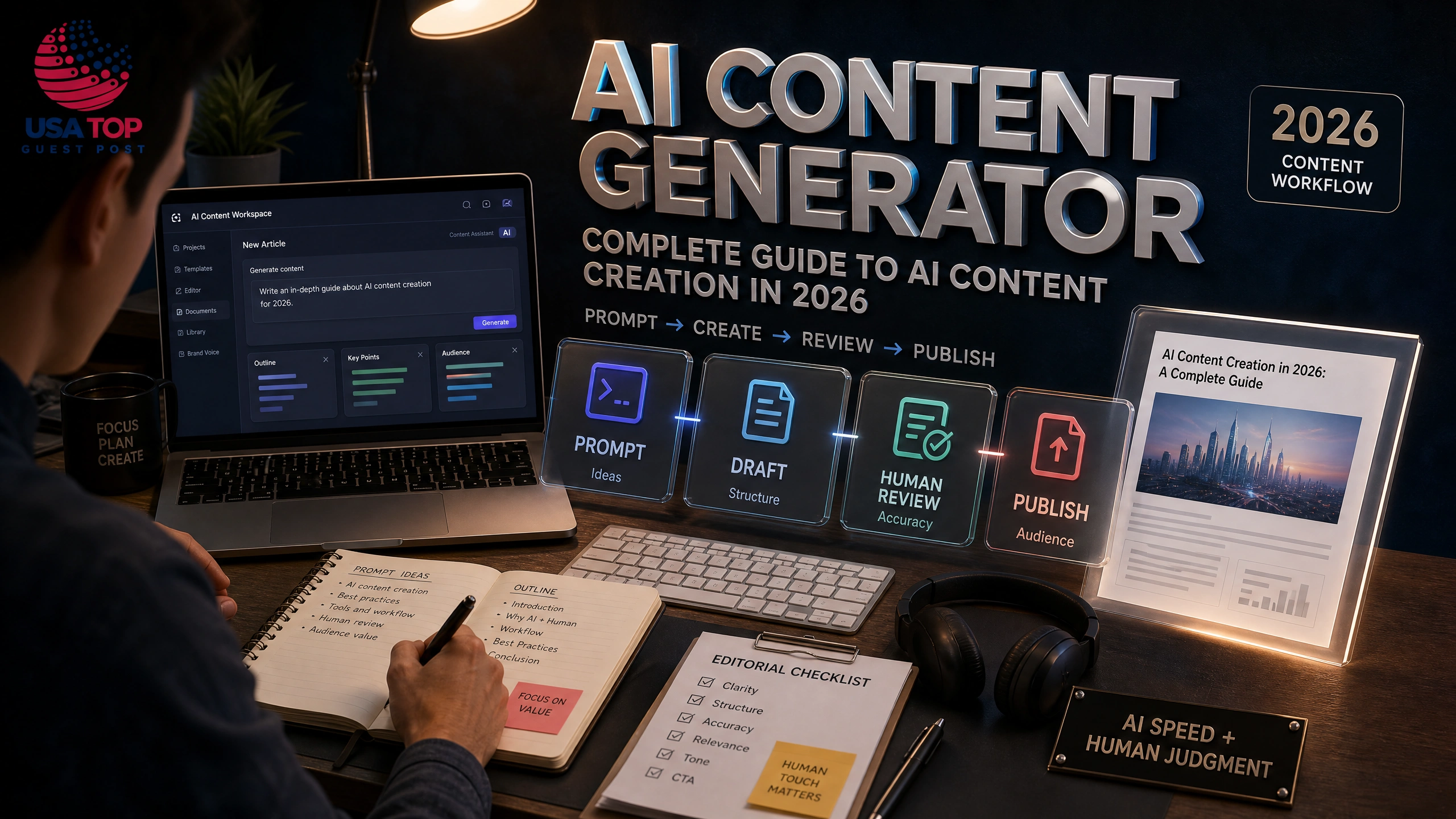
An AI content generator is an artificial intelligence-powered tool that can help create, rewrite, summarize, expand, optimize, and repurpose content from prompts, instructions, or existing information. Modern AI content generation tools can support blog posts, articles, website content, marketing copy, social media posts, product descriptions, landing pages, email copy, video scripts, meta titles, and other digital content.
But effective AI content creation is about more than generating text quickly.
A strong workflow combines generative AI, large language models, prompt engineering, content strategy, keyword research, search intent, semantic SEO, human editing, fact-checking, content accuracy, content originality, E-E-A-T, AEO, GEO, and AI search optimization.
In 2026, the competitive advantage is not simply producing more AI-generated content. It is using AI to improve productivity while adding human expertise, original insights, accurate information, and meaningful value to the final content.
What Is an AI Content Generator?
An AI content generator is software that uses artificial intelligence and large language models (LLMs) to generate or assist with written content based on a user’s instructions.
Depending on the platform, an AI content generator may function as an AI writer, AI writing assistant, AI article generator, AI blog generator, AI copy generator, AI paragraph generator, AI text generator, or broader AI content creation platform.
The basic process is straightforward. You provide a prompt, topic, audience, instructions, examples, or source information. The AI model processes that context and produces an output that can then be reviewed, edited, optimized, and published.
The important distinction is that AI-generated output should not automatically be treated as final content. Human judgment remains valuable for accuracy, originality, tone, context, and quality.
How Does an AI Content Generator Work?
An AI content generator generally works by interpreting an instruction and using an underlying language model to predict and generate a relevant sequence of words.
A simplified content generation process looks like this:
Prompt → AI model → Generated draft → Human editing → Fact-checking → Optimization → Final content
Large language models are central to this process. Technologies associated with modern AI writing include artificial intelligence, natural language processing (NLP), neural networks, generative AI, LLMs, and AI prompts.
How Does AI Understand a Content Prompt?
The quality of an AI output depends heavily on the context supplied in the prompt.
A vague instruction such as:
“Write an article about AI.”
gives the model very little direction.
A stronger prompt identifies the audience, topic, search intent, content format, tone, target keyword, important facts, examples, and constraints.
The more useful context the model receives, the easier it becomes to guide the resulting content toward a specific objective.
What Role Do Large Language Models Play?
Large language models provide the underlying language-generation capability behind many AI writing systems.
They can analyze patterns in language and generate text that fits the context of a prompt. However, fluent writing does not automatically mean factual accuracy.
That is why an AI writing workflow still needs human oversight, especially when content contains statistics, technical claims, current information, product specifications, or other facts that require verification.
What Can an AI Content Generator Create?
An AI content generator can support a wide range of content formats.
It can assist with blog posts, articles, website content, marketing copy, product descriptions, social media posts, landing pages, email copy, video scripts, content outlines, meta titles, meta descriptions, summaries, rewritten content, and expanded content.
Can an AI Content Generator Create Blog Posts and Articles?
Yes. AI can help create a blog outline, first draft, section ideas, introductions, conclusions, FAQs, and long-form articles.
For high-quality AI-generated blog posts and AI-generated articles, however, the strongest approach is to use AI during the drafting process and then improve the content with human research, editing, fact-checking, original examples, and SEO optimization.
Can AI Generate Website Content?
Yes. An AI content generator can assist with homepage copy, landing pages, service descriptions, website sections, FAQs, feature explanations, and other forms of AI-generated website content.
The output becomes more useful when the prompt includes information about the audience, brand profile, value proposition, tone, and desired action.
Can AI Create Marketing Copy?
AI can help create AI-generated marketing copy, advertising variations, sales emails, campaign assets, customer education content, and promotional messaging.
For businesses, the biggest advantage is not simply automated writing. It is the ability to create and adapt content efficiently while maintaining a consistent brand voice, tone of voice, and content strategy.
Can AI Generate Social Media Posts?
Yes. AI can create social media captions, post ideas, short-form content, promotional messages, and platform-specific variations.
A longer article can also be transformed into multiple social media posts, creating an efficient content repurposing workflow.
Can AI Create Product Descriptions?
Yes. An AI content generator can turn product information into structured product descriptions by emphasizing features, benefits, use cases, and customer needs.
Human review is important when product specifications, pricing, technical details, or performance claims are involved.

What Are the Best Uses of an AI Content Generator?
The most valuable use of AI is usually not replacing the entire content process. It is accelerating tasks that consume time while leaving strategic and editorial decisions to humans.
For bloggers, an AI content generator can support content ideas, topic research, outlines, first drafts, content iterations, rewriting, summarization, expansion, proofreading, and repurposing.
For marketers, it can assist with content marketing, SEO content, social media content, email marketing, customer education, sales collateral, website copy, and content personalization.
For ecommerce teams, it can help with product descriptions and content variations. For publishers, it can support content workflows and content automation.
The strongest results usually come when AI is used as part of a broader human-AI collaboration process rather than as an automatic publishing machine.
What Are the Benefits of Using an AI Content Generator?
The biggest advantage is increased content productivity.
AI can help writers move from a blank page to a usable first draft much faster. It can also generate multiple ideas, variations, headlines, summaries, and formats without requiring each version to be created manually.
Another advantage is adaptability. A single piece of research can become a blog post, email, social media content, video script, FAQ, or other marketing asset.
AI can also make repetitive content tasks more efficient. Rewriting, summarizing, expanding, simplifying, and formatting are examples of activities that can often be accelerated through AI-assisted writing.
For larger content teams, this can contribute to scalable content automation, content collaboration, and AI content workflows.
However, speed should not be confused with quality. Producing ten weak articles faster is not necessarily better than producing three useful and original articles.
What Are the Limitations of AI Content Generators?
AI content generators can produce fluent text, but they can also produce factual errors, repetitive wording, generic explanations, outdated information, unsupported claims, and content that lacks firsthand experience.
Another limitation is originality. If the prompt is generic and the editing process is minimal, the final article may sound similar to many other AI-generated pages.
AI can also struggle with context. A sentence may sound confident even when the underlying information is incomplete or incorrect.
For this reason, human oversight, human editing, fact-checking, proofreading, and content accuracy should be part of a responsible AI content workflow.
Can AI-Generated Content Rank on Google?
Yes, AI-assisted or AI-generated content can rank when the finished page provides useful, accurate, relevant, original information and satisfies the user’s search intent.
Using AI alone does not guarantee search rankings. The research framework for this topic specifically recommends focusing on content quality, originality, helpfulness, accuracy, search intent, and human editorial input, rather than assuming that AI usage itself determines ranking performance.
The better question is therefore not whether AI wrote the first draft. The better question is whether the published page is genuinely useful.
A strong AI content and Google strategy should consider topical relevance, semantic keywords, content optimization, on-page SEO, internal links, readability, originality, and E-E-A-T.
Does Google Penalize AI-Generated Content?
AI-generated content should not automatically be treated as low-quality simply because AI was involved in creating it.
The bigger concern is content that is created primarily to manipulate search rankings, provides little value, contains inaccuracies, or relies on scaled low-quality production.
That means AI content is not automatically synonymous with spam.
A responsible approach is to use AI as a productivity tool while maintaining human oversight, original thinking, editorial quality, and factual accuracy.
The research specifically recommends avoiding the misleading claim that “AI content equals penalty” and instead addressing the relationship between AI-generated content, low-quality content, spammy production, originality, helpfulness, and human oversight.
How Do You Use an AI Content Generator for SEO?
An AI content generator can support SEO throughout the content lifecycle, from topic research to final optimization.
A practical SEO workflow is:
Topic research → Keyword research → Search intent → Content brief → Outline → AI-assisted draft → Human editing → Semantic optimization → Internal linking → Fact-checking → Final review
How Can AI Help With Keyword Research?
AI can help organize keyword ideas into primary keywords, secondary keywords, related keywords, long-tail keywords, semantic keywords, and question-based searches.
For an article targeting AI content generator, the relevant keyword ecosystem can include terms such as best AI content generator, free AI content generator, AI content generator free, AI content generator for blogs, AI content generator for websites, AI content generator for SEO, AI content generator for marketing, AI content generator for social media, AI blog writer, AI article generator, AI blog generator, AI copy generator, AI paragraph generator, AI text generator, AI writing generator, AI content creation tools, AI content software, and AI content platform.
These terms should be used where their meanings naturally belong rather than inserted repeatedly into unrelated sentences. The supplied keyword sheet identifies this cluster as high-priority secondary coverage.
Can AI Generate SEO Content Outlines?
Yes. AI can help transform search intent and keyword research into an SEO content brief and structured outline.
A useful brief can define the target keyword, audience, search intent, supporting concepts, questions, semantic entities, content angle, internal links, and information gaps.
This gives the AI writer more context and reduces the chance of producing a generic article.
Can AI Create Meta Titles and Descriptions?
Yes. AI can generate multiple title tags, meta titles, and meta descriptions for review.
For this article, the recommended metadata is:
Meta Title: AI Content Generator: Complete 2026 Guide
Meta Description: Discover how an AI content generator supports SEO, AI search, AEO, GEO, content creation, human editing, and smarter workflows in 2026.
Can AI Help With Internal Linking?
Yes. AI can identify potentially relevant internal pages based on topic relationships, but the final internal links should be reviewed by a human.
For example, readers interested in how content fits into a broader marketing framework can naturally continue to your Marketing Strategy guide.
Readers interested in goal-oriented content planning can also explore your SMART Goals guide.
The purpose of an internal link should be clear: it should help the reader discover genuinely related information rather than exist only for keyword manipulation.
How Can AI Support Semantic SEO?
Semantic SEO focuses on meaning, relationships, and topical completeness rather than repeating one exact keyword.
For AI content generator, the semantic ecosystem includes artificial intelligence, generative AI, large language models, LLMs, natural language processing, AI prompts, prompt engineering, content creation, content generation, AI writing, content marketing, content automation, SEO content, keyword research, search intent, semantic keywords, related keywords, content optimization, human editing, fact-checking, content originality, AI hallucinations, E-E-A-T, and human-AI collaboration.
These concepts create context around the primary topic.
The supplied research specifically says these semantic and entity terms should be naturally integrated according to the context of individual sections rather than treated as a separate keyword-stuffing exercise.
How Can You Avoid Keyword Stuffing?
The best way to avoid keyword stuffing is to write about the concept rather than write for the keyword.
For example, a section discussing AI accuracy can naturally use AI hallucinations, factual errors, fact-checking, content accuracy, human oversight, and AI limitations because these concepts are directly related.
A section about SEO can naturally discuss keyword research, target keywords, secondary keywords, search intent, semantic SEO, on-page SEO, content optimization, and internal links.
The keyword appears because the topic requires it.
That is fundamentally different from forcing the same phrase into every paragraph.
Your research explicitly recommends the structure:
Question → Direct answer → Explanation → Evidence where appropriate → Entity → Related context → Practical takeaway
It also warns that this is not a secret AI-ranking formula or special keyword list.
How Can You Optimize AI Content for AI Search and AI Overviews?
AI search changes how users discover information. Instead of typing only short keywords, users increasingly ask complete questions and expect direct, contextual answers.
A strong AI-search-ready article therefore needs clear concepts and useful answer blocks.
For example, when someone asks:
“Can AI-generated content rank on Google?”
the article should provide the direct answer first, then explain the conditions that influence quality and usefulness.
The same principle applies to questions such as:
“What is an AI content generator?”
“How does AI content generation work?”
“How can I humanize AI content?”
“What is GEO?”
“How do I fact-check AI content?”
Clear answers make information easier for both people and AI-powered systems to understand.
There is no secret list of “AI ranking keywords.” The research specifically rejects that idea and recommends clear answer architecture, entity relationships, context, and useful information instead.

What Is GEO and How Does It Relate to AI Content?
GEO, or Generative Engine Optimization, refers broadly to improving how content can be understood, retrieved, and potentially surfaced within generative search and AI answer experiences.
GEO is not simply adding the word “AI” to an article.
A stronger GEO approach emphasizes AI search, clear answers, factual consistency, brand mentions, entity relationships, content authority, useful context, and information that can be understood without ambiguity.
For publishers, this means creating content that explains concepts clearly and connects related entities naturally.
The research identifies GEO, AI search, AI answers, citations, brand mentions, source selection, content authority, and factual consistency as important elements of this topic.
How Can You Make AI-Generated Content More Trustworthy?
Trustworthy AI content requires more than fluent writing.
A strong article should demonstrate experience, expertise, authoritativeness, and trustworthiness, commonly summarized as E-E-A-T.
Experience can come from practical observations, original examples, real workflows, or firsthand insights.
Expertise is demonstrated through accurate explanations, relevant knowledge, nuanced discussion, and appropriate context.
Authoritativeness can be strengthened through consistent topical coverage, useful related content, and a credible editorial approach.
Trustworthiness depends heavily on accuracy, transparency, responsible claims, and appropriate fact-checking.
The research identifies human expertise, verified facts, firsthand insights, original examples, and human editorial input as important ways to strengthen AI-assisted content.
How Can You Reduce AI Hallucinations and Factual Errors?
AI hallucinations occur when an AI system produces information that appears plausible but is incorrect, unsupported, or fabricated.
The risk becomes more serious when content contains statistics, technical details, product information, current events, or claims that readers may rely upon.
A reliable process is simple: provide good context, review important claims, verify factual information, remove unsupported statements, and complete a human editorial review before publication.
The research specifically identifies factual errors, AI hallucinations, repetitive content, outdated information, and fact-checking as critical risk topics for this article.
How Can You Humanize AI-Generated Content?
To humanize AI content, do not simply change a few words or attempt to fool an AI detector.
Improve the substance.
Remove generic statements and replace them with specific explanations. Add original examples, firsthand experience where genuinely available, relevant observations, useful comparisons, and a stronger author perspective.
Fact-check the output and remove claims that cannot be supported.
Then improve the tone, readability, sentence variation, and natural flow.
The objective of editing AI-generated content should be to make it more useful, specific, accurate, original, and human-led, not merely less detectable.
The keyword sheet specifically identifies humanize AI content, make AI content sound human, edit AI-generated content, improve AI-generated content, and fact-check AI content as important search-intent opportunities.
How Can You Make AI-Generated Content More Original?
Originality is one of the most important ways to separate a useful AI-assisted article from generic content.
A stronger article can include firsthand experience, original examples, expert opinions, proprietary data, original research, case studies, unique frameworks, and unique perspectives when these are genuinely available.
Even when AI helps with drafting, the final article should contribute something beyond information that could be copied from dozens of competing pages.
For example, instead of simply defining an AI content workflow, explain why each stage exists, where problems can occur, and how the workflow changes when accuracy or originality is particularly important.
The research specifically recommends firsthand experience, original examples, expert quotes, proprietary data, original research, case studies, unique frameworks, and unique opinions as differentiation opportunities.
What Makes AI-Generated Content High Quality?
High-quality AI-assisted content can be evaluated using a simple framework:
Accuracy + Relevance + Originality + Expertise + Readability + Search Intent + Evidence + Human Review
Accuracy means the information is reliable.
Relevance means the article directly addresses what the reader wants.
Originality means it provides value beyond generic summaries.
Expertise means the content demonstrates meaningful understanding.
Readability ensures the information is easy to follow.
Search intent keeps the article aligned with the reason someone searched.
Evidence strengthens important factual claims where appropriate.
Human review brings judgment, context, and accountability to the final publication.
This quality framework is directly aligned with the research document’s recommended content-quality model.
What Is the Best Workflow for Creating Content With AI?
A strong AI content workflow begins before the AI writer generates a single paragraph.
First, research the topic and identify the target audience. Then determine the search intent and perform keyword research.
Next, build a semantic topic map and create the content outline. AI can then assist with research and drafting.
After the first draft, human editing becomes important. Review the content for accuracy, originality, clarity, tone, and completeness.
Then optimize the article for SEO, semantic coverage, internal linking, and readability. Complete a final fact-check and editorial review before publishing.
The complete workflow is:
Topic research → Search intent → Keyword research → AI-assisted research → Outline → Draft → Human editing → Fact-checking → SEO optimization → Original insights → Final review → Publish → Update
This expanded workflow follows the research recommendation for combining AI productivity with human-led editorial quality.
How Should You Write Prompts for an AI Content Generator?
A strong AI prompt provides enough context for the model to understand the task.
A useful content prompt can include:
Audience + Search intent + Topic + Tone + Format + Constraints + Facts + Examples
For example, instead of asking:
“Write an article about AI content.”
A stronger instruction could specify the audience, target keyword, content format, desired tone, search intent, required topics, factual boundaries, and examples that should be included.
Specific prompts make it easier to control an AI writing generator and improve the consistency of its output.
The research identifies prompt engineering, prompt specificity, SEO content prompts, audience, search intent, topic, tone, format, constraints, facts, and examples as important parts of this section.
What Should You Look for in an AI Content Generator?
Choosing an AI content generator should depend on the user’s actual workflow rather than simply the number of features advertised.
Important evaluation criteria include output quality, accuracy, SEO features, customization, brand voice, supported content formats, multilingual capabilities, integrations, editing, originality, workflow support, and pricing or free-plan limitations.
A blogger may prioritize an AI blog writer and long-form content capabilities.
A marketing team may need brand voice, content collaboration, content automation, campaign assets, and SEO optimization.
An enterprise may care more about integrations, governance, workflow management, privacy, and scalability.
The right tool is therefore the one that fits the content creation process rather than the one with the longest feature list.
What Are the Best AI Content Generators?
There is no single best AI content generator for every user because different platforms are designed around different workflows.
Some tools focus heavily on AI writing and content marketing. Others emphasize general-purpose AI assistance, brand content, SEO optimization, workflow management, or content automation.
When comparing tools, evaluate them based on:
Best for → Key features → Strengths → Limitations → Ideal user
This is more useful than simply producing a ranking of tool names.
A blogger looking for an AI blog generator may need different capabilities from a marketing team creating multilingual content, website copy, campaign assets, and social media content.
The research specifically recommends a comparison format based on practical use rather than turning the section into a simple listicle.
Are Free AI Content Generators Worth Using?
Yes, a free AI content generator can be useful for brainstorming, basic rewriting, simple summaries, short drafts, and occasional content tasks.
However, free tools often come with limitations involving usage, features, output length, customization, integrations, or advanced functionality.
Someone searching for a free AI content generator, free AI content generator online, or similar option should consider not only whether the tool costs money but also whether it provides enough control and quality for the intended workflow.
Free tools can be enough for small content tasks. Larger content operations may need additional features, higher limits, stronger customization, or better workflow support.
The research identifies free-versus-paid functionality, limitations, output quality, usage limits, privacy, features, and use cases as the key areas for this intent.
Is AI-Generated Content Better Than Human-Written Content?
Neither is automatically better.
AI provides speed, scale, brainstorming support, drafting assistance, and efficient content production.
Humans provide expertise, originality, judgment, context, accountability, and firsthand experience.
The strongest approach is often a combination of both.
AI can help a writer create an outline or first draft. A human can then add original insights, verify claims, improve the structure, refine the tone, and make the content more useful.
That creates a human-AI collaboration model rather than treating the technology as a complete replacement for human expertise.
The research specifically recommends this nuanced comparison rather than claiming that AI or humans are universally superior.
What Is the Difference Between AI-Generated and AI-Assisted Content?
AI-generated content is content where the AI system produces most of the output.
AI-assisted content uses AI as one part of a broader human-led process.
In AI-assisted writing, a human may conduct the research, determine the search intent, create the strategy, guide the prompts, review the draft, fact-check the information, add original insights, and make the final publishing decision.
This distinction matters because stronger editorial involvement can improve originality, expertise, accuracy, and content quality.
A useful AI-assisted process is:
Human research → AI assistance → Human editing → Fact-checking → Optimization → Final approval
The research identifies this distinction as an important E-E-A-T opportunity.
Can AI-Generated Content Be Detected?
AI detection tools attempt to estimate whether content may have been produced or assisted by AI, but detection should not be treated as a perfect measurement of content quality.
A page can be original and useful regardless of whether AI was involved in the drafting process.
Likewise, content that passes a detector is not automatically accurate, authoritative, or valuable.
The more important editorial checks are accuracy, originality, relevance, expertise, readability, search intent, and human review.
Should You Use an AI Detector Before Publishing?
An AI detector can be one optional signal in a broader editorial workflow, but it should not replace proofreading, fact-checking, plagiarism checks, or human judgment.
Are AI Detection Tools Always Accurate?
No tool should be treated as infallible.
For that reason, publishing decisions should be based primarily on the actual quality and usefulness of the content rather than a single detection score.
The research specifically recommends explaining AI detection limitations without making overly confident claims about detector accuracy.
How Should You Fact-Check AI-Generated Content?
Fact-checking should happen before publication whenever an AI-generated draft contains claims that matter to the reader.
Start by identifying statements involving statistics, dates, technical information, product specifications, named people, current developments, or other factual claims.
Then verify important information, remove unsupported claims, correct inaccuracies, and make sure the final article does not present uncertain information as established fact.
The key principle is simple:
AI can assist with content generation, but the publisher remains responsible for the quality of the final information.
The research identifies fact-checking, content accuracy, AI hallucinations, authoritative information, and human oversight as core quality and trust topics.
How Can AI Support Content Personalization?
AI can help adapt content for different audiences, use cases, tones, formats, and stages of the customer journey.
For example, the same core information can be rewritten for beginners, experienced professionals, customers, marketers, or business owners.
AI can also help maintain a consistent brand voice across different formats.
However, personalization should be based on meaningful audience differences rather than creating hundreds of nearly identical pages with minimal value.
Useful personalization adds context. It should not become a method for mass-producing thin content.
How Can AI Support Content Repurposing?
AI makes it easier to transform one strong content asset into multiple formats.
A detailed article can become social media posts, an email newsletter, a video script, a FAQ section, short-form educational content, or sales collateral.
This creates a more efficient content marketing system because the original research can support several distribution channels.
The important part is adaptation. Each format should be rewritten for its specific audience and purpose rather than duplicated mechanically.
How Can AI Help With Content Automation?
AI can automate or accelerate repetitive parts of content workflows, including drafting, rewriting, summarization, formatting, idea generation, content variations, and certain optimization tasks.
However, automation should not eliminate quality control.
A strong automated workflow still needs rules for content accuracy, human oversight, brand voice, fact-checking, originality, editorial review, and content governance.
Automation is most useful when it removes repetitive work while keeping important decisions under human control.
How Can AI Content Improve Content Marketing?
AI can support the full content marketing process, from brainstorming and research to content creation, distribution, repurposing, and optimization.
For example, marketers can use AI to develop content ideas around customer problems, create an initial content outline, draft supporting material, and repurpose the final article into social media or email content.
The broader marketing context matters because content should support a defined audience and business objective rather than exist only to attract search traffic.
For readers interested in the broader role of content, digital channels, and audience strategy, your Marketing Strategy guide provides a relevant internal resource.
How Does Brand Voice Affect AI Content?
Brand voice determines how a company communicates.
An AI writing tool can produce grammatically correct content, but without clear brand guidance, it may sound generic or inconsistent.
A useful prompt can specify whether the writing should be professional, conversational, technical, educational, concise, persuasive, or friendly.
The prompt can also include examples of preferred wording, sentence style, terminology, and tone.
Human review remains important because maintaining a brand voice is not simply a matter of replacing individual words. It requires consistency across the entire content experience.
What Are the Risks of Publishing Unedited AI Content?
Publishing unedited AI content can create several problems.
The article may contain factual errors, generic explanations, repetitive phrasing, unsupported claims, weak examples, outdated information, or an inconsistent brand voice.
It may also fail to address the deeper questions behind the user’s search.
That is why the most reliable workflow is not:
Generate → Publish
Instead, use:
Research → Generate → Review → Improve → Verify → Optimize → Publish
This approach increases the chance that AI contributes to productivity without becoming a source of avoidable quality problems.
How Can You Build an AI Content Strategy?
An effective AI content strategy starts with the audience and business objective rather than the AI tool itself.
First, identify what your audience needs to know. Then map the relevant search intent, keywords, questions, entities, and content gaps.
Next, determine which parts of the process should be handled by AI and which require human expertise.
For example, AI may be highly useful for brainstorming, outlining, summarizing, and drafting, while humans should retain responsibility for originality, strategic direction, factual verification, and final editorial judgment.
This creates an AI content strategy based on purpose rather than automation for its own sake.
What Is the Future of AI Content Generation in 2026?
AI content generation is evolving beyond simple text creation.
Modern content workflows increasingly involve AI-assisted content, AI search, AI Overviews, GEO, human-led AI workflows, content originality, AI hallucinations, fact-checking, AI visibility, brand and entity recognition, content citation, and multimodal AI.
This creates a major shift in how publishers should approach content.
The competitive advantage is unlikely to come simply from generating more words. It will increasingly come from creating information that is useful, accurate, original, clearly structured, contextually rich, and easy for both people and AI-powered systems to understand.
The research specifically identifies these 2026 topics as important opportunities for differentiating this article from older competitor content.
Frequently Asked Questions About AI Content Generators
What is an AI content generator?
An AI content generator is software that uses artificial intelligence and language models to create or assist with content based on prompts, instructions, or source information.
Can an AI content generator create SEO content?
Yes. An AI content generator can assist with keyword research, search intent, SEO outlines, semantic keywords, content optimization, meta titles, descriptions, and internal-link ideas. Human editing and fact-checking remain important.
What is the best AI content generator?
There is no universal best option. The right AI content generator depends on your content format, workflow, SEO needs, brand voice, customization requirements, integrations, budget, and desired level of human editing.
Can AI-generated content rank on Google?
Yes. AI-assisted or AI-generated content can rank when the finished page is useful, accurate, relevant, original, and aligned with search intent. AI usage itself does not guarantee rankings.
Are free AI content generators worth using?
A free AI content generator can be useful for brainstorming, rewriting, summaries, short drafts, and occasional content tasks. More advanced workflows may require additional features or usage capacity.
How can you humanize AI content?
You can improve AI content by adding specificity, original examples, genuine expertise, relevant context, verified facts, natural tone, and stronger editorial judgment.
What is AEO?
AEO, or Answer Engine Optimization, focuses on making information easier to understand and retrieve for question-based and conversational search experiences. Direct answers and clear question-based sections can support this approach.
What is GEO?
GEO, or Generative Engine Optimization, broadly focuses on improving how content can be understood and surfaced within generative search and AI answer environments. It works alongside broader SEO and content-quality practices.
What is LLMO?
LLMO, or Large Language Model Optimization, broadly refers to structuring information so that large language models and AI-powered systems can better understand topics, entities, relationships, and answers.
How do you fact-check AI-generated content?
Review important factual claims, verify statistics and dates, check technical information, remove unsupported statements, and complete a human editorial review before publishing.
Can AI replace human writers?
AI can accelerate many writing tasks, but humans remain important for expertise, originality, judgment, firsthand experience, context, and accountability. Human-AI collaboration is often more effective than complete replacement.
Final Thoughts on AI Content Generators
An AI content generator can dramatically improve the efficiency of modern content creation, but the strongest results come from using AI as part of a thoughtful editorial workflow.
The most effective process combines artificial intelligence, generative AI, LLMs, AI writing, prompt engineering, content strategy, keyword research, search intent, semantic SEO, content optimization, human editing, fact-checking, content originality, E-E-A-T, AEO, GEO, and AI search optimization.
The objective should not be to produce the maximum possible number of AI-generated pages.
It should be to create content that answers real questions, provides meaningful information, demonstrates expertise, avoids unsupported claims, adds original value, and gives readers a clear path to useful related resources.
In practical terms:
Research deeply → Understand search intent → Build topical coverage → Use AI intelligently → Add human expertise → Fact-check → Improve originality → Optimize for search → Strengthen internal context → Publish → Update
That is a more durable approach to AI content creation in 2026.
And most importantly, there is no guaranteed “AI ranking formula.” The research itself emphasizes that no structure can guarantee a #1 Google position or inclusion in an AI Overview. The realistic objective is to combine better topical coverage, helpfulness, original value, clear answers, E-E-A-T, current information, and strong semantic/entity relationships.


