

What Are SMART Goals and Why Are They Important?
SMART goals are clear goals with a real plan.
SMART goals help you turn vague ideas into action. Each goal follows five simple parts. It must be specific, measurable, achievable, relevant, and time-bound.
This method helps you know what to do next. It also helps you track your progress. When you use SMART goals, you stop guessing. You start working in a direction.
Goal setting using SMART goals works well for many people. You can use it for work, school, business, health, or personal growth. Many USA students, employees, managers, and freelancers use this method. It helps them stay focused in a busy life.
For example, “I want to improve at work” sounds unclear. A better goal is, “I will complete one online work course in 30 days.” That goal gives you action, time, and purpose.
What Does Each Letter in SMART Goals Mean?
SMART means Specific, Measurable, Achievable, Relevant, and Time-bound.
Each letter helps you create a stronger goal. If one part is missing, your goal may feel weak. A smart goals template can help you fill each part correctly.
| SMART Part | Meaning |
Simple Example |
| Specific | You know exactly what you want. |
I will improve my email writing. |
| Measurable | You can track the result. |
I will write five clear emails daily. |
| Achievable | The goal is realistic. |
I can do this during work hours. |
| Relevant | The goal supports your bigger plan. |
Better emails help my job growth. |
| Time-bound | The goal has a deadline. |
I will do this for 30 days. |
This structure makes planning easier. It also helps you avoid weak goals. When you learn how to write SMART goals, you make better choices.
How Do You Write SMART Goals Step by Step?
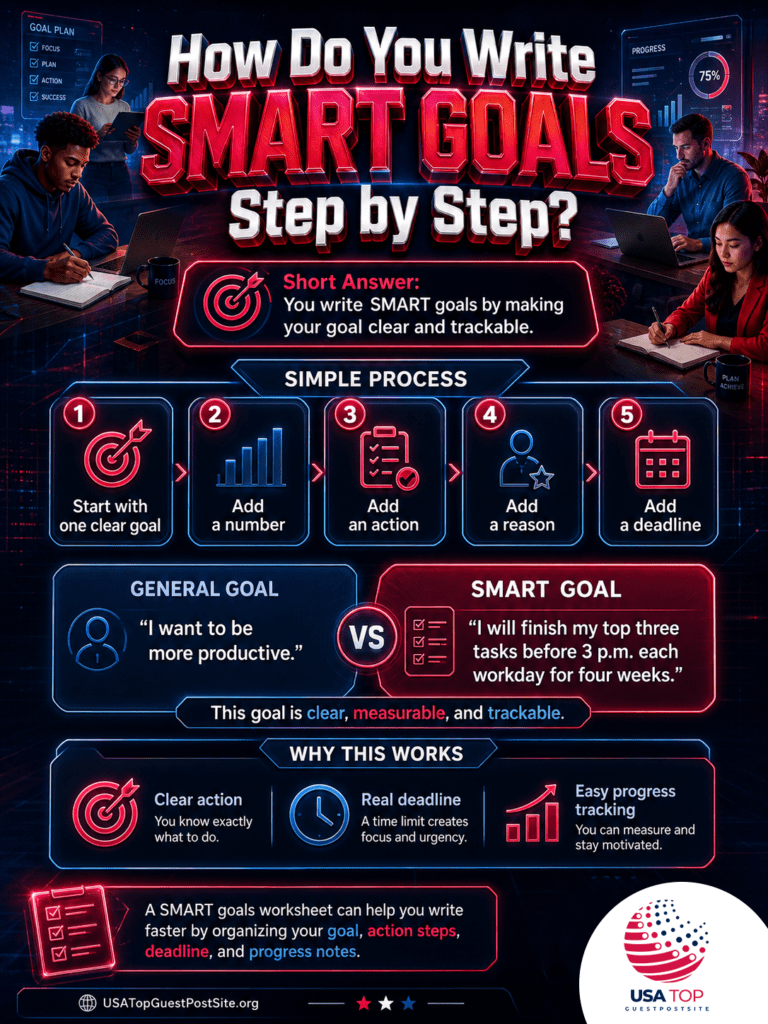
You write SMART goals by making your goal clear and trackable.
Start with a simple goal. Then make it more detailed. Your final goal should show what you will do. It should also show how you will measure success.
Here is a simple process:
- Start with one clear goal.
- Add a number, action, reason, and deadline.
Example:
General goal: “I want to be more productive.”
SMART goal: “I will finish my top three tasks before 3 p.m. each workday for four weeks.”
This goal is clear. You know the action. You know the deadline. You can also track your results.
A SMART goals worksheet can help you write this faster. It gives you space for your goal, action steps, deadline, and progress notes.
What Are the Best SMART Goals Examples for Beginners?
Good SMART goals examples are simple and realistic.
If you are new to SMART goals, start small. Small goals build confidence. They also help you avoid stress.
Here is a beginner example:
General goal: “I want to read more.”
SMART goal: “I will read one book each month for six months.”
This goal is easy to understand. It also has a deadline. You can measure it by counting books.
Another example:
General goal: “I want better habits.”
SMART goal: “I will wake up at 7 a.m. on weekdays for 30 days.”
This is a strong, smart goal for personal growth. It helps you build discipline without pressure.
How Can a SMART Goals Template Help You Plan Better?
A SMART goals template helps you organize your goals clearly.
A template saves time. It also keeps your thinking focused. Instead of writing random goals, you follow a proven structure.
Use this SMART goals template:
My Goal: What do you want?
Specific Action: What will you do?
Measurable Result: How will you track it?
Achievable Plan: Can you realistically do it?
Why It Matters: Why is this goal important?
Deadline: When will you finish it?
Progress Check: How will you review results?
This format works for many needs. Students can use it for study plans. Employees can use it for performance goals. Managers can use it for team planning. You can also use it for personal growth.
What Should You Include in a SMART Goals Worksheet?
A SMART goals worksheet should include actions, deadlines, and progress tracking.
A worksheet gives your goal structure. It also helps you stay accountable. You can review it weekly or monthly.
Your SMART goals worksheet should include:
Goal statement, action steps, deadline, progress tracker, challenges, notes, and final result.
For example, you may write one work goal. Then you can track it every Friday. This helps you see what works. It also helps you fix weak areas fast.
A worksheet works best when you keep it simple. Do not make it too long. You need a tool you will actually use.
What Are Some SMART Goals for Work?
SMART goals for work improve focus, performance, and career growth.
Work goals help you stay productive. They also help you show real progress. This matters during reviews, promotions, and team meetings.
Here are some smart goals for work:
“I will complete three major project tasks by Friday each week for one month.”
“I will reply to work emails within 24 hours during business days.”
“I will attend one skill-based training session each month for six months.”
These SMART goals examples are useful because they are clear. You know what success means. You also know when to review progress.
In my experience, work goals fail when they feel too broad. “Be better at work” gives no direction. A SMART goal gives you a real path.
How Can SMART Goals Help Employees Improve Performance?
SMART goals for employees give clear expectations and measurable results.
Employees often feel pressure at work. They may have many tasks. They may also face unclear expectations. SMART goals solve this problem.
When your manager sets a clear goal, you know what matters. You also know how success will be measured. This makes performance reviews easier.
SMART goals for employees can improve:
Time management, communication, teamwork, leadership, customer service, sales, and task completion.
For example:
“I will reduce customer response time by 20% within 60 days.”
This goal gives a clear target. It also supports better service.
Many HR teams use SMART goals for employees. They help connect daily tasks with company results. They also make coaching more useful.
How Can SMART Goals Help with Professional Development?
SMART goals for professional development help you grow your career.
Career growth does not happen by accident. You need a plan. SMART goals for professional development help you build skills step by step.
Here are strong examples:
“I will complete one leadership course within 60 days.”
“I will give one team presentation each month for three months.”
“I will update my resume and apply to five jobs within 30 days.”
These goals help USA professionals stay competitive. They also help freelancers, managers, and career changers. You can use them to build confidence and skill.
Expert opinion: Your career goal should match your next real step. Do not choose a goal only because it sounds impressive. Choose one that supports your future.
What Are the Best SMART Goals for Students?
SMART goals for students improve study habits and academic success.
Students need simple goals. School life can feel busy. A SMART goal helps you manage time better.
Here are some smart goals for students:
“I will study math for 30 minutes each school night for four weeks.”
“I will submit every assignment one day early this semester.”
“I will raise my science grade from B to A by semester’s end.”
These goals work for high school students. They also work for college students and online learners.
A SMART goals worksheet can help students track progress. It can also reduce stress. When your plan is clear, studying feels easier.
What Are Some SMART Goals for Personal Growth?
SMART goals for personal growth help you build better habits.
Personal growth can mean many things. You may want better health, focus, confidence, or discipline. SMART goals make these ideas easier to follow.
Here are examples:
“I will journal for 10 minutes each morning for 30 days.”
“I will walk for 20 minutes five days a week for two months.”
“I will save $100 each month for six months.”
These smart goals examples support daily improvement. They also help you create better routines.
Personal example: If you want less stress, start small. Do not plan a full lifestyle change overnight. Try one clear habit for 30 days.
How Does Goal Setting Using SMART Goals Improve Productivity?
Goal setting using SMART goals improves focus and action.
Productivity improves when your goal is clear. You know what to do first. You also know what to ignore.
A vague goal sounds like this:
“I want to be more productive.”
A SMART version sounds like this:
“I will plan my top three tasks each morning for 30 days.”
That goal gives you a repeatable habit. It also gives you a deadline. You can check progress every week.
Goal setting using SMART goals also supports motivation. You see small wins faster. Those wins help you keep going.
What Mistakes Should You Avoid When Writing SMART Goals?
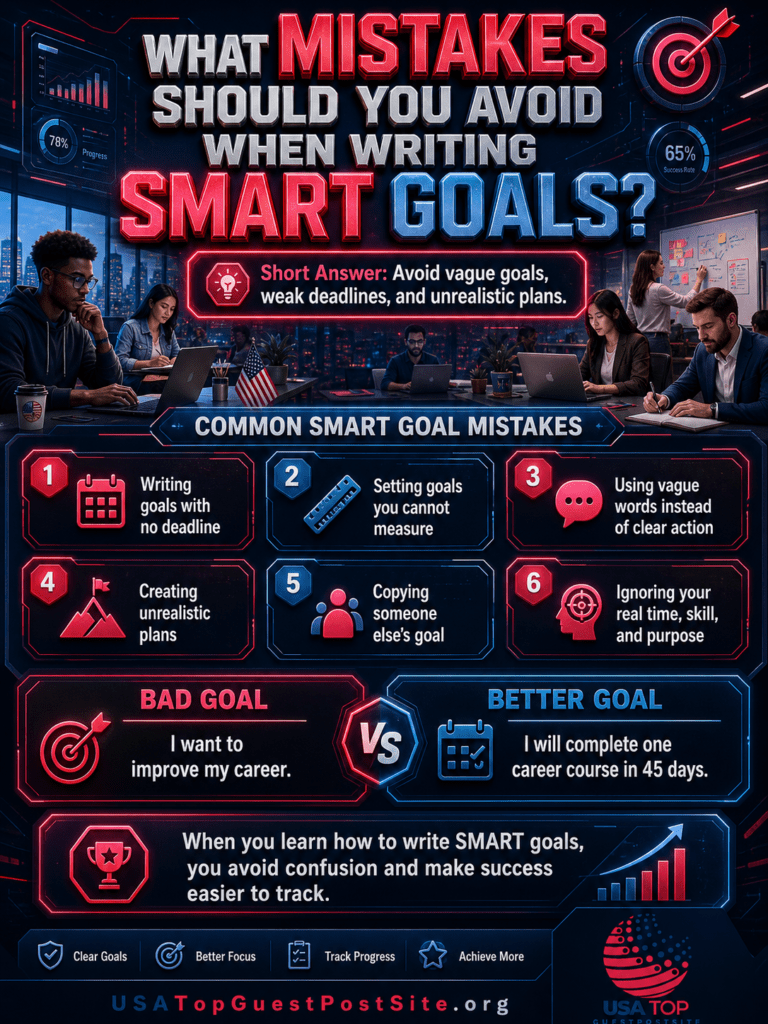
Avoid vague goals, weak deadlines, and unrealistic plans.
Many people write goals that sound nice. But those goals do not guide action. You need clear words and real numbers.
Common mistakes include:
- Writing goals with no deadline.
- Setting goals you cannot measure.
You should also avoid copying someone else’s goal. Your goal should fit your real life. It should match your time, skill, and purpose.
Bad goal: “I want to improve my career.”
Better goal: “I will complete one career course in 45 days.”
When you learn how to write SMART goals, you avoid confusion. You also make success easier to track.
What Are Short-Term and Long-Term SMART Goals Examples?
Short-term goals bring quick wins, while long-term goals build bigger results.
You need both types. Short-term goals help you act now. Long-term goals help you stay focused over time.
Short-term SMART goal:
“I will complete my weekly project report by Thursday for four weeks.”
Long-term SMART goal:
“I will earn a digital marketing certificate within six months.”
Both goals are clear. Both have deadlines. Both support progress.
Smart goals for work often include short-term targets. Smart goals for professional development often need longer timelines. You can combine both for better results.
Why Are SMART Goals Better Than Regular Goal Setting?
SMART goals turn unclear wishes into clear action plans.
Regular goals often sound too broad. They may inspire you at first. But they do not always guide your next step.
Regular goal: “I want to get better at work.”
SMART goal: “I will complete one project management course within 45 days.”
The SMART goal works better. It shows what you will do. It shows when you will finish. It also shows why it matters.
SMART goals are easier to measure. They are easier to review. They are also easier to improve.
What Is the Bottom Line on SMART Goals?
SMART goals help you plan better and achieve realistic progress.
SMART goals work because they give structure. You can use them at work, school, or home. You can also use them for career growth and personal development.
If you want better results, start with one goal. Make it specific. Add a number. Set a deadline. Then track your progress.
You do not need a perfect plan. You need a clear next step.
For more simple guides on productivity, personal development, business growth, and goal setting, explore more helpful content on USATopGuestPostSite.org.
Top 5 Short FAQs About SMART Goals
What are SMART goals?
SMART goals are goals that are Specific, Measurable, Achievable, Relevant, and Time-bound.
What is a good SMART goal example?
A good example is, “I will exercise for 30 minutes, five days weekly, for two months.”
How do you write SMART goals?
You make your goal clear, measurable, realistic, relevant, and deadline-based.
Why are SMART goals important for students?
They help students manage time, study better, and track progress.
What is a SMART goals template?
A SMART goals template helps you organize your goals into five clear parts.