
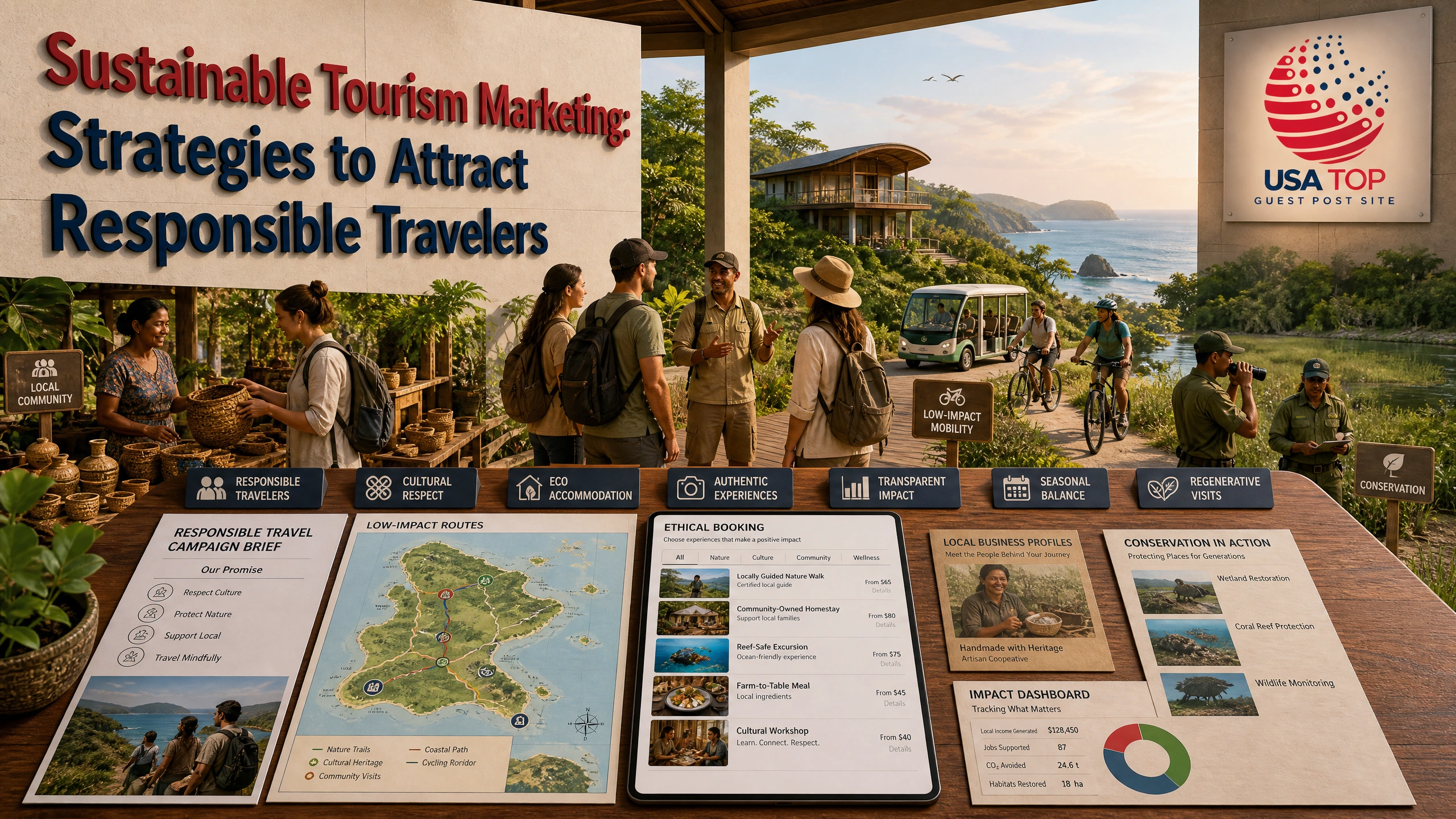
Sustainable tourism marketing is the practice of promoting destinations, experiences, and travel businesses in ways that attract visitors while protecting the environment, supporting local communities, and preserving long-term destination value.
Unlike traditional tourism marketing, the goal is not simply to bring more people to a destination. Effective sustainable travel marketing focuses on attracting the right travelers, distributing visitors more responsibly, strengthening local economic benefits, and reducing negative environmental and social impacts.
That means a successful strategy may promote a less-visited area instead of an overcrowded attraction, encourage off-season travel instead of adding pressure during peak months, or highlight public transportation and local experiences rather than high-impact travel options.
For destinations, tourism boards, destination marketing organizations (DMOs), hotels, tour operators, and other tourism stakeholders, this approach connects marketing with destination sustainability. It also creates an opportunity to build stronger trust with eco-conscious travelers who increasingly want authentic experiences, responsible travel choices, and evidence behind sustainability claims.
What Is Sustainable Tourism Marketing?
Sustainable tourism marketing is a marketing approach that promotes tourism while considering environmental protection, community well-being, cultural preservation, economic sustainability, and the long-term health of a destination.
In practical terms, it means marketing a destination in a way that helps create value without treating unlimited visitor growth as the only measure of success.
A sustainable tourism strategy may promote:
- Authentic travel experiences
- Local culture and cultural heritage
- Community-based tourism
- Nature-based tourism
- Wildlife conservation
- Eco-friendly accommodations
- Sustainable transportation
- Slow travel
- Off-season travel
- Local businesses
- Responsible visitor behavior
- Conservation and environmental protection
The important distinction is that sustainability becomes part of the destination marketing strategy itself rather than being added as a promotional message after the campaign has already been designed.
A useful way to think about the model is:
Attract → Distribute → Benefit → Protect → Measure
Attract the right travelers, distribute visitation more intelligently, make sure local communities benefit, protect natural and cultural resources, and measure both marketing performance and sustainability outcomes.
Why Is Sustainable Tourism Marketing Important?
Sustainable tourism marketing matters because tourism can create economic opportunities while also placing pressure on natural resources, local communities, infrastructure, and cultural heritage.
A destination that focuses only on increasing visitor numbers can eventually face overcrowding, seasonal pressure, rising resource consumption, resident dissatisfaction, and damage to the very experiences that attract travelers.
Sustainable marketing takes a longer view.
It considers whether tourism creates meaningful economic impact for local businesses, whether visitors are distributed across suitable locations and seasons, whether environmental impacts are controlled, and whether communities remain involved in tourism development.
This creates a more balanced definition of growth:
More visitors is not automatically better tourism.
Better tourism can mean better visitor distribution, stronger local economic benefits, more responsible traveler behavior, and lower negative environmental impact.
That distinction is increasingly important for destinations trying to balance destination awareness with destination sustainability.
How Is Sustainable Tourism Marketing Different From Traditional Tourism Marketing?
Traditional tourism marketing often emphasizes increasing awareness, attracting visitors, filling rooms, selling experiences, and increasing bookings.
Sustainable tourism marketing considers those goals but adds another layer: the long-term impact of attracting and distributing those visitors.
The difference can be summarized simply:
| Traditional Tourism Marketing | Sustainable Tourism Marketing |
| More visitors | More appropriate visitors |
| Maximum demand | Balanced demand |
| Peak-season focus | Year-round demand |
| Famous attractions | Broader destination experiences |
| Short-term bookings | Long-term destination value |
| Promotion-first | Impact-aware promotion |
| Visitor volume | Visitor quality and distribution |
| Generic messaging | Audience-specific sustainability messaging |
A destination may therefore decide that sending even more visitors to an already crowded attraction is not the best marketing decision.
Instead, it could promote nearby communities, alternative routes, lesser-known attractions, local experiences, or different travel periods.
That is where destination marketing becomes closely connected with destination management.
Who Is the Target Audience for Sustainable Tourism Marketing?
Sustainable tourism does not appeal to one single type of traveler. Audience segmentation should consider both demographics and motivations.
Important audiences can include eco-conscious travelers, responsible travelers, Millennials, Gen Z travelers, experience-driven travelers, ethical consumers, domestic travelers, and international visitors.
However, simply labeling someone an “eco-conscious traveler” is not enough.
A stronger sustainable travel strategy asks why that person cares, what influences their decision, what proof they expect, and what makes them distrust sustainability claims.
For example, an environmentally conscious traveler may want to know whether a hotel genuinely reduces waste or energy use. Another traveler may care more about whether their spending reaches local businesses. Someone interested in cultural tourism may prioritize authentic local experiences and cultural heritage preservation.
This makes psychographic segmentation particularly useful.
Eco-Conscious Travelers
Eco-conscious travelers are often interested in reducing environmental impact without giving up meaningful travel experiences.
They may look for information about:
- Carbon footprint
- Carbon emissions
- Eco-friendly accommodations
- Sustainable transportation
- Conservation
- Waste reduction
- Nature protection
- Responsible travel practices
Marketing should give them specific information rather than broad claims such as “green” or “eco-friendly.”
Millennials and Gen Z Travelers
Millennial travelers and Gen Z travelers can respond strongly to authenticity, purpose, community stories, social proof, and visual content.
But generational targeting should not become a stereotype.
A better approach is to understand the behavior behind the audience. Some younger travelers may prioritize local experiences, while others may care about affordability, convenience, cultural immersion, climate-conscious travel, or unique travel inspiration.
This is where destination storytelling, social media marketing, travel influencers, and user-generated content can support a wider tourism marketing strategy.
Experience-Driven and Responsible Travelers
Experience-driven travelers may be more interested in what they can genuinely do than in sustainability terminology itself.
Instead of simply advertising an “eco-friendly destination,” show the actual experience: a locally operated cultural tour, a conservation activity, a walkable historic district, a community-based tourism project, or a low-impact nature experience.
The sustainability benefit becomes part of the experience rather than an unsupported marketing claim.
What Do Eco-Conscious Travelers Look for Before Booking a Trip?
Eco-conscious travelers often want more than a sustainability label. They want enough information to decide whether a destination, accommodation, or experience actually aligns with their values.
Useful information can include:
- Evidence of environmental practices
- Community benefits
- Local ownership or participation
- Sustainable transportation options
- Authentic local experiences
- Conservation initiatives
- Waste-reduction practices
- Responsible visitor guidance
- Sustainability certifications where relevant
- Clear explanations of limitations
Trust becomes especially important here.
A traveler may be skeptical when every hotel, tour operator, and destination describes itself as “green” without explaining what that means.
Good sustainability messaging therefore answers the practical question:
“What are you actually doing, and how can I verify it?”
What Are the Most Effective Sustainable Tourism Marketing Strategies?
The most effective strategies connect visitor demand with destination needs.
A useful sustainable marketing strategy should not begin with “Which social platform should we use?” It should begin with questions about the destination, audience, capacity, visitor behavior, and desired impact.
A practical approach includes:
- Define the destination’s sustainability priorities.
- Identify the travelers most aligned with those priorities.
- Understand their motivations and decision factors.
- Map visitor demand by location and season.
- Create experiences that provide genuine local or environmental value.
- Build destination storytelling around real people and places.
- Use SEO, content, social media, and partnerships to reach the right audience.
- Measure both marketing and sustainability outcomes.
- Refresh campaigns based on evidence and changing traveler behavior.
For broader planning principles, a structured marketing strategy framework can help connect objectives, audience, positioning, channels, content, and measurement.
The central principle remains simple: market tourism according to what the destination can sustainably support, not simply according to how much demand can be generated.
How Can Destination Storytelling Support Sustainable Tourism?
Destination storytelling can make sustainability more understandable because travelers often connect with people, places, and experiences more easily than with abstract environmental language.
Instead of saying that a destination supports conservation, tell the story of what conservation looks like there.
Instead of saying that local communities benefit from tourism, explain how visitors can participate in locally operated experiences and how tourism spending supports local businesses.
Useful storytelling themes include:
- Local culture
- Cultural heritage
- Community voices
- Conservation stories
- Wildlife protection
- Nature conservation
- Local businesses
- Traditional practices
- Authentic travel experiences
- Responsible visitor behavior
The strongest stories do not exaggerate the destination. They make its real strengths easier to understand.
This also creates stronger destination branding because the brand becomes connected to identifiable places, people, values, and experiences rather than generic sustainability language.

How Can Tourism Brands Promote Sustainable Experiences?
Sustainable experiences should be marketed as desirable experiences first and sustainable experiences second.
A traveler may choose a walking tour because it provides access to local culture, not simply because it has a lower carbon footprint.
Similarly, someone may choose a locally operated food experience because it offers authentic cuisine and meaningful interaction with residents.
Useful examples include:
- Cultural tourism
- Community-based tourism
- Local food experiences
- Nature-based tourism
- Wildlife tourism with responsible practices
- Conservation activities
- Walking and cycling experiences
- Slow travel itineraries
- Local transportation
- Public transportation
- Eco-friendly outdoor activities
The marketing should clearly explain what makes the experience valuable and what responsible behavior is expected from visitors.
That makes sustainability practical rather than abstract.
Why Should Sustainable Tourism Marketing Involve Local Communities?
Local communities should not be treated simply as scenery for tourism marketing.
They are part of the destination itself and can contribute knowledge, culture, entrepreneurship, services, and experiences that make tourism more authentic.
Community involvement can support:
- Local economic benefits
- Community well-being
- Cultural preservation
- Heritage protection
- Local business growth
- Authentic experiences
- Better visitor education
- Stronger stakeholder relationships
For example, instead of creating a campaign about a traditional community without meaningful participation, a destination can involve local businesses, guides, artists, cultural organizations, and residents in deciding what should be promoted and how it should be represented.
This improves both authenticity and trust.
It also helps prevent destination storytelling from becoming disconnected from the people who actually live there.
How Can Destinations Reduce Overtourism Through Marketing?
Marketing can contribute to overtourism when it repeatedly sends large numbers of visitors toward the same attraction, neighborhood, or season.
But marketing can also become part of the solution.
A practical overtourism response is:
Peak attraction → alternative attraction → alternative season → alternative route → visitor guidance → measurement
Instead of continuously promoting the most famous location, a destination can introduce travelers to less-visited places with genuine visitor appeal.
It can also use off-season marketing to shift demand away from peak periods.
Other approaches include:
- Promoting alternative destinations
- Creating neighborhood-level travel content
- Highlighting lesser-known attractions
- Encouraging longer stays
- Promoting off-season travel
- Publishing responsible visitor guidance
- Using time-based campaigns
- Improving visitor distribution
- Communicating capacity limitations honestly
The goal is not simply to hide crowded places from visitors. It is to create better options while protecting places that are already under pressure.
What Is Destination Carrying Capacity and Why Does It Matter?
Destination carrying capacity refers broadly to the level of tourism activity a destination can handle without causing unacceptable environmental, social, cultural, or infrastructure impacts.
It is important because marketing can create demand faster than a destination can sustainably absorb it.
A destination may have physical capacity for a certain number of visitors but still experience social or environmental pressure before reaching that theoretical limit.
For this reason, sustainable tourism promotion should consider:
- Infrastructure
- Water and energy use
- Waste management
- Traffic
- Resident experience
- Environmental sensitivity
- Cultural preservation
- Visitor behavior
- Seasonal pressure
- Natural resource availability
Marketing teams do not necessarily determine carrying capacity on their own. Destination managers, tourism boards, local authorities, businesses, communities, and other tourism stakeholders may all have a role.
The key is to connect marketing decisions with destination-management realities.
How Can Off-Season Tourism Support Sustainability?
Off-season tourism can help spread demand across the calendar rather than concentrating visitors during a few high-pressure periods.
A well-designed off-season campaign can provide several benefits:
- More balanced visitor distribution
- Reduced peak-season pressure
- Better use of existing infrastructure
- More stable local economic activity
- More year-round employment opportunities
- Different experiences for travelers
However, off-season marketing should not simply move the same overcrowding problem to another period.
It should be based on the destination’s actual capacity and seasonal conditions.
For example, a destination could promote cultural events, local food, wellness, nature activities, or slower itineraries during periods that can comfortably support additional visitors.
This creates a stronger connection between sustainable destination development and destination marketing.
How Should Tourism Brands Use Social Media for Sustainable Tourism Marketing?
Social media marketing can make sustainable tourism visible through stories, experiences, education, and community voices.
The strongest content usually feels useful or authentic rather than promotional.
Effective formats include:
- Short-form travel videos
- Destination guides
- Educational posts
- Community stories
- Behind-the-scenes content
- Responsible travel tips
- User-generated content
- Local creator content
- Conservation stories
- Visual destination storytelling
A tourism brand can also use social media to influence visitor behavior before and during a trip.
For example, a short video could explain how to use public transportation, where to visit during quieter periods, what local customs travelers should respect, or how to protect a sensitive natural area.
For broader social and digital planning principles, the site’s digital marketing resources provide related guidance on content, SEO, social media, and online visibility.

Can Influencer Marketing Support Sustainable Tourism?
Yes, but influencer marketing works best when creator selection is based on audience alignment and credibility rather than follower count alone.
A responsible travel creator can demonstrate sustainable experiences in a way that feels more authentic than a conventional advertisement.
Good partnerships should consider:
- Audience relevance
- Geographic alignment
- Authenticity
- Content quality
- Engagement quality
- Sustainability knowledge
- Disclosure
- Brand fit
- Responsible visitor messaging
Travel influencers can show what sustainable travel looks like in practice. They can demonstrate local experiences, public transportation, slow travel, community-based tourism, or conservation activities.
However, brands should avoid asking creators to make unsupported sustainability claims.
The creator should have enough freedom to describe the experience honestly, including limitations where appropriate.
How Can Content Marketing Improve Sustainable Tourism Visibility?
Content marketing helps destinations answer the questions travelers ask before they decide where, when, and how to travel.
A strong destination content marketing strategy can include:
- Sustainable travel guides
- Destination guides
- Responsible travel education
- Local experience guides
- Seasonal travel guides
- Transportation information
- Cultural etiquette
- Conservation information
- Community stories
- Sustainable accommodation guides
- Nature and wildlife content
The important principle is to build content around real traveler needs rather than producing articles simply because a keyword has search volume.
A useful content journey might look like:
Travel inspiration → Destination research → Experience comparison → Practical planning → Responsible travel guidance
This creates a more complete customer journey and gives travelers useful information at multiple decision stages.
A content-focused digital marketing framework can also help organize content, SEO, internal links, audience needs, and measurement into one connected system.
How Can SEO Support Sustainable Tourism Marketing?
SEO can help sustainable tourism brands reach travelers who are already searching for information about destinations, experiences, accommodations, transportation, and responsible travel.
The strongest approach is not to repeat “sustainable tourism marketing” throughout every paragraph.
Instead, build a semantic topic around the subject.
Relevant content may naturally include concepts such as:
- Sustainable travel
- Responsible tourism
- Sustainable destination marketing
- Destination marketing
- Eco tourism marketing
- Tourism marketing strategy
- Sustainable tourism strategy
- Responsible travel
- Eco-conscious travelers
- Sustainable destinations
- Eco-friendly destinations
- Travel SEO
- Destination storytelling
- Local experiences
- Community-based tourism
- Conservation
- Sustainable transportation
- Overtourism
- Destination sustainability
Search intent should determine how these concepts are used.
Someone searching for “what is sustainable tourism marketing” needs a definition.
Someone searching for “sustainable destination marketing ideas” needs strategies and examples.
Someone searching for “eco-friendly destinations” may need destination comparisons or practical planning information.
This is why semantic SEO and topic clustering are more useful than forcing every keyword into the same page. A related semantic SEO guide explains how topic coverage, search intent, entities, and internal linking can work together without relying on keyword stuffing.
Destination-specific SEO is equally important. Instead of targeting only broad phrases, a destination can create useful pages around genuine local experiences, transportation, cultural attractions, sustainable accommodations, seasonal travel, and responsible visitor information.
For practical SEO planning, a focused SEO action plan can help organize keyword mapping, content optimization, internal links, and performance tracking.
How Is AI Changing Sustainable Tourism Marketing?
AI is changing how travelers discover and compare destinations.
Instead of relying only on traditional search results, travelers can increasingly ask conversational questions and receive synthesized recommendations, itinerary ideas, comparisons, and planning suggestions.
This creates a new layer of travel discovery.
A traveler might ask an AI system:
- Which destinations are good for responsible travel?
- Where can I find less-crowded nature experiences?
- What are sustainable alternatives to popular tourist attractions?
- Which destinations have good public transportation?
- Where can I experience local culture responsibly?
- What are some eco-friendly travel options for a short trip?
This means tourism content needs to be understandable not only to traditional search users but also to systems that retrieve, interpret, and summarize information.
The opportunity is not to write “for AI” in an artificial way.
It is to create genuinely useful information that is clear, structured, accurate, and easy to understand.
How Can Tourism Brands Improve AI Visibility?
There is no magic “AI keyword” that guarantees visibility in AI-generated answers.
A stronger approach is to make the destination’s information clear, specific, consistent, and trustworthy.
Tourism brands can improve their readiness for AI-driven discovery by focusing on several areas.
Use Clear Definitions
Explain important concepts directly.
For example, define sustainable tourism, responsible travel, regenerative tourism, destination sustainability, and sustainable transportation in plain language.
Answer Real Questions
Question-based sections make complex topics easier to understand.
Instead of hiding the answer inside a long introduction, answer the question first and then explain the reasoning.
Build Strong Entity Relationships
Connect the destination with relevant entities such as:
- Tourism destination
- DMO
- Tourism board
- Local communities
- Local businesses
- Cultural heritage
- Conservation
- Biodiversity
- Sustainable accommodations
- Transportation
- Responsible travel
- Overtourism
This gives the content a coherent topical context.
Add Original Information
Generic descriptions are easy to reproduce.
Original information creates stronger differentiation.
That could include destination-specific observations, original frameworks, practical visitor guidance, unique comparisons, first-hand scenarios, locally relevant examples, or clearly explained decision criteria.
Demonstrate Experience and Expertise
Experience can be demonstrated by explaining how a tourism strategy would work in a real situation.
For example, instead of saying “reduce overtourism,” explain how a destination could shift a campaign from its most crowded attraction toward a suitable alternative area and an off-season experience.
That is more useful than simply repeating a sustainability principle.
Keep Information Updated
Travel conditions, visitor behavior, transportation options, tourism trends, and destination priorities can change.
Refreshing useful content helps keep it relevant.
The site’s AI content and search guide also discusses the importance of originality, factual accuracy, internal linking, human oversight, and useful structure when creating content for modern search environments.
How Can Tourism Brands Avoid Greenwashing?
Greenwashing occurs when a sustainability claim creates a stronger impression of environmental or social responsibility than the available evidence supports.
Tourism marketing is particularly vulnerable because words such as “green,” “eco-friendly,” “sustainable,” and “responsible” can sound persuasive without explaining what they actually mean.
A stronger sustainability communication strategy should connect claims with evidence.
Instead of:
“Stay at our eco-friendly hotel.”
Explain:
“What does the hotel do to reduce energy use, waste, water consumption, or other impacts?”
Instead of:
“Our tour supports the local community.”
Explain:
“How does the tour create community benefit? Who operates it? What part of the visitor spending reaches local businesses?”
Good sustainability messaging should prioritize:
- Evidence
- Transparency
- Specific claims
- Relevant certifications where applicable
- Measurable outcomes
- Clear limitations
- Honest language
Avoid exaggerated claims that cannot be verified.
Trust grows when travelers can understand both what a destination is doing and what it is not claiming to do.
This is also an important E-E-A-T signal: credibility comes from demonstrating knowledge and transparency, not simply describing a brand as trustworthy.
How Do You Measure Sustainable Tourism Marketing Success?
Sustainable tourism marketing should be measured through both marketing KPIs and sustainability outcomes.
Website traffic alone cannot tell you whether a destination’s strategy is successful.
A more useful framework separates the measurements into several categories.
| Area | Example Metrics |
| Marketing visibility | Organic impressions, clicks, destination awareness |
| Engagement | Time on page, content engagement, video engagement |
| Visitor behavior | Search interest, itinerary choices, attraction preferences |
| Visitor distribution | Geographic distribution, alternative-site visitation |
| Seasonality | Off-season visitation, peak-period pressure |
| Economic impact | Local spending, local business participation |
| Community | Community participation, resident feedback |
| Environment | Carbon reduction, waste reduction, resource impact |
| Experience | Visitor satisfaction, responsible behavior |
| Business | Bookings, repeat visitation, marketing ROI |
A particularly useful distinction is:
Marketing success ≠ only more visitors.
A stronger sustainable tourism measurement framework asks:
Did we attract appropriate travelers?
Did we distribute visitors more effectively?
Did local communities and businesses benefit?
Did we reduce negative environmental or social pressure?
Did visitor satisfaction remain strong?
Did the destination become more resilient over time?
This connects tourism analytics with destination sustainability rather than treating them as separate systems.
For broader performance planning, the site’s marketing strategy guide provides related principles for connecting objectives, channels, KPIs, and optimization.
What Are the Biggest Sustainable Tourism Marketing Trends in 2026?
Several trends are shaping how destinations think about sustainable travel and marketing.
Regenerative Tourism
Regenerative tourism goes beyond minimizing harm and asks how tourism can contribute positively to destinations, ecosystems, communities, and cultural systems.
The concept encourages tourism stakeholders to think about restoration, resilience, and long-term value rather than only reducing negative impact.
AI Travel Planning
AI-powered travel discovery is becoming an important part of the traveler journey.
This makes clear destination information, trustworthy sustainability messaging, structured content, and accurate travel guidance increasingly valuable.
Climate-Conscious Travel
Travelers are becoming more aware of climate-related issues, carbon emissions, transportation choices, and the environmental consequences of different travel behaviors.
This creates opportunities for tourism brands to explain lower-impact options without turning every message into a technical climate discussion.
Slow Travel
Slow travel emphasizes deeper experiences, longer stays, local connections, and less rushed itineraries.
It can naturally support local economic benefits and more meaningful visitor experiences when implemented appropriately.
Local-First Experiences
Travelers increasingly seek experiences connected to local food, culture, people, traditions, and communities.
This can create stronger opportunities for local businesses and community-based tourism.
Transparent Sustainability Reporting
Generic sustainability claims are becoming less useful.
Clear explanations of actions, evidence, progress, limitations, and measurable outcomes can create stronger brand trust.
Authenticity Over Perfection
Travelers do not necessarily need a destination to claim that it is perfectly sustainable.
They need honest information about what the destination is doing, where it is improving, and how visitors can participate responsibly.
What Is the Future of Sustainable Tourism Marketing?
The future of sustainable tourism marketing will likely be less about convincing people that a destination is “green” and more about helping travelers understand the real relationship between travel choices and destination impact.
Marketing will increasingly connect:
Traveler intent + destination capacity + local benefit + environmental responsibility + useful information
That means the tourism brands best positioned for long-term visibility will not necessarily be the ones making the biggest sustainability claims.
They will be the ones that provide the clearest information, understand traveler behavior, create authentic experiences, work with communities, manage visitor demand responsibly, and demonstrate measurable progress.
Digital discovery will also continue to evolve.
Search engines, conversational interfaces, AI travel planning, social platforms, and traditional travel content will increasingly work together throughout the customer journey.
For tourism marketers, that makes useful content more important—not less.
The opportunity is to create destination information that works at every stage:
Discover → Understand → Compare → Plan → Travel → Behave Responsibly → Share → Return
Frequently Asked Questions About Sustainable Tourism Marketing
What is sustainable tourism marketing?
Sustainable tourism marketing is the promotion of tourism in ways that consider environmental protection, local communities, cultural heritage, economic benefits, visitor behavior, and the long-term sustainability of destinations.
Why is sustainable tourism marketing important?
It helps destinations attract visitors while reducing the risks associated with overcrowding, environmental pressure, seasonal concentration, and weak community benefits. It connects tourism promotion with long-term destination sustainability.
How do you market sustainable tourism?
Start by understanding the destination’s sustainability priorities and target audiences. Then promote authentic experiences, local businesses, responsible travel practices, conservation, suitable visitor locations, and off-season opportunities through content marketing, SEO, social media, partnerships, and other relevant channels.
What is the difference between sustainable tourism and eco-tourism?
Sustainable tourism is a broader approach that considers environmental, social, cultural, and economic impacts across tourism. Eco-tourism generally focuses more specifically on nature-based travel, conservation, education, and responsible interaction with natural environments.
How can destinations attract eco-conscious travelers?
Destinations can attract eco-conscious travelers by providing specific sustainability information, authentic local experiences, responsible transportation options, conservation opportunities, community benefits, and transparent evidence rather than relying on vague green claims.
How can tourism marketing reduce overtourism?
Marketing can reduce overtourism by promoting alternative attractions, less-visited areas, off-season travel, different routes, longer stays, and responsible visitor behavior. Campaigns should also consider destination carrying capacity and monitor visitor distribution.
What are examples of sustainable tourism marketing?
Examples include promoting off-season travel, highlighting community-based tourism, showcasing local businesses, creating conservation-focused destination content, promoting public transportation, developing responsible travel guides, and using authentic destination storytelling.
Is sustainable tourism marketing only for eco-friendly travelers?
No. Sustainable tourism marketing can appeal to many audiences. Travelers may be motivated by authentic experiences, local culture, affordability, convenience, nature, community connection, or responsible travel values. Understanding the motivation behind the behavior is more useful than relying on one audience label.
How does SEO support sustainable tourism marketing?
SEO helps travelers discover useful information about sustainable destinations, responsible travel, local experiences, accommodations, transportation, seasonal travel, and conservation. A strong approach focuses on search intent, semantic topic coverage, destination-specific information, useful content, and clear internal linking rather than keyword repetition.
How does AI affect sustainable tourism marketing?
AI is changing travel discovery by helping users ask conversational questions, compare destinations, create itineraries, and discover travel options. Tourism brands can prepare by publishing clear, accurate, structured, original, and trustworthy information that addresses real traveler questions.
What is GEO in sustainable tourism marketing?
GEO, or Generative Engine Optimization, refers broadly to preparing content so it can be understood and potentially surfaced within AI-generated search and answer experiences. It is not a separate replacement for SEO. Strong fundamentals such as useful content, clear structure, entity relationships, internal linking, accuracy, and originality remain important.
How can tourism brands improve AI visibility?
Tourism brands can improve their AI-search readiness by answering real questions clearly, defining important concepts, connecting related entities, publishing original information, demonstrating expertise, keeping information updated, and providing specific evidence for sustainability claims.
How can tourism brands avoid greenwashing?
They should avoid vague or exaggerated sustainability claims and instead provide specific information, evidence, relevant certifications where applicable, measurable outcomes, and transparent explanations of both progress and limitations.
What is regenerative tourism?
Regenerative tourism is an approach that looks beyond reducing negative impacts and considers how tourism can contribute positively to the resilience, restoration, well-being, culture, and long-term health of destinations.
What metrics should sustainable tourism marketers track?
Useful metrics include organic visibility, engagement, bookings, visitor satisfaction, off-season visitation, geographic visitor distribution, local business spending, community participation, environmental impact, carbon reduction, waste reduction, and marketing ROI.
What is the main goal of sustainable tourism marketing?
The main goal is not simply to increase visitor volume. It is to create a healthier relationship between tourism demand and destination capacity by attracting appropriate travelers, distributing visitation responsibly, supporting local communities, protecting environmental and cultural resources, and measuring long-term outcomes.


