What Is the Best Iceland Travel Itinerary for First-Time Visitors?
The best Iceland travel itinerary for a first-time visitor is, without question, a 7-day Ring Road trip. Iceland’s famous Route 1 — the Ring Road — circles the entire country and connects nearly every major landscape and landmark: thundering waterfalls, calving glaciers, volcanic plains, black sand beaches, geothermal wonders, and charming northern towns.
Seven days gives you enough time to cover the circuit without sprinting. You won’t see absolutely everything Iceland has to offer, but you will see the most iconic and memorable parts of it — and that’s the real goal of a first visit.
Is 7 Days Enough for an Iceland Travel Itinerary?
Yes — if you plan it well. A 7-day Iceland itinerary works because the Ring Road is designed for exactly this kind of structured road trip. Each day flows naturally into the next, with overnight stops placed at logical points along the route.
The key is not to overload any single day. Iceland’s weather is famously unpredictable, distances between stops can surprise you, and some of the best moments — like watching the light shift over a lava field or stumbling on a hidden waterfall — only happen when you’re not rushing. Build in buffer time, and seven days feels generous. Overschedule every hour, and it’ll feel like a blur.
What Does a Perfect 7-Day Iceland Itinerary Look Like?
A well-structured 7-day Iceland Ring Road itinerary covers the Golden Circle on day one, the South Coast on days two and three, the glacier lagoon and Diamond Beach on day four, the East Fjords on day five, North Iceland on day six, and a return through West Iceland on day seven. Each region has a distinct personality, and moving through them in sequence gives you a genuinely complete picture of the country.
What Are the Must-See Places in Iceland on a 7-Day Trip?
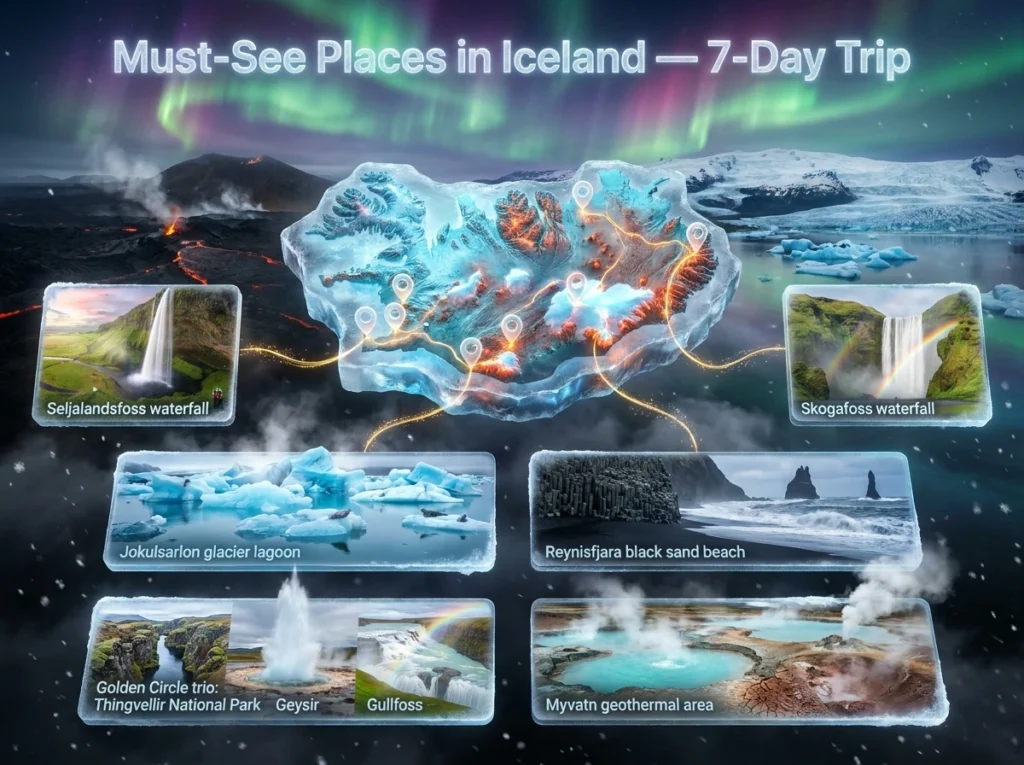
Iceland’s headline attractions are famous for good reason, but a few stand above the rest. Seljalandsfoss and Skogafoss on the South Coast are both extraordinary — the former lets you walk behind the curtain of water, which is one of those experiences that sounds gimmicky until you’re actually standing there drenched and grinning. Jokulsarlon Glacier Lagoon is genuinely unlike anywhere else on Earth: massive blue-white icebergs drifting silently toward the sea. Reynisfjara black sand beach has a dramatic, almost otherworldly quality that photographs can’t fully capture.
Beyond those, the Golden Circle — combining Thingvellir National Park, the erupting Geysir, and Gullfoss waterfall — makes for a powerful opening day. And the Myvatn geothermal area in the north is the kind of place that makes you feel like you’ve landed on another planet.
What Is the Detailed 7-Day Iceland Ring Road Itinerary?
What should you do on Day 1 of your Iceland travel itinerary?
Start in Reykjavik — pick up your rental car and head straight for the Golden Circle. The route hits three unmissable sites: Thingvellir National Park, where you can walk between the North American and Eurasian tectonic plates in a rift valley that doubles as Iceland’s most historically significant site; the Geysir geothermal area, where Strokkur erupts every five to ten minutes; and Gullfoss, a two-tiered waterfall that crashes into a narrow canyon with jaw-dropping force.
This is an excellent first day because the Golden Circle is a well-signed loop that’s easy to navigate and gives you a taste of nearly every type of Icelandic landscape.
What are the best things to do on Day 2 in Iceland?
Day 2 belongs entirely to the South Coast. Drive east from your overnight stop near Hvolsvollur and you’ll encounter Seljalandsfoss early — take the path that winds behind the falls. A short drive further brings you to the towering cascade of Skogafoss, which is even more powerful up close. End the afternoon at Reynisfjara black sand beach, where the basalt columns rise like organ pipes from the cliff face and the Atlantic surf is genuinely dangerous. Stay well back from the water — sneaker waves here are a real hazard, not a cautionary cliché.
What to see on Day 3 of your Iceland itinerary?
Day 3 is for the glaciers. Skaftafell, now part of Vatnajokull National Park, offers some of the most accessible glacier hiking in Iceland. You’ll need to book a guided glacier walk in advance — don’t attempt this independently — but the experience of strapping on crampons and walking across ancient ice with the vast white expanse of Vatnajokull stretching behind you is something you’ll talk about for years.
What makes Day 4 special in Iceland?
Jokulsarlon Glacier Lagoon and Diamond Beach make Day 4 the visual centerpiece of the entire trip. The lagoon sits at the edge of the Vatnajokull glacier, and the icebergs that calve from it drift slowly toward the sea before washing up on the black sand beach across the road — hence Diamond Beach, named for the way the ice glitters against the dark shore. Arrive early morning for the best light and fewer crowds, and stay for sunset if the conditions are right.
What should you expect on Day 5 in Iceland?
Day 5 involves the longest drive of the trip as you head up through the East Fjords. This section is genuinely underrated. The fjords are quieter and less visited than the south, and the road winds through a series of narrow valleys and coastal inlets that feel genuinely remote. You might stop in Djupivogur or Seydisfjordur — a particularly charming town connected to the main road by a steep mountain pass. The pace is slower here, and that’s the point.
What are the top things to do on Day 6 in North Iceland?
Akureyri is Iceland’s second city and a worthy base for northern exploration. The real highlight of Day 6, though, is Lake Myvatn and its surrounding geothermal landscape. The Hverir mudpots bubble and hiss at the earth’s surface, the Dimmuborgir lava formations look like the ruins of some ancient alien civilization, and the Myvatn Nature Baths offer a quieter, less crowded alternative to the Blue Lagoon. If you’re visiting in winter, North Iceland is also one of the better areas for Northern Lights viewing away from light pollution.
How should you spend Day 7 in Iceland?
Day 7 is the return leg through West Iceland. The drive from Akureyri back to Reykjavik via the Ring Road takes roughly four to five hours without stops, but there are worthwhile detours. Hraunfossar — a series of waterfalls that seep from a lava field directly into a river — is one of Iceland’s more unusual and less-visited natural features. Give yourself time to stop, take a breath, and arrive in Reykjavik with enough energy to enjoy the city’s restaurant scene on your final evening.
How Do You Plan a Ring Road Trip in Iceland?
Is driving in Iceland safe for tourists?
Yes. Driving in Iceland is safe and well-suited to self-guided travel, even for tourists unfamiliar with the roads. The Ring Road is entirely paved and well-maintained. The main risks come from weather — sudden winds, reduced visibility, and road icing in winter — and from underestimating distances between fuel stops in remote areas.
Always check the Icelandic Road and Coastal Administration website (road.is) before driving each day. It provides real-time road conditions and closures, and Icelanders use it religiously.
Do you need a 4×4 vehicle in Iceland?
For the Ring Road in summer, a standard two-wheel-drive car is perfectly adequate. For winter travel, or if you plan to take any F-roads (highland routes, which are strictly 4×4 only and closed from roughly October to June), a 4×4 vehicle is essential. Most rental companies make this very clear, and driving a non-4×4 on an F-road voids your insurance — don’t risk it.
Here is a straightforward planning checklist for your Ring Road road trip:
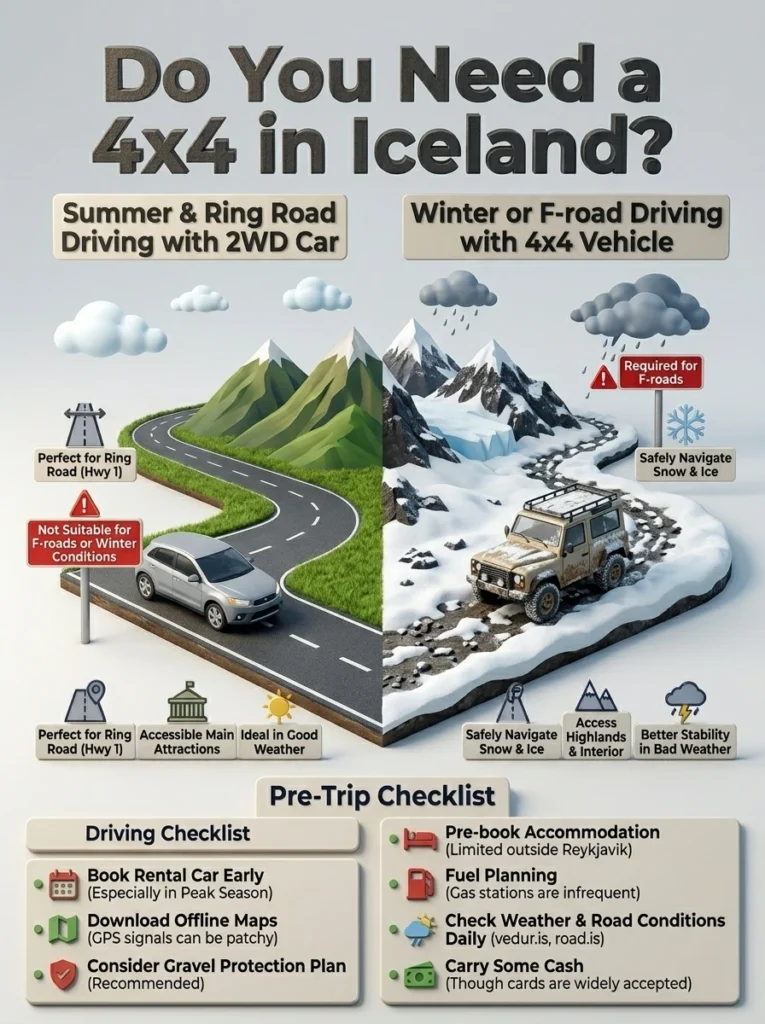
- Book your rental car at least 8 to 10 weeks in advance, especially for summer travel when availability drops sharply.
- Download offline maps through Google Maps or Maps.me before you leave Reykjavik — cell coverage in remote areas is unreliable.
- Purchase a gravel protection plan from your rental company if you’re driving on unsealed roads near attractions.
- Pre-book all accommodation along the route — particularly in summer, guesthouses and hostels fill up months ahead.
- Fill up at every fuel station you pass in the east and north; gaps between stations can exceed 50 kilometers.
- Check weather forecasts every morning at Vedur.is and adjust plans accordingly — flexibility is not optional in Iceland.
- Carry cash for smaller guesthouses, farm stays, and parking fees in more remote areas where card terminals aren’t reliable.
How Expensive Is an Iceland Vacation?
Iceland is genuinely one of the more expensive travel destinations in the world, but costs are manageable with planning. Accommodation is the biggest variable — camping reduces costs dramatically in summer, while guesthouses and hotels represent the major expense for most travelers. Fuel adds up quickly given the distances involved, and dining out in Reykjavik can be eye-watering.
Budget travelers can manage on roughly $150–$180 USD per day by self-catering, staying in guesthouses, and booking well in advance. Mid-range travelers spending $250–$350 per day will be comfortable without sacrificing much. The biggest money-saver is cooking your own meals — Icelandic supermarkets are well-stocked, and most guesthouses have guest kitchens.
What Is the Best Time to Visit Iceland?
Q: When should you visit Iceland for the best experience?
The answer depends entirely on what you’re after. Summer (June to August) offers the midnight sun, long daylight hours, fully open roads, and the easiest driving conditions — ideal for the Ring Road. Winter (November to February) brings the possibility of seeing the Northern Lights, dramatic snowy landscapes, and far fewer tourists, but also more challenging roads and reduced daylight hours.
Shoulder seasons — particularly May and September — are genuinely excellent compromise options. The light is beautiful, crowds are smaller than peak summer, and road conditions are still generally manageable.
How Does This Compare to Other Iceland Travel Itineraries?
What is an Iceland travel itinerary for 10 days like?
A 10-day Iceland itinerary gives you room to breathe — longer stays at each location, detours into the highlands if the season permits, and a deeper engagement with the regions you pass through. You can spend two nights in the north, explore the Westfjords as an add-on, or simply slow down and enjoy more of what each area has to offer.
What is a 5-day Iceland itinerary best for?
A 5-day Iceland itinerary is best suited to the Golden Circle and South Coast — the most concentrated stretch of headline attractions. You won’t complete the Ring Road, but you’ll hit the most photographed and beloved sites in the country. It’s the right call for travelers with limited time who want to make the most of a short visit.
Is Iceland good for solo travel?
Absolutely. Iceland solo travel is among the easiest and most rewarding in the world. The country is exceptionally safe, the locals speak near-perfect English, and the self-drive nature of the Ring Road means solo travelers have complete freedom to go at their own pace. Many guesthouses along the route actively cater to solo travelers, and it’s easy to meet other visitors at popular sites.
What Mistakes Should You Avoid When Visiting Iceland?
The most common mistake is underestimating driving distances. What looks like a short hop on the map can easily take two or three hours when you factor in single-lane bridges, winding mountain roads, and inevitable stops for wildlife or scenery. The second most common mistake is ignoring weather forecasts — conditions can shift from sunshine to sleet within an hour, and unprepared travelers pay for it. Finally, overscheduling is a real problem. An itinerary packed with ten stops per day leaves no room for the spontaneous moments that tend to define a great Iceland trip.
Conclusion
A 7-day Iceland Ring Road trip is one of those rare travel experiences that genuinely delivers on its promise. From the erupting geysers of the Golden Circle to the otherworldly blue icebergs of Jokulsarlon, from the roaring falls of the South Coast to the quiet drama of the East Fjords, Iceland in a week covers an extraordinary amount of emotional and geographical ground. Plan well, drive carefully, check the weather daily, and leave space in the schedule for the unexpected. That’s how you make an Iceland travel itinerary truly perfect.
Frequently Asked Questions
What is there to do in Iceland besides sightseeing?
Iceland offers hot spring bathing, whale watching off Husavik, horseback riding on Icelandic horses, sea kayaking in the fjords, and excellent local food experiences centered on lamb, skyr, and fresh seafood. The country rewards slow exploration as much as landmark-hopping.
What to see in Iceland for first-time visitors?
Focus on the Golden Circle, the South Coast waterfalls, Jokulsarlon Glacier Lagoon, and Reynisfjara black sand beach. These four experiences give first-time visitors the clearest sense of what makes Iceland unlike anywhere else on Earth.
Where to go in Iceland for the best views?
The South Coast between Vik and Hofn is consistently spectacular. Jokulsarlon at sunrise or sunset is arguably the single most photogenic spot in the country. The drive through the East Fjords on a clear day rivals anything in Scandinavia.
What are the top things to visit in Iceland?
The Blue Lagoon for geothermal bathing, the Golden Circle for a concentrated introduction to Iceland’s natural wonders, Vatnajokull National Park for glacier experiences, and the Ring Road itself — which is less a single destination and more the experience that ties everything together.
How can you make your Iceland travel itinerary perfect?
Book early, stay flexible, prioritize the experiences that matter most to you personally, and resist the urge to fill every hour. The best Iceland Ring Road itineraries are the ones with a little room left for the unexpected — because Iceland almost always delivers something you didn’t plan for.