What Is a Travel Nurse Resume and Why Does It Matter?
A travel nurse resume is your professional passport to short-term clinical assignments across different healthcare settings. It highlights your clinical experience, adaptability, and certifications in a way that lets recruiters instantly judge whether you’re ready to hit the ground running.
Think of it this way — a hiring manager at a busy hospital system may spend less than ten seconds on your resume before deciding whether to call you. That means every word has to work hard. A well-crafted resume isn’t just a formality; it’s the difference between landing a high-paying contract and getting passed over entirely.
What Makes a Travel Nurse Resume Different from a Regular Nursing Resume?
Most people assume a nursing resume is a nursing resume. It isn’t.
A standard nursing resume is built around long-term employment at a single institution. A travel nursing resume, by contrast, tells a completely different story — one of variety, resilience, and rapid adaptation. Recruiters reading it want to know: Can this person walk into an unfamiliar unit on day one and function independently?
Here’s a side-by-side look at the key differences:
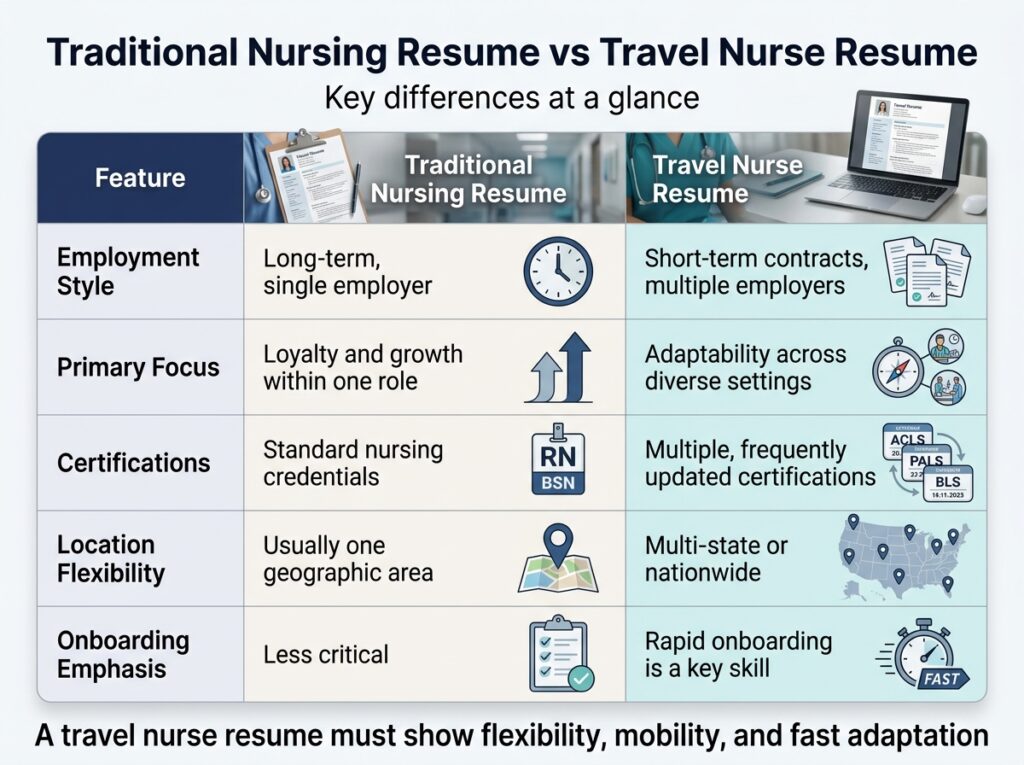
| Feature | Traditional Nursing Resume | Travel Nurse Resume |
| Employment style | Long-term, single employer | Short-term contracts, multiple employers |
| Primary focus | Loyalty and growth within one role | Adaptability across diverse settings |
| Certifications | Standard nursing credentials | Multiple, frequently updated certifications |
| Location flexibility | Usually, one geographic area | Multi-state or nationwide |
| Onboarding emphasis | Less critical | Highlighted — Rapid onboarding is a key skill |
The core message your travel nurse resume needs to communicate is simple: you are someone who adapts fast, performs consistently, and brings value from day one — regardless of the setting.
What Should You Include in a Travel Nurse Resume?
A complete and competitive travel nursing resume includes the following elements: a professional contact header, a strong summary statement, your clinical work experience, a skills section, certifications and licenses, and your educational background.
Each section plays a specific role. Together, they paint a picture of a confident, qualified professional who understands the unique demands of contract nursing. Leaving any section out — or filling it in lazily — weakens the overall impression you make.
How Do You Write a Professional Summary for a Travel Nurse Resume?
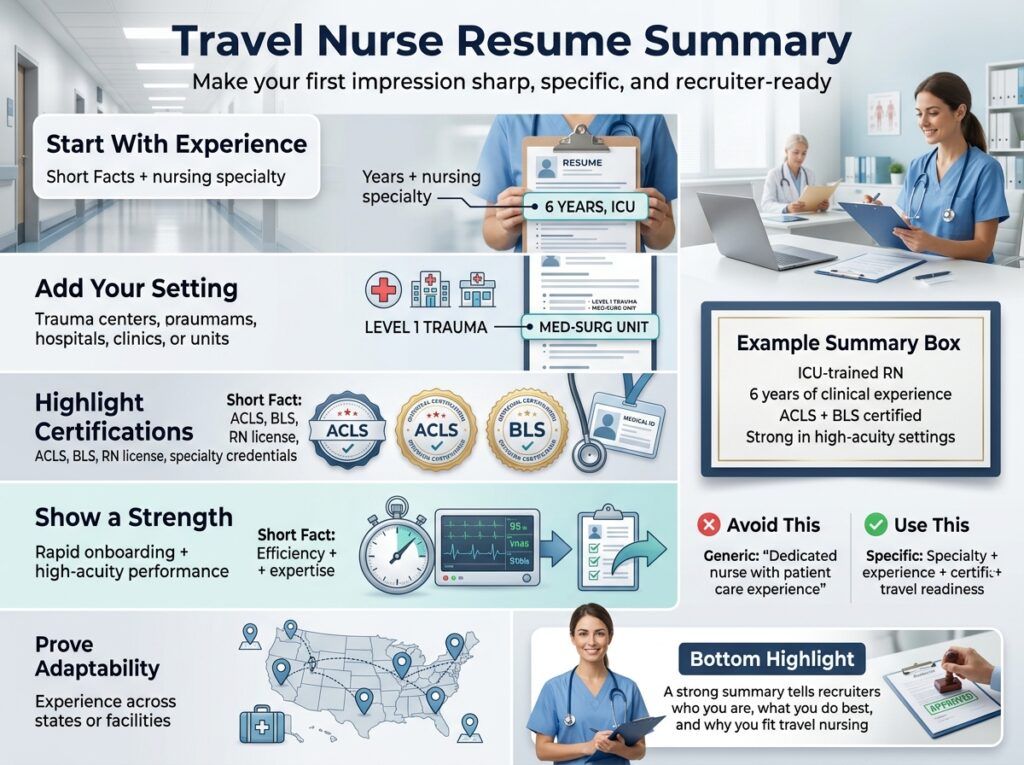
Your professional summary is the first thing a recruiter reads. It needs to be sharp, specific, and tailored. A generic opener like “Dedicated nurse with experience in patient care” is forgettable. A specific one is not.
A strong summary for a travel nurse typically opens with your years of experience and specialty, follows with a notable achievement or skill, and closes with a line about your adaptability or licensure. Here’s an example of what that structure looks like in practice:
“ICU-trained RN with 6 years of clinical experience across Level I trauma centers and community hospitals. ACLS and BLS certified. Known for rapid onboarding and strong performance in high-acuity settings across three states.”
That’s three sentences. It tells recruiters exactly who you are, what you’re good at, and why you’re suited for travel nursing specifically.
What Are the Essential Sections of a Travel Nurse Resume?
What Contact Information Should You Add?
Keep your contact header clean and professional. Include your full name, phone number, a professional email address, and your current city and state. You should also add your nursing license number and the states in which you’re licensed — this matters enormously for travel roles. If your LinkedIn profile is up to date, include that too.
How Do You Present Your Nursing Experience Effectively?
List your assignments in reverse chronological order, starting with the most recent. For each role, include the hospital or facility name, the city and state, the contract duration, your unit or specialty, and three to five bullet points covering your key responsibilities and achievements.
Wherever possible, quantify your impact. “Managed care for 6–8 patients per shift in a 24-bed ICU” is far more convincing than “provided patient care in the ICU.” Numbers give recruiters something concrete to evaluate.
Which Skills Should You Highlight?
Your skills section should reflect a balance of clinical competencies and professional soft skills. Tailor this section to match the job description — if a posting emphasizes telemetry experience, and you have it, make sure it appears prominently.
Strong clinical and soft skills to consider, including: patient assessment, IV insertion, electronic health records (EHR) proficiency, HIPAA compliance, rapid adaptability, cross-functional team communication, crisis management, and multi-system EMR experience.
How Do You List Certifications and Licenses Properly?
This section is non-negotiable for travel nurses. Create a clean, scannable list that includes the certification name, the issuing organization, and the expiration date. Keep it current — an expired ACLS certification on a resume signals carelessness to recruiters.
Common certifications worth listing include BLS, ACLS, PALS, NRP, and any specialty-specific credentials relevant to your unit.
What Education Details Should You Include?
List your nursing degree (ADN, BSN, or MSN), the institution name, and your graduation year. If you’ve completed any continuing education courses or specialty training relevant to travel nursing assignments, include those as well. You don’t need a lengthy education section — clarity matters more than length here.
What Is the Best Format for a Travel Nurse Resume?
The reverse-chronological format is the clear winner for travel nursing resumes. It puts your most recent and relevant experience front and center, which is exactly what recruiters want to see. Functional formats — which organize content by skill rather than timeline — tend to obscure the breadth of your contract history, which is one of your biggest assets.
Formatting tips worth following: use a clean, single-column layout, choose a readable font like Calibri or Georgia at 10–12pt, maintain consistent margins, and avoid graphics, photos, or elaborate color schemes. These visual elements can disrupt ATS (Applicant Tracking System) parsing and cause your resume to get filtered out before a human ever sees it.
What Does a Travel Nurse Resume Example Look Like?
Reviewing a travel nurse resume sample is one of the fastest ways to understand how all the sections fit together. A strong example typically follows this structure:
| Resume Section | What It Should Contain |
| Header | Name, phone, email, location, license number |
| Professional Summary | 2–3 sentences: specialty, experience, top strengths |
| Clinical Experience | Assignments in reverse order with quantified achievements |
| Key Skills | Clinical and soft skills tailored to the role |
| Certifications | BLS, ACLS, and state licenses with expiration dates |
| Education | Degree, institution, graduation year |
Looking at a travel nurse resume example from a well-organized source helps you benchmark your own document and identify gaps you might have overlooked. Pay close attention to how strong examples use action verbs — words like “managed,” “coordinated,” “implemented,” and “trained” carry far more weight than passive language.
Where Can You Find the Best Travel Nurse Resume Template?
A good travel nurse resume template is available through many reputable career and nursing-specific websites. When choosing one, prioritize ATS compatibility over visual flair. A beautifully designed template with text boxes and columns might look impressive on screen, but it often breaks when parsed by recruitment software.
The best templates offer a clean single-column layout, clearly labeled sections, easy-to-edit formatting, and enough white space to keep the document readable. Many word processing platforms offer free templates you can adapt — the goal is structure, not decoration.
How Can You Write a Resume for Travel Nurse Jobs with No Experience?
If you’re breaking into travel nursing without prior contract experience, don’t panic — your clinical training and internship history still count for a great deal. Focus your resume on the rotations you completed during nursing school, any float pool experience, and situations where you demonstrated adaptability.
Your professional summary should honestly reflect where you are while emphasizing your eagerness and preparation. Something like: “Recent BSN graduate with clinical rotations across med-surg, pediatrics, and emergency settings. BLS and ACLS certified. Eager to bring strong foundational skills and adaptability to a first travel nursing contract.”
Lead with what you have. Recruiters working with newer nurses understand the entry-level landscape — they’re looking for potential, professionalism, and the right attitude.
What Common Mistakes Should You Avoid in a Travel Nurse Resume?
Here are the most frequent errors that weaken an otherwise solid resume:
- Using a generic professional summary that could apply to any nurse, make yours specific to your specialty and contract work.
- Listing outdated or expired certifications — always check dates before submitting.
- Including irrelevant work history — older non-nursing jobs from a decade ago rarely add value.
- Omitting contract duration and location for past assignments — recruiters need this context.
- Neglecting ATS optimization — if your resume doesn’t include relevant keywords from the job posting, it may never reach a human reviewer.
- Using a cluttered or overly designed layout — complex formatting often breaks ATS systems.
- Writing in vague, unmeasurable terms — replace “helped patients” with specific, quantified contributions.
How Can You Make Your Travel Nurse Resume Stand Out?
The resumes that get callbacks share a few consistent qualities. They use strong action verbs, they quantify results wherever possible, and they’re clearly tailored to the specific role rather than mass-submitted.
Beyond the content itself, customization is what separates memorable resumes from forgettable ones. Read the job description carefully and mirror its language where it genuinely applies to your background. If the posting emphasizes experience with Epic EHR, a nd you have it, make sure that it appears prominently. If it highlights telemetry or step-down unit experience, surface that early.
A tailored travel nursing resume signals to recruiters that you’re intentional — and intentional candidates tend to be better hires.
How Do You Optimize Your Travel Nurse Resume for ATS?
Applicant Tracking Systems scan resumes for keywords before a human ever reads them. To make sure yours passes through, keep formatting simple, use standard section headers like “Work Experience” and “Certifications,” and avoid placing critical information inside tables, text boxes, or headers and footers.
Use keywords that naturally appear in the job description — terms like “ICU RN,” “patient assessment,” “multi-state licensure,” and “contract nursing” are commonly searched. Don’t stuff them in artificially, but don’t omit them either. The goal is a resume that reads naturally to a person and scans cleanly for software.
What Is the Ideal Length of a Travel Nurse Resume?
One to two pages is the standard. If you have fewer than five years of experience, aim for one page. If you have a long history of diverse travel nursing assignments across multiple specialties, two pages is reasonable — but only if every line earns its place.
Padding your resume with filler to reach two pages is just as damaging as cramming everything into an illegible one-pager. Recruiters appreciate restraint. Give them what they need to make a decision, and nothing more.
FAQs
What should a travel nurse’s resume include?
A travel nurse resume should include contact information, a strong professional summary, clinical experience, key skills, certifications, and education. It should clearly highlight adaptability and experience across different healthcare settings to attract recruiters quickly.
How is a travel nurse’s resume different from a regular nursing resume?
A travel nurse’s resume focuses on short-term assignments, flexibility, and diverse clinical experience. It emphasizes adaptability, multiple locations, and certifications, unlike traditional nursing resumes that focus on long-term roles.
What are the best skills to include in a travel nurse resume?
The best skills include patient care, critical thinking, adaptability, communication, ICU or ER experience, and teamwork. Adding both clinical and soft skills increases your chances of getting selected for travel nursing jobs.
How long should a travel nurse’s resume be?
A travel nurse’s resume should be one to two pages long. Keep it concise while including relevant experience, certifications, and skills that demonstrate your ability to work in different healthcare environments.
Where can I find travel nurse resume examples and templates?
You can find travel nurse resume examples and templates online or create your own using a clean format. Reviewing examples helps you understand structure, while templates ensure your resume looks professional and ATS-friendly.