
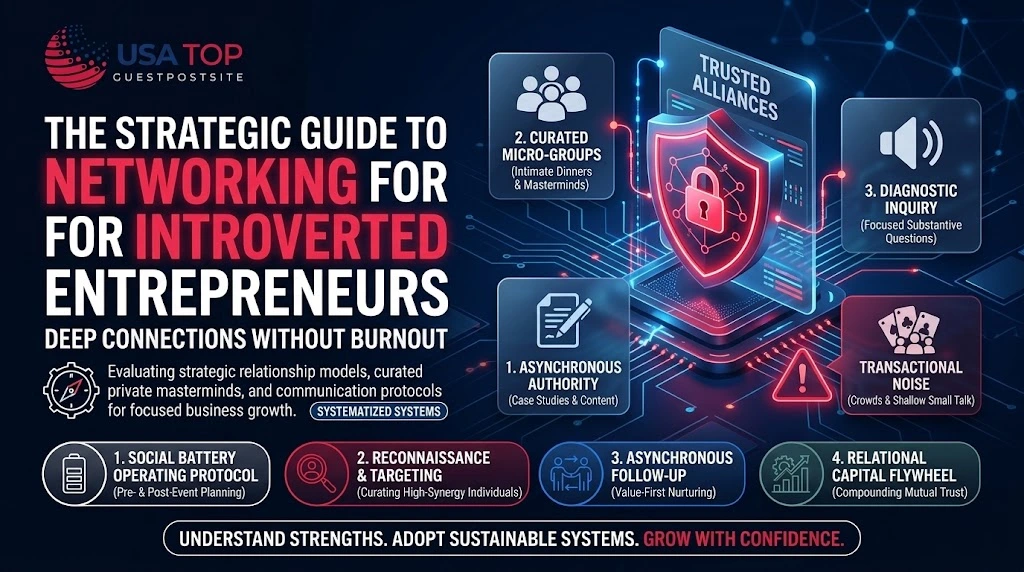
Traditional business advice was built almost entirely for the outgoing founder. For decades, business books, masterminds, and corporate conventions have championed the same formula: work the entire room, hand out stacks of business cards, dominate small talk, and project boundless extroverted charisma.
For independent founders, solopreneurs, and business owners who recharge in quiet environments, this playbook is not only unnatural—it is actively counterproductive. Trying to impersonate an extroverted entrepreneur leads directly to energy depletion, shallow interactions, transactional sales pitches, and social exhaustion.
True connection in modern business is not about aggressive room-working. It is about building strategic relationships, cultivating relational capital, and creating long-term commercial partnerships.
Introversion is not a disadvantage to be overcome. When channelled strategically, your natural disposition for keen observation, analytical patience, and focused one-on-one conversations becomes a major competitive differentiator.
This comprehensive guide breaks down the neurobiology of temperament, provides actionable frameworks to replace shallow small talk with meaningful professional dialogue, and outlines a sustainable system to grow your revenue, authority, and professional circle without sacrificing your mental well-being.
The Neurological Advantage: Why Introverts Make Exceptional Networkers
Many founders mistake introversion for shyness, social hesitation, or a lack of social competence. In reality, these concepts describe entirely different psychological realities:
- Shyness is driven by an acute fear of negative evaluation and social judgment.
- Anxiety in social settings represents a clinical or psychological distress response to scrutiny.
- Introversion is a hardwired neurobiological processing style cantered on how an individual responds to environmental stimulation and manages cognitive energy.
Research in cognitive neuroscience reveals that introverts and extroverts process environmental inputs through different neurotransmitter pathways. Extroverts thrive on the dopamine pathway—a fast-paced, high-arousal reward system triggered by novelty, social risk, and dynamic group interactions.
Introverts operate primarily on the acetylcholine pathway. Acetylcholine is a neurochemical tied to internal reflection, deep thinking, memory retrieval, and calm contemplation. Furthermore, introverts possess higher resting cortical arousal, meaning sensory-rich, noisy environments—such as crowded banquet halls or loud cocktail mixers—quickly push an introvert past their cognitive processing threshold into nervous system fatigue.
| Extroverted Networking | Introverted Strategic Relationship Building |
| Broad reach across crowds | Depth of 1-to-1 connection |
| Transactional cards | Curated relational alignment |
| Talking and pitching | Active listening and diagnostic discovery |
| Spontaneous, loud energy | Deliberate, reflective, and prepared |
| Rapid follow-up blasts | Customized, value-first follow-through |
When introverts stop fighting their neurobiology and embrace their internal wiring, distinct advantages in entrepreneurship emerge:
1. Superior Active Listening (Diagnostic Discovery)
Most people do not listen to understand; they listen to formulate their own reply. Because introverts process information internally before speaking, they practice deep listening—absorbing subtle context, observing micro-expressions, and tracking unspoken operational nuances. In a business interaction, this transforms standard pleasantries into a diagnostic consultation. Clients and prospective partners walk away feeling genuinely heard and understood.
2. High-Trust Retention
While broader social butterflies excel at initial cold introductions, sustainable business value is generated through long-term relationship-building. Introverts naturally prioritize emotional resonance and thoughtfulness over superficial contact volume. By nurturing five deeply aligned strategic alliances instead of accumulating five hundred disconnected business cards, introverted founders create referral loops that yield significantly higher conversion rates.
3. Intentional Signal Over Noise
Introverts rarely speak simply to fill empty air. When an introverted entrepreneur provides an observation, recommendation, or business insight, it is well-considered, measured, and high-value. In crowded professional environments, this calm restraint conveys executive presence, operational competence, and quiet authority.
Understanding how to align your temperament with scalable commercial growth requires adopting proven business leadership and development insights designed for sustainable operations. Furthermore, modern founders can leverage specialized digital marketing strategies to generate inbound opportunities without cold outreach, while staying ahead of emerging enterprise technology and software trends that enable seamless asynchronous collaboration.
Deconstructing the Extroverted Myth: Redefining “Networking”
The term “networking” carries a transactional stigma because it is frequently associated with predatory, pitch-heavy interactions. Overcoming the fundamental networking problem as an introvert requires discarding the belief that business growth demands schmoozing in massive crowds.
To succeed, you must adopt a completely new operational mindset:
Old Paradigm: Persuading as many strangers as possible that you and your business are impressive.
Strategic Paradigm: Identifying aligned professionals, understanding their operational challenges, and delivering targeted value to build mutual, compounding trust.

When you view professional outreach as focused research, problem-solving, and relationship curation, the friction of self-promotion disappears. You are no longer performing on a stage; you are conducting targeted business analysis and building peer alliances that reflect your unique strengths to entrepreneurship.
Energy Management: The “Social Battery” Operating Protocol
For introverts, energy is a finite resource. Extroverts recharge by being around crowds; introverts recharge in quiet, low-stimulation environments. The greatest threat to an introverted entrepreneur’s business visibility is not poor social skills—it is acute physical, emotional, and cognitive exhaustion caused by sensory overload.
Treat your social battery like an operational budget by applying structured energy boundaries, especially when attending unavoidable high-energy events.
Pre-Event: The Energy Bank Deposit (50% Preparation)
Never enter a high-density setting directly from an exhausting workday. Energy conservation starts hours before you arrive:
- Schedule White Space: Block out a mandatory 90-minute quiet period before attending any major gathering. Turn off notifications, avoid client calls, and reset your baseline cognitive state.
- Conduct Reconnaissance: Review attendee lists, speakers, or sponsors in advance. Choose two to four specific people you wish to meet, research their recent projects, and prepare your conversational bridges. This eliminates the anxiety of the unknown.
- The “Early Arrival” Strategic Hack: Arriving early to a large networking event is a powerful tactical advantage. Entering a crowded room is intimidating, but stepping into an empty venue allows you to acclimate to the sensory space. You can introduce yourself to the hosts and talk to early arrivals one-on-one before loud clusters form.
Mid-Event: Strategic Pacing (30% Execution)
- The Two-Connection Rule: Set a strict, realistic objective. Tell yourself: “I am here to have two high-quality, memorable dialogues, not to collect 30 business cards”. Once those connections are made, your mission is accomplished.
- Tactical Micro-Breaks: When you feel your cognitive reserves dropping, take five minutes to step into a quiet hallway, walk outside for fresh air, or step away to reset your sensory system.
- Permissible Exits: Give yourself advance permission to leave early. Pushing through deep exhaustion leads to flat interactions and poor first impressions. Leave while your energy is still positive.
Post-Event: Energy Reclamation and Asynchronous Follow-Up (20% Recovery)
- The Silent Buffer: Block the morning or evening following an intensive gathering as quiet operational time. Protect yourself from back-to-back meetings.
- Asynchronous Deepening: Move new contacts immediately into written, one-on-one digital channels where introverts naturally communicate with clarity and precision.
The Strategic Framework: 5 Systems for Introverted Networking
To build a sustainable client and partner pipeline without burning out, replace spontaneous schmoozing with systematized operational habits and proven networking tips.
System 1: The Asynchronous-First Pipeline (The Digital Front Door)
Introverts express their deepest strategic thinking in writing. Instead of relying on random mixer events, use thoughtful writing and personal branding as your primary business introduction engine.
- Long-Form Authority Positioning: Write analytical essays, tear-down case studies, or detailed industry breakdowns. This acts as automated relationship building; it filters for prospects who value your analytical approach before you ever exchange a direct message.
- The Targeted Commenting Strategy: Pick 10 non-competing, complementary founders, partners, or industry leaders. Instead of sending cold sales pitches, leave three insightful, value-adding comments on their content over three weeks. When you finally reach out directly, you are already a recognized peer rather than an uninvited salesperson.
System 2: Micro-Masterminds and Curated Private Dinners
Large industry trade shows produce low conversion rates for high energy costs. Introverted founders generate significantly higher ROI by seeking out or curating smaller, higher-trust environments:

- Alternative Gathering Formats: Rather than attending noisy conventions, seek out small workshops, participate in collaborative co-working meetups, or join focused niche interest meetups where business discussions emerge naturally around shared work.
- The 4-Person Round Table: Host a quarterly 60-minute virtual coffee or an in-person dinner with three carefully chosen peers tackling similar business bottlenecks.
- The Host Advantage: Paradoxically, hosting is easier for introverts than attending. As the host, you set the agenda, establish the ground rules, control the environment, and bypass awkward small talk by introducing structured discussion topics. Joining an intentional, relationship-first group allows you to sidestep aggressive pitch cultures entirely.
System 3: The Diagnostic Inquiry Framework (Ditching Small Talk)
Introverts dread transactional small talk: “What do you do?”, “Crazy weather, right?”, “Busy quarter?” Superficial questions are draining because they offer no intellectual substance.
Learning how to be great at networking simply requires asking better questions that pivot away from surface chatter and spark meaningful conversations:
| Surface-Level Small Talk (Avoid) | Strategic Diagnostic Inquiries (Use Instead) |
| “What do you do?” | “What interesting initiative is consuming your focus right now?” |
| “How’s business?” | “What’s the biggest operational friction point you are solving in your industry this year?” |
| “Been to this event before?” | “What specific insight or connection made you decide to attend today?” |
| “Nice to meet you.” | “What inspired your shift into this line of work?” |
These inquiries achieve two things: they relieve you of the burden of talking constantly, and they give the other person permission to speak authentically about their real challenges.
System 4: The 30-Second Clarified Positioner (No Elevator Pitches)
Traditional elevator pitches feel like aggressive infomercials, making quiet founders self-conscious and hesitant. Replace the pitch with a three-part framework focused on pain points, operational mechanics, and measurable transformation:
$$\text{Positioning} = \text{Target Audience Pain} + \text{Core Mechanism} + \text{Measurable Transformation}$$
- Step 1 (The Problem): “You know how most B2B founders struggle to get consistent inbound enterprise leads without spending thousands on cold outreach?” (The listener nods: “Yes.”)
- Step 2 (The Mechanism): “We built a dedicated content architecture that turns technical engineering insights into a qualified organic pipeline.”
- Step 3 (The Outcome): “It allows technical founders to close enterprise deals without ever having to make cold phone calls.”
This approach is clear, confident, and invites a natural follow-up question: “How does that work?”
System 5: The “Relational Arbitrage” Follow-Up System
The initial meeting accounts for only a fraction of an alliance’s business value; the remainder is determined by follow-through. Because extroverted networkers move on quickly to work the next room, thoughtful entrepreneurs can leverage attentive listening to build lasting loyalty.
Never send a generic follow-up: “Great meeting you, let’s grab coffee sometime.” Execute a targeted value-add:
- Recall a Specific Detail: Reference a specific challenge or personal interest they mentioned during your conversation.
- Provide Instant, Unsolicited Value: Share a relevant framework, link a specialized resource, introduce a potential collaborator, or recommend an applicable case study.
- Remove Pressure: Close your message without making an immediate commercial demand.
Sample Follow-Up Template:
Subject: Quick resource regarding [Topic they mentioned]
Hi [First Name],
I really enjoyed our conversation yesterday at [Event Name], especially your
perspective on [Specific topic or problem they brought up].
You mentioned your team was looking at ways to streamline [operational bottleneck].
I came across this specific case study recently and thought it directly mapped
to what you’re working on: [Link].
No reply needed—just wanted to share it in case it’s helpful as you plan Q3.
Best,
[Your Name]
This establishes you as an insightful peer rather than an aggressive vendor, mastering the core principles of networking 101.
Communication Mastery: Managing Professional Interactions
Developing refined communication and networking skills does not require altering your personality; it requires having structured scripts ready so you never experience social freezing.
Breaking Into an Existing Group
When you see two or three people talking and need to enter the circle gracefully:
“Pardon the interruption—I caught the tail end of what you were saying about [Topic]. Do you mind if I listen in?”
Gracefully Exiting a Conversation Without Lying
When your energy has dipped and you need to step away:
“It has been great learning about what you are building with [Project]. I want to make sure you have time to connect with others here, so I’m going to step away for a moment. Let’s make sure we connect on LinkedIn before tomorrow.”
Deflecting Uncomfortable Self-Promotion
When someone asks for an instant sales pitch before you have built rapport:
“Rather than giving you the polished brochure version of our company, I’m more interested in how businesses like yours are handling [specific industry challenge] right now. How is your team approaching that?”
Case Study: From Overwhelmed Founder to Predictable Inbound Pipeline
To understand how to build a sustainable network without leaving your office, consider the real-world operational journey of David, a software founder who struggled with conventional outreach:
- The Problem: David attended weekend start-up mixers and developer demo days. He spent hours standing quietly near the perimeter, collecting generic business cards, and returning home exhausted with zero enterprise leads.
- The Strategic Shift: David stopped attending mixed-interest conferences entirely. Instead, he mapped out the 50 chief information security officers (CISOs) who represented his ideal client profile. He spent four hours every week writing technical teardowns on LinkedIn, highlighting security architecture bugs overlooked by legacy platforms.
- The Outreach Protocol: When target CISOs interacted with his posts, David reached out with a brief message highlighting a single line of insecure code in common enterprise setups, accompanied by a two-minute walkthrough video.
- The Metric Outcome: Within twelve months, without attending a single in-person mixer, David built a closed-door referral network of eight fractional security advisors. This generated four enterprise client contracts valued at $1.2 million in annual recurring revenue. He worked entirely within his zone of genius: technical analysis, clear written communication, and diagnostic exploration.
30-Day Networking Implementation Roadmap
To turn these practical strategies into measurable business momentum, follow this systematic four-week execution schedule:
WEEK 1: INFRASTRUCTURE & POSITIONING
[ ] Write down your 3-part Problem-Pivot-Outcome positioning statement.
[ ] Define your Social Battery Budget (max 2 public networking sessions per month).
[ ] Audit your online profiles: ensure your headline communicates the tangible
transformation you deliver rather than an ambiguous corporate title.
WEEK 2: ASYNCHRONOUS TARGETING
[ ] Identify 15 high-value peers, potential partners, or dream clients.
[ ] Add them to a CRM or spreadsheet tracker.
[ ] Engage with their shared insights by leaving 3 thoughtful comments over 10 days.
WEEK 3: CURATED HIGH-LEVERAGE ENGAGEMENT
[ ] Attend 1 highly targeted workshop or host a 3-person virtual round table.
[ ] Apply the Two-Connection Rule: focus on 2 high-depth dialogues.
[ ] Apply the Diagnostic Inquiry Framework; spend 70% of the interaction listening.
WEEK 4: VALUE-FIRST RELATIONSHIP NURTURING
[ ] Execute the Relational Arbitrage follow-up within 24–48 hours for new contacts.
[ ] Share relevant, non-transactional resources with your past 5 primary connections.
[ ] Conduct an energy retrospective: note what drained you, what energized you,
and adjust your social protocols for the following month.
To explore the deeper psychological and neurological foundations behind personality traits, consulting peer-reviewed research through the American Psychological Association personality resources provides rigorous clinical perspective on introversion, behavioural tendencies, and cognitive energy regulation.
Frequently Asked Questions
How do introverted entrepreneurs build a high-leverage network from scratch?
Introverted founders build networks by trading broad visibility for narrow, high-value depth. Instead of attending unstructured cocktail mixers, they identify 10 to 20 strategic peers, complementary service providers, or prospective partners and engage through asynchronous channels first. By publishing long-form problem breakdowns, leaving analytical commentary on target profiles, and inviting select contacts to private, 30-minute virtual discussions, introverts build high-trust relationships without ever having to “work a room.”
Can introverts be genuinely good at networking?
Introverts frequently make the most effective networkers because modern business partnerships depend on trust, reliability, and diagnostic comprehension rather than superficial charisma. While extroverts naturally excel at cold introductions and wide-net reach, introverts excel at deep listening, identifying unmet operational needs, and executing thoughtful, long-term follow-ups. When networking is framed as building substantive alliances rather than collecting business cards, introverts hold an inherent structural advantage.
What are the 5 P’s of effective networking?
The 5 P’s represent an operational framework that allows introverts to network deliberately without suffering social burnout:
- Purpose: Define exactly why you are entering a room or starting a conversation (e.g., meeting two potential referral partners rather than “mingling”).
- Preparation: Research attendees, industry topics, and conversational bridges ahead of time to eliminate uncertainty.
- Pacing: Manage your social battery by budgeting time, taking periodic sensory breaks, and leaving when your energy drops.
- Presence: Focus completely on the individual in front of you through active, diagnostic listening rather than scanning the room.
- Persistence (Follow-Through): Solidify the relationship within 48 hours by providing relevant, unsolicited value via asynchronous channels.
Are high-IQ people typically introverted?
Psychological research indicates a notable correlation between high general intelligence and introversion. Studies by the Gifted Child Development Centre and various cognitive assessments suggest that a disproportionate percentage of individuals scoring in gifted ranges (IQ 130+) demonstrate introverted personality traits. Introverts tend to spend more time in solitary contemplation, deliberate practice, and deep reading—behaviours that foster pattern recognition, abstract reasoning, and systemic problem-solving. However, high IQ exists across both extroverted and introverted populations.
Are most CEOs introverts or extroverts?
While extroverts occupy roughly 60% to 70% of high-profile corporate CEO roles due to traditional executive hiring biases that reward vocal assertiveness, long-term leadership research tells a different story. In comprehensive studies conducted by the CEO Genome Project and researchers at Harvard and Stanford, introverted CEOs regularly met or exceeded performance expectations compared to extroverted peers. Introverted leaders excel at managing proactive, highly skilled teams because they give autonomy to experts, analyse strategic risks methodically, and listen objectively before executing critical pivots.
Building a Business Network That Honours Your Nature
Sustainable commercial success does not require transforming into an aggressive salesperson. When examining the operating models of successful introverted business owners, a common pattern appears: they do not compete on volume, noise, or charisma. Instead, they focus on intellectual Depth, relational consistency, and mutual value creation.
Mastering networking and visibility for introverted entrepreneurs means creating systems that protect your time while compounding the power of network equity over years. By stepping away from noisy conference halls and focusing on genuine connection, you build an enduring foundation of advocates, collaborators, and clients.
When you deliberately implement these Core strategies for introverts, building professional alliances stops feeling like an exhausting chore and becomes a powerful engine for commercial growth. The goal is not to collect the most business cards—it is to build real relationship capital that stands the test of time.
To see these principles broken down into a practical visual walkthrough, consult this structured video on YouTube: The Introvert’s Guide to Networking. This resource provides clear communication examples that demonstrate how to navigate modern professional settings with calm confidence, offering a comprehensive introvert’s guide to building lasting alliances while establishing the best networking for introverted entrepreneurs.


