
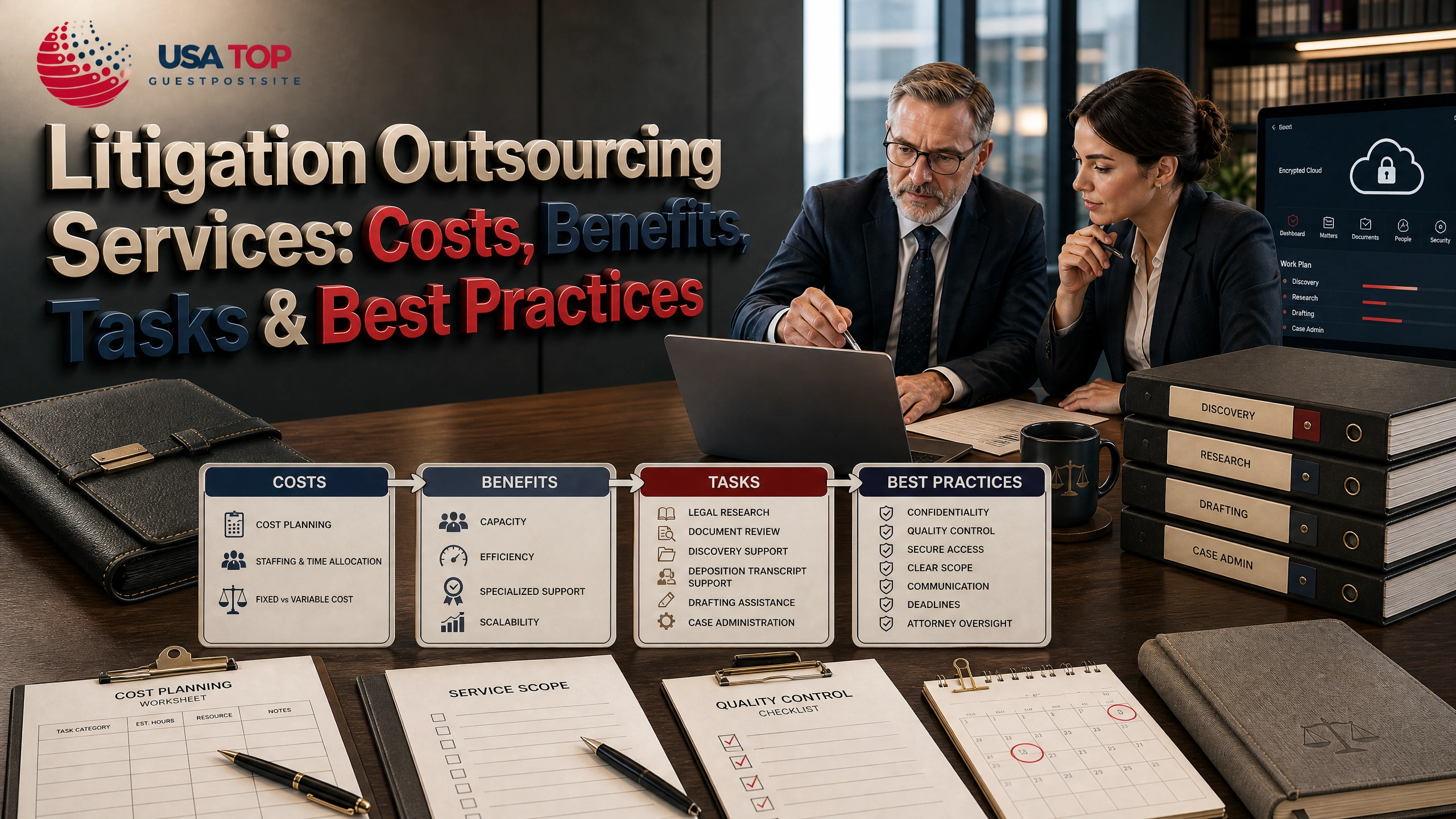
Litigation outsourcing services help law firms and legal departments delegate selected litigation-related work to qualified external professionals while keeping legal strategy, professional judgment, client decisions, and final review under appropriate internal control. Depending on the matter, outsourced litigation support can include legal research, document review, e-discovery, legal drafting, pleadings, deposition summaries, case management, court filing support, trial preparation, and litigation document management. For firms facing a heavy litigation workload, case backlog, staffing constraints, or a temporary surge in discovery work, a structured outsourcing model can provide additional capacity without requiring permanent expansion of every internal role.
What Are Litigation Outsourcing Services?
Litigation outsourcing services are external legal support services that allow law firms or legal departments to delegate selected litigation-related tasks to qualified outside professionals. The work may range from research and document review to e-discovery, drafting support, case administration, and trial preparation.
The purpose is not necessarily to outsource an entire case or replace the firm’s legal team. Instead, litigation support outsourcing separates suitable process-heavy work from responsibilities that require direct legal judgment. A firm can therefore use outsourced litigation support to increase capacity while attorneys continue managing strategy, client relationships, legal decisions, and final work product.
Common services can include legal research, document review, legal document drafting, pleadings, brief drafting, contract review, legal transcription, deposition summaries, court reporting, case management, and litigation document management.
For many firms, the practical value comes from matching the right task with the right level of external support.
How Does Litigation Outsourcing Work Step by Step?
Litigation outsourcing works best as a controlled workflow rather than as a simple handoff of work to an outside provider. The firm first identifies a workload problem, determines which tasks are appropriate for delegation, defines the expected deliverables, evaluates providers, establishes confidentiality procedures, and then monitors the completed work.
A practical process includes these steps:
Step 1: Identify the litigation bottleneck. Determine whether the problem is a case backlog, discovery volume, research workload, administrative pressure, or limited staffing capacity.
Step 2: Define the tasks to outsource. Separate repetitive, process-driven, or support-oriented work from core legal strategy and professional judgment.
Step 3: Set the scope and deliverables. Establish instructions, deadlines, file requirements, quality standards, communication procedures, and expected outputs.
Step 4: Evaluate providers. Review litigation experience, practice-area expertise, technology, security procedures, quality control, pricing, and scalability.
Step 5: Review confidentiality and security. Establish how confidential client information, case files, privileged materials, and other sensitive data will be accessed and protected.
Step 6: Set the communication workflow. Determine who handles questions, escalations, progress updates, and deadline changes.
Step 7: Establish quality control. Define reviewer qualifications, sample checks, accuracy standards, revision procedures, and escalation requirements.
Step 8: Measure performance. Track turnaround time, accuracy, revisions, backlog reduction, internal hours saved, and other relevant metrics.
Step 9: Scale or adjust the workflow. Expand the relationship when the process works or change the scope when the provider is not meeting expectations.
This process-based approach makes litigation workflow management more predictable and gives the internal legal team a clear way to maintain control.

What Is the Difference Between Litigation Outsourcing and Legal Process Outsourcing?
Litigation outsourcing is a specialized form of legal support focused on litigation-related work, while legal process outsourcing covers a broader range of legal and legal-support processes.
Legal process outsourcing (LPO) can include litigation support, contract-related work, legal research, compliance support, legal administration, document processing, and other services. Litigation outsourcing focuses more specifically on activities connected to disputes and litigation workflows.
For example, a legal process outsourcing provider may support contract management for a corporate legal department, while a litigation-focused provider may handle document review, e-discovery, deposition summaries, legal research, or trial preparation support.
The distinction is useful because a firm should choose a provider according to the actual workflow it needs to improve rather than assuming that every legal outsourcing provider has the same litigation capabilities.
What Is the Difference Between Litigation Outsourcing and Offshoring?
Litigation outsourcing means using an external provider to perform selected work, while offshoring means moving work to a provider or team located in another country.
Outsourcing does not necessarily mean offshoring. A law firm can outsource litigation support to a domestic company, a remote professional, or an international provider.
Location is only one consideration. A firm should also evaluate confidentiality, data security, communication, quality control, jurisdictional knowledge, technology, turnaround time, and the type of work being delegated.
For sensitive litigation matters, the decision should be based on the firm’s professional obligations, client requirements, applicable rules, and risk-management process rather than price or location alone.
Why Do Law Firms Outsource Litigation Work?
Law firms outsource litigation work when internal teams need additional capacity, specialized expertise, faster turnaround, or a more flexible way to manage workload. The strongest outsourcing decisions usually solve a specific operational problem rather than simply attempting to reduce headcount.
A firm dealing with a growing litigation workload may use external support to process documents, organize evidence, complete research, or prepare summaries while attorneys focus on case strategy and client communication.
Common reasons include:
- Reducing case backlog
- Improving law firm efficiency
- Increasing staffing flexibility
- Accessing specialized legal expertise
- Improving turnaround time
- Supporting productivity
- Managing temporary workload increases
- Obtaining scalable legal support
- Handling litigation surge support
- Reducing pressure on internal teams
The benefit should always be evaluated against the actual workflow. For example, outsourcing document review may be useful when discovery volume is creating a bottleneck, while outsourcing core litigation strategy would raise very different professional and quality considerations.
What Litigation Tasks Can Law Firms Outsource?
Law firms can outsource many litigation support functions when the work can be clearly defined, appropriately supervised, securely handled, and reviewed.
What Does Litigation Outsourcing Include?
Pre-litigation support may include case intake, legal research, document organization, and evidence preparation.
Discovery support may include document review, e-discovery, document coding, data organization, and litigation document management.
Case preparation may include legal research, legal memoranda, pleadings, brief drafting, legal drafting, deposition summaries, and case chronology preparation.
Trial support may include trial preparation support, exhibit preparation, court filing support, legal filing services, court reporting coordination, and litigation administration.
Administrative support may include case management, document management, case updates, calendar management, legal transcription, and selected billing or administrative tasks.
This range makes litigation support services useful across multiple stages of a case rather than limiting outsourcing to document review alone.
Which Litigation Tasks Are Best Suited for Outsourcing?
The best candidates for outsourcing are generally repetitive, process-driven, volume-heavy, or clearly measurable tasks that can be performed according to established instructions.
Suitable examples can include document review, legal research support, document organization, e-discovery, legal transcription, deposition summaries, case administration, filing support, and certain types of legal drafting.
More sensitive responsibilities may require stronger internal control. These can include core litigation strategy, privileged communications, high-value client decisions, client counseling, and final legal judgment.
A simple decision test is useful:
Can the task be clearly documented? If yes, it may be easier to delegate.
Is the task repetitive or volume-heavy? If yes, external capacity may be useful.
Does it require core legal judgment? If yes, internal control may be more appropriate.
Does it involve highly sensitive information? If yes, additional security and supervision are needed.
Can quality be measured? If yes, the firm can create objective performance standards.
The objective is not to outsource as much as possible. It is to outsource the work that creates the greatest operational value without weakening legal oversight.
Can Legal Research and Document Review Be Outsourced?
Yes. You can outsource legal research and document review when the assignment has clear instructions, appropriate qualifications, confidentiality controls, and internal review.
Legal research outsourcing can support case law research, statutory research, source organization, research summaries, and preliminary memoranda. The responsible legal team should review the work and make the final legal determination.
Document review is often suitable when litigation involves large quantities of information. External reviewers can work according to predefined criteria to organize, categorize, or identify relevant documents.
Legal document drafting can also be supported externally, including preliminary pleadings, legal memoranda, brief drafting, summaries, and other work product. Final review remains important because legal meaning depends on the facts, jurisdiction, procedural requirements, and strategy of the individual matter.
How Does Outsourcing Support E-Discovery?
Outsourcing can support e-discovery by providing additional people, technology, and workflow capacity for large volumes of electronic information.
E-discovery support may include:
- Document collection coordination
- Document review
- Document coding
- Data organization
- Information classification
- Litigation document management
- Review workflow administration
- Quality checks
- E-discovery technology support
The value of outsourced e-discovery becomes especially apparent when a litigation team faces a large discovery dataset and limited internal capacity.
However, technology alone does not guarantee reliable results. The provider should have documented procedures, trained personnel, appropriate security controls, and a quality-control process.
Can Litigation Support Include Trial Preparation and Court Filing?
Yes. Litigation support can extend beyond discovery into trial preparation, exhibit organization, deposition summaries, court filing support, and other case-related administrative work.
Trial preparation support may involve organizing exhibits, preparing case materials, maintaining document sets, creating chronologies, and coordinating administrative requirements.
Court filing support can help organize filing-related documentation and administrative steps, but the responsible legal team should maintain control over deadlines, procedural requirements, accuracy, and final submissions.
Other support may include court reporting coordination, legal transcription, deposition summaries, and case management. These services can reduce administrative pressure while allowing attorneys to concentrate on case strategy and client-facing responsibilities.
How Much Do Litigation Outsourcing Services Cost?
There is no universal price for litigation outsourcing services because the litigation support cost depends on the task, complexity, provider, geography, specialization, technology requirements, document volume, turnaround time, and staffing model.
Common pricing structures include:
| Pricing Model | How It Works |
| Hourly pricing | The firm pays according to time worked |
| Project-based pricing | A defined project has an agreed scope and price |
| Flat-fee arrangements | A specific service is delivered for a predetermined fee |
| Dedicated staffing | A professional or team provides ongoing support |
| Volume-based pricing | Cost changes according to workload or document volume |
A firm’s legal outsourcing cost should not be evaluated by hourly rate alone. Internal review time, project management, revisions, delays, technology, and quality-control requirements can affect the total cost.
A lower provider rate may not represent better value if the output requires substantial rework.
What Factors Affect the Cost of Litigation Outsourcing?
Several factors can change legal outsourcing pricing and the overall cost of an outsourced litigation workflow.
Task complexity: Specialized research, complex discovery, or technical litigation work may require more experienced professionals.
Volume: A large document set or high number of cases can change pricing and staffing requirements.
Turnaround time: Urgent assignments may require additional resources.
Jurisdiction: Work involving specialized jurisdictional knowledge may require appropriately qualified professionals.
Specialization: Certain practice areas or technical matters require specific expertise.
Technology: E-discovery platforms, document-management systems, automation, and other technology can affect the total cost.
Security requirements: Sensitive data may require additional access controls, secure systems, monitoring, and review procedures.
Staffing model: Dedicated support and project-based work can have different pricing structures.
For that reason, outsourced legal services costs should always be compared against the expected operational value rather than a single headline rate.
What Are the Benefits of Litigation Outsourcing?
The main potential benefits of litigation outsourcing are greater capacity, flexible staffing, specialized support, faster turnaround, reduced backlog, and improved workflow efficiency.
Lower overhead can help firms avoid maintaining permanent capacity for temporary workload levels.
Flexible capacity allows firms to add support when litigation volume increases.
Specialized expertise can provide access to litigation support professionals with experience in specific workflows.
Faster turnaround can help when deadlines or discovery volumes place pressure on internal teams.
Reduced backlog can free internal professionals from repetitive work.
Technology access can help firms use specialized e-discovery, document-management, or automation tools without building every capability internally.
Scalable staffing can be especially useful for litigation surge support when workload changes rapidly.
The value depends on implementation. Outsourcing should improve the workflow rather than simply move the same problems to another team.
What Are the Risks and Challenges of Litigation Outsourcing?
Litigation outsourcing can create operational value, but it also introduces risks that should be managed before sensitive work is delegated.
Potential risks include:
- Confidentiality concerns
- Data security issues
- Quality inconsistency
- Communication gaps
- Workflow integration problems
- Jurisdictional concerns
- Loss of internal knowledge
- Provider dependency
- Revision requirements
- Insufficient supervision
One important risk is losing too much internal knowledge. If a firm permanently delegates a workflow without retaining adequate understanding of the process, it may become dependent on the provider.
Another risk is assuming that outsourcing automatically creates cost reduction. If work requires repeated corrections or excessive internal management, the expected savings may disappear.
A strong outsourcing relationship therefore needs clear responsibilities, review procedures, security controls, and performance measurement.

How Can Law Firms Protect Confidential Client Information?
Law firms should treat legal data security and confidential client information as core parts of the outsourcing decision. Litigation files may contain privileged communications, personal information, business records, financial information, evidence, and other sensitive materials.
A secure outsourcing workflow can include:
- Non-disclosure agreements
- Access controls
- Encryption
- Secure document transfer
- Data retention rules
- Role-based permissions
- Audit logs
- Confidentiality procedures
- Provider security certifications where relevant
- Incident-response procedures
- Controlled data deletion
A provider should be able to explain who can access information, how access is granted, how files are transferred, where information is stored, and what happens when the project ends.
Security certifications and privacy frameworks can also be relevant, but requirements depend on the jurisdiction, data type, client requirements, and specific engagement. Standards such as SOC 2 or ISO 27001 should not automatically be described as universal legal requirements, and privacy frameworks such as GDPR or HIPAA should only be discussed when they are actually applicable to the particular situation.
This risk-management approach is more useful than simply asking whether a provider says it is “secure.”
How Can Law Firms Maintain Quality Control When Outsourcing?
A strong quality control system should be established before outsourced work begins. Quality should be measurable rather than based only on whether the final output “looks good.”
A practical framework can include:
Reviewer qualifications: Assign work to professionals with appropriate experience for the task.
Standard operating procedures: Create clear instructions for recurring workflows.
Sample review: Check an initial sample before scaling the project.
Quality checks: Measure accuracy and identify recurring errors.
Escalation process: Establish a clear procedure for questions or uncertain documents.
Turnaround standards: Define expected completion times.
Confidentiality controls: Make security requirements part of the workflow.
Ongoing performance monitoring: Track quality over time rather than evaluating only one assignment.
For larger document-review projects, firms can monitor accuracy rates, revision rates, error categories, turnaround time, escalation frequency, and deadline performance.
The goal is to create a repeatable quality system that supports both the provider and the internal legal team.
How Is AI Changing Litigation Outsourcing Services?
AI is changing litigation outsourcing by helping professionals process large volumes of information, automate repetitive workflows, organize documents, and support certain research and review activities.
Current applications can include:
- Legal AI
- AI-powered legal services
- Legal automation
- AI-assisted document review
- E-discovery automation
- Machine learning
- Natural language processing
- Document automation
- Legal technology
- AI transcription
- Human-in-the-loop workflows
AI-assisted document review and e-discovery technology can help identify, classify, organize, or prioritize information within large datasets. Document automation and AI transcription can also reduce repetitive processing work.
However, AI should not be treated as a substitute for professional legal judgment. A human-in-the-loop workflow is often more appropriate because human legal professionals remain important for reviewing outputs, understanding context, identifying errors, applying judgment, and maintaining quality control.
The strongest use of AI in litigation outsourcing is therefore not “AI replaces lawyers.” It is using technology to assist high-volume or repetitive work while maintaining appropriate human review and accountability.
How Do You Choose the Right Litigation Outsourcing Provider?
Choosing a litigation outsourcing company requires more than comparing prices. The provider should fit the firm’s actual practice area, workflow, security requirements, communication style, and expected workload.
Evaluate:
- Litigation experience
- Relevant practice-area expertise
- Legal research capability
- Document review capacity
- E-discovery capability
- Data security
- Quality control
- Turnaround time
- Communication
- Pricing model
- Scalability
- Technology stack
- Confidentiality procedures
- Jurisdictional knowledge
A provider with strong general legal outsourcing experience may not necessarily have the same capabilities as a provider specializing in litigation.
The evaluation should therefore focus on whether the provider can handle the exact work the firm intends to delegate.
What Should You Look for in a Litigation Outsourcing Company?
A reliable litigation support company should be able to explain its workflow, staffing, quality-control process, security procedures, communication model, and pricing structure clearly.
Look for evidence of:
- Relevant litigation experience
- Qualified litigation support professionals
- Clear project management
- Document review capacity
- E-discovery capabilities
- Strong data-management procedures
- Transparent pricing
- Defined turnaround standards
- Scalable staffing
- Appropriate technology
- Confidentiality procedures
- Quality assurance
Ask how the provider handles errors, urgent deadlines, security incidents, unclear instructions, and changes in project scope.
A strong provider should also explain what remains under the law firm’s control. This is important because effective law firm outsourcing is a partnership between external support and internal professional oversight, not a transfer of responsibility without supervision.
How Can a Law Firm Decide What to Keep In-House?
A law firm should generally keep work in-house when it depends heavily on core legal judgment, sensitive client decisions, litigation strategy, or direct professional responsibility.
A practical framework is to classify tasks according to risk and complexity.
| Task Type | Outsourcing Potential | Main Consideration |
| Document organization | High | Clear procedures |
| Legal transcription | High | Accuracy and confidentiality |
| Document review | Often high | Review standards and supervision |
| E-discovery support | Often high | Technology and quality control |
| Legal research support | Moderate to high | Attorney review |
| Drafting support | Moderate | Final legal review |
| Case administration | High | Workflow integration |
| Litigation strategy | Low | Core legal judgment |
| Privileged client decisions | Low | Confidentiality and professional responsibility |
| Final legal judgment | Low | Responsible attorney control |
The goal is to identify work that can safely be delegated while keeping the firm’s core legal responsibilities under appropriate internal control.
How Can You Measure the Success of Litigation Outsourcing?
The success of outsourcing should be measured with practical performance indicators rather than assumptions about cost savings.
Useful metrics include:
| Metric | What It Shows |
| Turnaround time | How quickly work is completed |
| Accuracy rate | Quality of the delivered work |
| Revision rate | Amount of rework required |
| Backlog reduction | Effect on pending workload |
| Cost per task | Financial efficiency |
| Deadline compliance | Reliability |
| Escalation rate | Frequency of unresolved issues |
| Internal hours saved | Effect on attorney and staff workload |
| Quality consistency | Stability over time |
A firm can compare these metrics before and after outsourcing.
For example, if outsourced document review reduces the backlog but requires substantial attorney correction, the process may need improvement. If the same workflow reduces backlog, maintains quality, saves internal hours, and meets deadlines, it is more likely to be delivering meaningful operational value.
This measurement approach also prevents the firm from judging outsourcing solely by the provider’s hourly rate.
Is Litigation Outsourcing Suitable for Small and Mid-Sized Firms?
Yes. Small and mid-sized law firms can use outsourced litigation support when they need additional capacity without maintaining full-time specialists for every possible workload.
A smaller firm may outsource:
- Document review
- Legal research support
- E-discovery
- Deposition summaries
- Legal transcription
- Filing support
- Case administration
- Trial preparation support
- Litigation document management
This can be particularly useful when the firm experiences a temporary increase in cases or discovery volume.
Small firms should nevertheless pay close attention to confidentiality, supervision, provider communication, pricing transparency, and the security of client information.
For firms that want to understand broader legal outsourcing models, see our guide to USA legal outsourcing services companies.
Can Litigation Outsourcing Help During a Case Backlog or Workload Surge?
Yes. Litigation surge support can help firms respond to temporary increases in discovery volume, new matters, deadlines, or administrative workload.
For example, an internal team may have sufficient attorneys to manage case strategy but not enough capacity to review thousands of documents within a required timeframe. External support can provide additional resources for document review, e-discovery, summaries, legal research, or case administration.
The key is to identify the bottleneck first.
If the problem is document volume, document-focused support may help. If the problem is research capacity, legal research support may be more appropriate. If the problem is administrative coordination, case management support may provide greater value.
Outsourcing should therefore be matched to the actual source of the backlog rather than used as a generic solution.
What Are the Latest Trends in Litigation Outsourcing in 2026?
In 2026, litigation outsourcing is increasingly shaped by AI-assisted workflows, legal technology, flexible staffing, and specialized support.
Important developments include:
AI-assisted legal workflows: Providers are increasingly integrating AI into repetitive information-processing tasks.
Automated document review: Technology can assist with large-scale document organization and review workflows.
E-discovery technology: Advanced tools can help legal teams manage increasingly large electronic datasets.
Hybrid human and AI workflows: Human professionals remain important for review, judgment, context, and quality control.
Remote legal professionals: Remote support allows firms to access specialized talent without requiring every role to be physically located inside the firm.
Flexible staffing: Firms can scale external capacity according to litigation workload.
Data security: As more sensitive information moves through digital workflows, security and access control remain central considerations.
Legal workflow automation: Automation can reduce repetitive administrative work and create more consistent processes.
Specialized litigation support: Providers are increasingly differentiated by specific capabilities rather than offering only generic legal support.
The important trend is not simply the adoption of AI. It is the integration of technology with human oversight, clear workflows, security controls, and measurable quality standards.
For a broader look at the value of outsourcing legal operations, our guide on measuring the ROI of outsourcing legal operations provides a related decision framework.
What Questions Should You Ask Before Outsourcing Litigation Work?
Before selecting a provider, ask practical questions about capability, security, quality, cost, and communication.
Does the provider have litigation-specific experience?
Ask whether the team has handled litigation research, document review, e-discovery, trial preparation, case management, or other workflows relevant to your matter.
What tasks can the provider support?
Confirm whether the provider handles legal research, document review, e-discovery, legal drafting, pleadings, deposition summaries, court filing support, trial preparation, or administrative support.
How is confidential client information protected?
Ask about NDAs, access controls, encryption, secure document transfer, data retention, permissions, monitoring, and incident response.
How does quality control work?
Ask how reviewers are qualified, how samples are checked, how errors are measured, and how corrections are handled.
What pricing model is used?
Determine whether the provider uses hourly, project-based, flat-fee, dedicated staffing, or volume-based pricing.
How quickly can work be completed?
Discuss standard and urgent turnaround times before assigning a project.
How does communication work?
Clarify who manages the relationship, how questions are escalated, and how project progress is reported.
Can the provider scale with the litigation workload?
Ask how the team handles sudden increases or decreases in workload.
What remains under the law firm’s control?
Clarify responsibility for legal judgment, strategy, client communication, final review, filing decisions, and other professional responsibilities.
For firms also managing broader legal content and writing workflows, our guide on outsourcing legal writing effectively explains how to structure external support with internal review and quality control.
What Are the Most Common Questions About Litigation Outsourcing Services?
What are litigation outsourcing services?
Litigation outsourcing services allow law firms and legal departments to delegate selected litigation-related support tasks to qualified external professionals. Common examples include legal research, document review, e-discovery, drafting support, case management, deposition summaries, court filing support, and trial preparation.
What is litigation support outsourcing?
Litigation support outsourcing means obtaining selected litigation support functions from an external provider instead of performing every task internally.
Is litigation outsourcing the same as legal process outsourcing?
No. Legal process outsourcing is broader and can cover many legal and administrative workflows. Litigation outsourcing focuses specifically on litigation-related work.
Is litigation outsourcing the same as offshoring?
No. Outsourcing means using an external provider, while offshoring means relocating work to another country. Outsourcing does not necessarily mean offshoring.
How much do litigation outsourcing services cost?
There is no universal price. Cost depends on task complexity, document volume, provider experience, staffing model, turnaround time, technology, specialization, jurisdiction, and security requirements.
What litigation tasks can be outsourced?
Common tasks include legal research, document review, e-discovery, legal document drafting, pleadings, brief drafting, deposition summaries, case management, legal transcription, court filing support, trial preparation, and document management.
Can legal research be outsourced?
Yes. Legal research support can be delegated when the scope and review process are clearly defined. The responsible legal team should maintain appropriate review and final legal judgment.
Can document review be outsourced?
Yes. Document review is often a suitable outsourcing candidate when the review criteria, security requirements, reviewer qualifications, and quality-control procedures are clearly established.
Can e-discovery be outsourced?
Yes. E-discovery support can be outsourced, particularly when litigation involves large quantities of electronic information and the firm needs additional technology or review capacity.
What are the main benefits of litigation outsourcing?
Potential benefits include flexible capacity, specialized expertise, faster turnaround, reduced backlog, technology access, scalable staffing, and lower internal workload.
What are the main risks?
The main risks include confidentiality, data security, quality inconsistency, communication problems, workflow integration, provider dependency, jurisdictional concerns, and loss of internal knowledge.
How should a law firm choose a litigation outsourcing provider?
Evaluate litigation experience, practice-area expertise, research capability, document review capacity, e-discovery, security, quality control, turnaround, communication, pricing, scalability, technology, confidentiality, and jurisdictional knowledge.
Can small law firms use litigation outsourcing?
Yes. Small and mid-sized firms can outsource selected litigation support tasks or temporary workload surges without maintaining permanent internal capacity for every function.
Can AI be used in litigation outsourcing?
Yes. AI can assist with document review, e-discovery, transcription, automation, data organization, and other high-volume workflows. Human review remains important for context, accuracy, professional judgment, and quality control.
What security controls should a litigation outsourcing provider have?
Depending on the engagement, relevant controls can include NDAs, access restrictions, encryption, secure file transfer, role-based permissions, audit logs, data retention procedures, incident response, and appropriate security certifications.
How can a law firm measure whether outsourcing is working?
Track turnaround time, accuracy, revision rates, backlog reduction, cost per task, deadline compliance, escalation rates, internal hours saved, and quality consistency.
Bottom Line: Is Litigation Outsourcing Right for Your Law Firm?
Litigation outsourcing services can be a practical way for law firms and legal departments to increase capacity, manage case backlogs, access specialized support, and improve litigation workflow efficiency. The strongest approach is not to outsource every legal responsibility. Instead, firms should identify repetitive, process-driven, measurable, or volume-heavy tasks that can be delegated while maintaining appropriate control over strategy, client decisions, professional judgment, confidentiality, and final review.
A well-designed model connects litigation support services, legal research, document review, e-discovery, legal drafting, trial preparation, case management, security, quality control, technology, and provider evaluation into one structured workflow.
For firms exploring broader managed support, our related guide to legal managed services in the USA explains how managed legal support can fit into a wider operational model.
Ultimately, the right outsourcing decision should be based on more than price. Evaluate the provider’s litigation experience, security procedures, quality-control system, communication, technology, scalability, jurisdictional knowledge, and ability to deliver measurable improvements. When the workflow is carefully planned and continuously monitored, outsourced legal professionals can extend a firm’s capacity without removing the internal legal oversight that remains essential to high-quality litigation work.


