
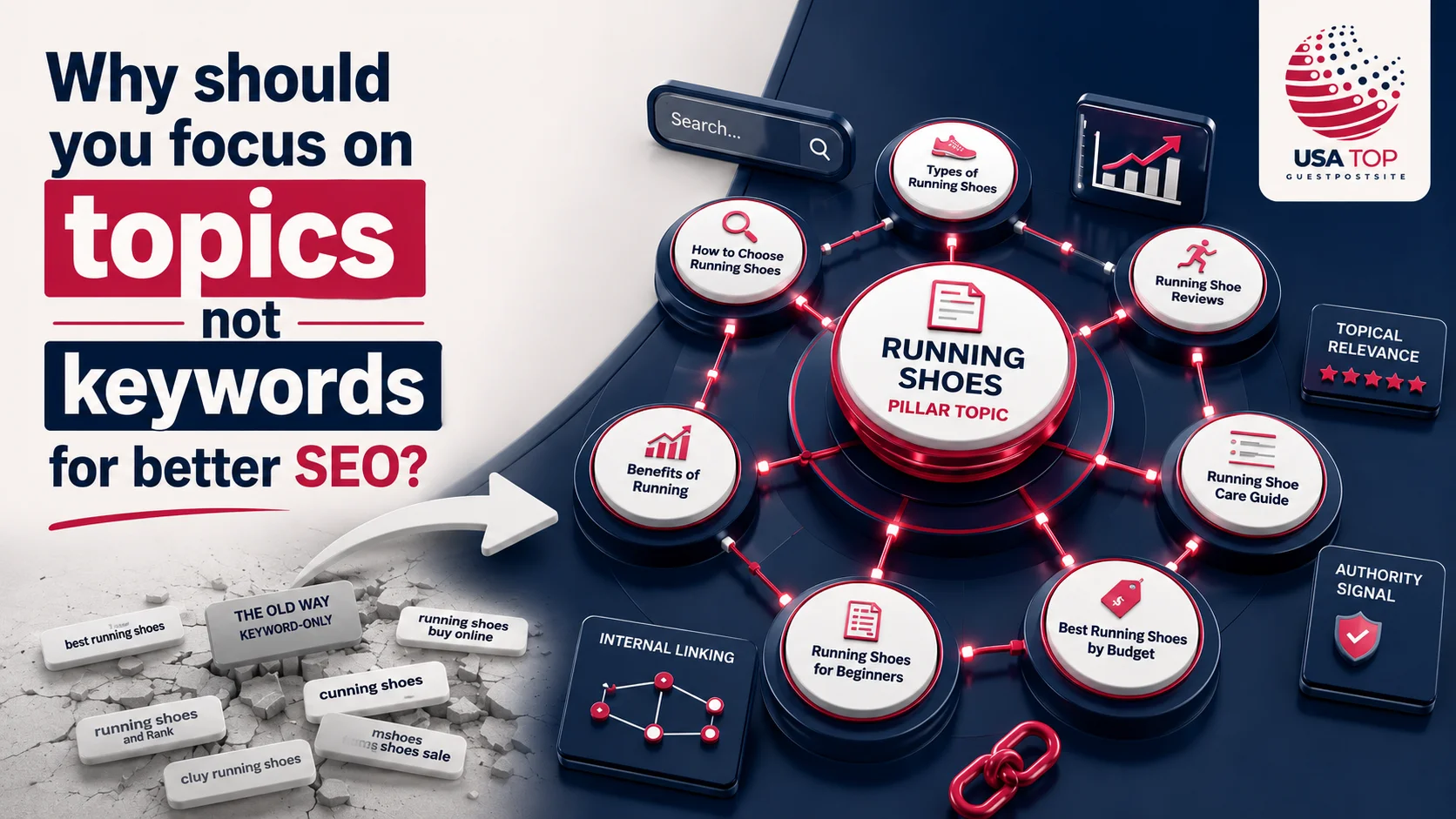
You do not win SEO by chasing one keyword anymore. You win by helping people understand a complete topic clearly. When you focus on topics not keywords, you answer real questions, match search intent, and build trust. This approach helps Google and AI systems understand your content better. At USATopGuestPostSite, we believe strong content should rank well and teach readers something useful.
Why does topic-based SEO matter today?
When you focus on topics not keywords, you stop writing only for search engines and start writing for people. Your audience wants full answers, simple explanations, examples, and useful next steps. If your blog only repeats one keyword many times, readers leave quickly because they do not get enough value. Search engines also look beyond exact-match phrases now. They try to understand meaning, context, and user intent.
This is why a topic-based SEO strategy matters for your website. It helps you cover the full subject around your main idea, not just one search term. For example, if you write about SEO content, you should also explain search intent, topic clusters, helpful content, topical authority, and semantic meaning. In this guide, we will show you why topics, not keywords, can help you build better blogs for readers, Google, and AI Overview results.
What does “Focus on Topics Not Keywords” really mean?
The phrase focus on topics not keywords means you should build content around a complete subject instead of forcing one keyword into every paragraph. You still use keywords, but you use them naturally. In our experience, this method creates smoother writing and stronger SEO results.
When you focus on topics instead of keywords, you should think about:
- What your reader wants to learn
- What questions do they ask before making a decision
- What problems do they need to solve
- What related subtopics support the main idea
- What examples make the topic easier to understand
- What internal links can guide them to more helpful pages
This approach works well because it gives both people and search engines a clear path. Your article becomes more useful, easier to scan, and more likely to answer AI-driven search results.
Topics vs Keywords: What is the real difference?
Keywords are search phrases people type into Google. Topics are the full subjects behind those searches. For example, “SEO content strategy” is a keyword, but the topic includes content planning, search intent, blog structure, topical authority, and user experience.
When we build content for a website, we never ignore keywords. We use them as signals. But we do not let them control the whole article. A strong blog should answer the larger need behind the search. That is where topical relevance in SEO becomes important.
Here is a simple comparison:
| Focus Area | Keyword-Only SEO | Topic-Based SEO |
| Main Goal | Rank for one phrase | Build subject authority |
| Content Style | Repetitive and narrow | Helpful and complete |
| Reader Value | Limited answers | Full explanation |
| SEO Strength | Short-term chance | Long-term growth |
| AI Overview Chance | Lower | Higher when answers are clear |
If you want better results, use keywords as part of the plan, but build the content around the full topic.
Why should you focus on topics instead of keywords?
You should focus on topics instead of keywords because search behavior has changed. People do not always search with the same words. One person may search “topic-based SEO,” another may search “how to build topical authority,” and another may ask, “Do keywords still matter?” All three users may need the same type of article.
A topic-first approach helps you serve all of them. It also helps your website become more trusted in your niche. For a USA-focused publishing platform like USATopGuestPostSite, this matters because readers come from different industries, locations, and experience levels. Some are business owners. Some are bloggers. Some are marketers. When you cover a topic deeply, you help each group understand the subject thoroughly.
How does topic-based SEO improve search intent?
Search intent optimization means you match your content with what the user really wants. If someone searches “focus on topics not keywords,” they likely want to understand why topic-based content works better than keyword stuffing. They may also want a clear process they can follow.
In our content work, we see one common mistake: many websites answer the keyword but not the intent. They add the phrase several times, but they do not explain the problem, solution, steps, or examples. That creates weak content.
A better approach starts with the reader’s goal. Ask what they want to know, what they already understand, and what action they should take next. Then write around that journey. This makes your blog more useful for Google, AI search tools, and real people who want direct answers.
Why is topical relevance important for SEO?
Topical relevance in SEO means your content closely matches the subject your audience searches for. Google wants to show pages that answer a topic clearly, not pages that only repeat one phrase. When your article covers related ideas, search engines can understand the depth of your content.
This is very important now because many search results include AI-generated summaries. These systems often pull clear, direct, well-structured answers from pages that explain a subject fully. If your content gives short answers, helpful sections, related terms, examples, and clean formatting, it becomes easier for search systems to understand.
For your website, this means every blog post should support a bigger content plan. A digital marketing article can link to your Digital Marketing category. A blogging guide can connect with your Blogging category. This structure helps users move through your website and helps search engines see your authority.
How can topical authority SEO help your website grow?
Topical authority SEO helps your website become known for covering a subject well. You build it when you publish useful content around connected ideas. For example, one article about topic-based SEO can connect with articles about keyword research, content clusters, semantic SEO, AI Overview ranking, and blog optimization.
You do not need to publish random blogs to grow. You need a clear content map. In our expert opinion, a small website with well-organized topic clusters can often perform better than a larger site with scattered content. Readers trust websites that guide them clearly.
If your audience sees that you answer their questions again and again, they return. Google also sees stronger content patterns. Over time, this can improve ranking potential, brand trust, and organic visibility across more search terms.
How to build a topic-based SEO strategy
Step 1: Choose one main topic. Start with a subject your audience cares about. For this article, the main topic focuses on topics not keywords. Your topic should connect with your website niche and business goals.
Step 2: Find related subtopics. Add supporting ideas like semantic SEO strategy, search intent, topical relevance, topic clusters, helpful content, and internal linking. These subtopics help you cover the full subject.
Step 3: Answer real questions. Use questions from Google, AI tools, and your customer conversations. Write direct answers first, then explain with examples.
Step 4: Organize your content. Use H2 and H3 headings, tables, bullet points, and short paragraphs. This makes your blog easier to read.
Step 5: Link to helpful pages. Connect your blog to relevant categories like digital marketing, blogging, artificial intelligence, or business and entrepreneurship when it fits naturally.

What role does a semantic SEO strategy play?
A semantic SEO strategy helps search engines understand the meaning behind your content. It connects words, phrases, ideas, and user intent. You do not just use one keyword. You use related terms that explain the full subject.
For example, this article uses phrases like topics not keywords, topic clusters, topical authority, search intent, and helpful content. These terms support the main idea. They show that the article covers the subject from different angles. This helps readers learn more and helps search engines understand the content better.
In our experience, semantic SEO also improves writing quality. You stop repeating the same phrase in every sentence. Your content sounds more natural, more human, and more useful. That is exactly what readers and AI search systems prefer.
Keyword-only content vs topic-focused content
Many websites still create keyword-only content. They pick one phrase, repeat it too often, and hope Google ranks the page. That method may have worked years ago, but it now creates thin, boring, and low-value content. Readers notice it quickly.
A topic-focused article gives more value. It explains the main idea, answers related questions, shares examples, and guides the reader toward the next step. That is why we recommend a topic based SEO strategy for long-term growth.
| Content Type | Problem | Better Solution |
| Keyword-stuffed blog | Sounds forced | Use natural language |
| Narrow article | Misses user questions | Cover related subtopics |
| No structure | Hard to scan | Add headings and tables |
| No examples | Feels generic | Share real use cases |
| No internal links | Weak site flow | Link to useful categories |
If you want content that performs better, build each post like a helpful guide. Do not chase one phrase. Build trust around the whole topic.
What are the main benefits of focusing on topics?
When you focus on topics not keywords, your content becomes more useful for both readers and search engines. You give people a better learning experience, and you create stronger signals for SEO.
Main benefits include:
- Better coverage of user questions
- Stronger topical relevance in SEO
- More natural keyword usage
- Higher trust from readers
- Better internal linking opportunities
- Stronger chance to appear in AI-driven results
- More long-term organic traffic

The best part is simple: topic-based content feels more human. It helps you write like an expert instead of a machine. When your audience learns something useful, they spend more time on your site and trust your brand more.
Final thoughts
If you want better SEO, you should focus on topics not keywords. Keywords still matter, but they should guide your content, not control it. A helpful blog explains the full subject, answers user questions, and gives readers clear value.
At USATopGuestPostSite, we believe strong content should educate, build trust, and support long-term search growth. Start with one main topic, add related subtopics, match search intent, and write in a way your audience can understand. That is how you build content for Google, AI Overview, and real people.
Grow your content with USATopGuestPostSite
At USATopGuestPostSite, we help businesses, bloggers, marketers, and content creators publish useful, SEO-friendly content for audiences across the USA. Our platform covers digital marketing, blogging, artificial intelligence, business, making money online, lifestyle, real estate, health, travel, and more.
If you want to grow your online presence with helpful content and stronger visibility, we are here to support you. Visit our homepage or contact us at info@usatopguestpostsite.org to start building better content for your audience.
FAQs
What does focus on topics not keywords mean?
Focus on topics, not keywords, which means you build content around a complete subject instead of only repeating one search phrase. You still use keywords, but you use them naturally inside helpful, topic-rich content.
Why should you focus on topics instead of keywords?
You should focus on topics instead of keywords because readers want complete answers, not repeated phrases. This approach helps you match search intent, improve content quality, and build stronger SEO value.
How does topic-based SEO help rankings?
A topic-based SEO strategy helps rankings by covering related questions, subtopics, and user needs. It gives search engines more context and gives readers a better experience.
When should you use keywords in a topic-based article?
You should use keywords in the title, introduction, headings, meta description, and body content when they fit naturally. Do not force them because forced wording hurts readability and trust.
What is the cost of topic-based SEO?
The cost depends on content depth, keyword research, topic planning, and writing quality. If you do it yourself, it takes time; if you hire experts, you pay for strategy, writing, optimization, and publishing support.
What is the best way to build topical authority?
The best way to build topical authority SEO is to publish connected articles around one main subject. Use pillar content, supporting blog posts, internal links, and clear answers to common questions.
Is it worth focusing on topics not keywords?
Yes, it is worth it because topic-focused content gives more value and supports long-term SEO growth. It also helps your website look more trustworthy to readers and search engines.
How does a semantic SEO strategy support topic-based content?
A semantic SEO strategy supports topic-based content by using related terms, ideas, and meanings. It helps search engines understand what your page covers beyond one exact keyword.
What is search intent optimization?
Search intent optimization means you write content that matches what the user wants to learn, compare, solve, or decide. It helps you create answers that feel useful instead of random.
Can topic-based content rank in AI Overview?
Yes, topic-based content can improve your chance of appearing in AI Overview when it gives clear, direct, and well-structured answers. Use simple explanations, strong headings, helpful examples, and complete topic coverage.


