
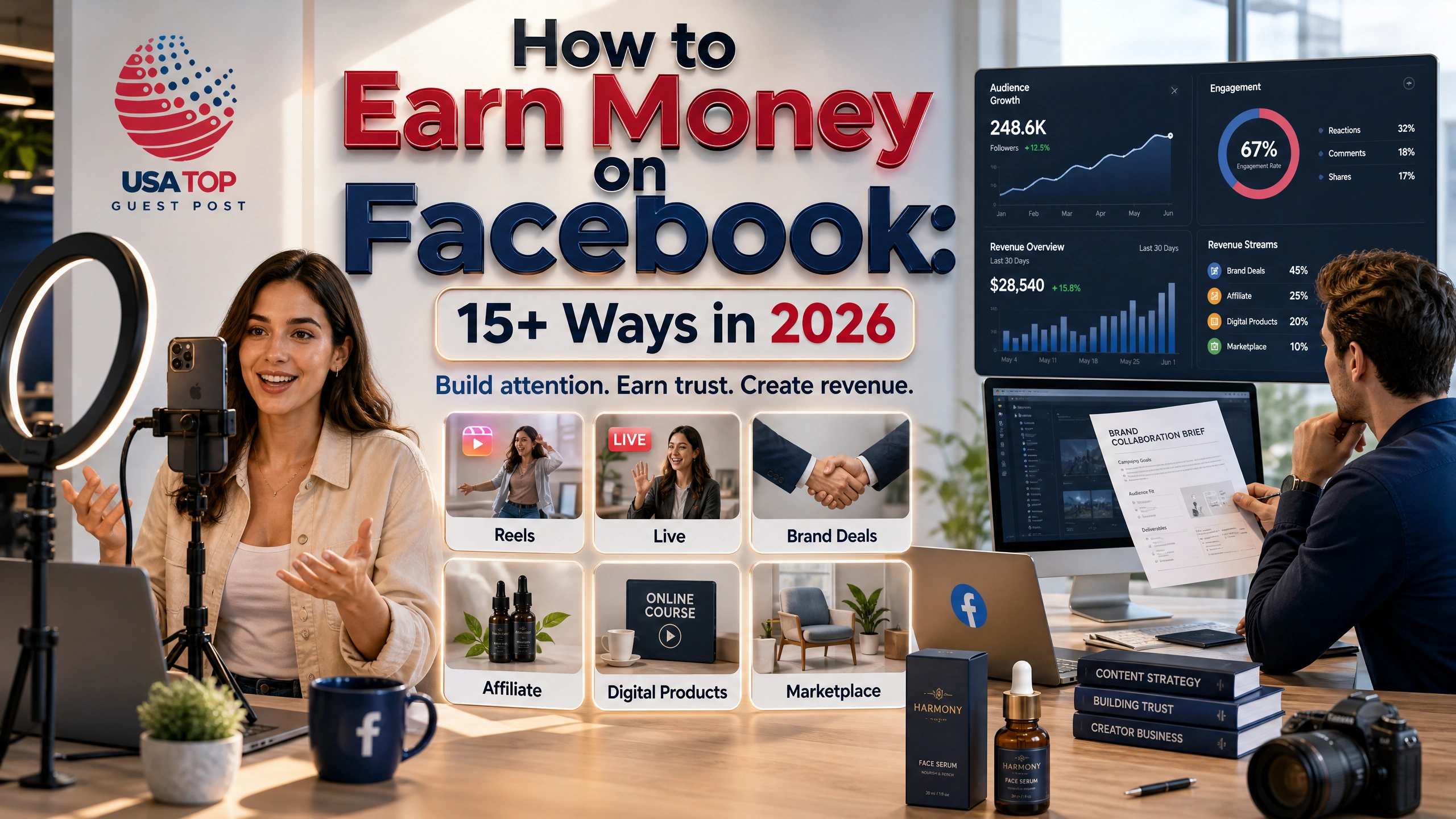
Facebook is no longer just a place to post photos, chat with friends, or share updates. For creators, bloggers, influencers, online sellers, and small businesses, it can become a traffic source, audience-building platform, sales channel, and part of a larger income strategy.
If you want to earn money on Facebook, there are two broad paths. Facebook may pay eligible creators through its monetization features, or you can use Facebook to generate income somewhere else through affiliate marketing, brand partnerships, product sales, services, lead generation, or website traffic.
The important point is that there is no single Facebook income method that works for everyone. Your results can depend on your audience, content, engagement, niche, eligibility, country, monetization method, and ability to turn attention into a valuable action.
This guide explains the major ways to make money on Facebook in 2026, what each method is best suited for, what beginners should know, and how to build a realistic monetization strategy without relying on misleading income promises.
Can You Actually Make Money on Facebook in 2026?
Yes, you can make money on Facebook, but having an account, followers, likes, or views does not automatically create income. Eligible creators may use Facebook’s native monetization features, while other users can earn through brand deals, affiliate marketing, product sales, services, lead generation, and traffic sent to websites. The right approach depends on your audience, content, eligibility, niche, and monetization model.
A useful way to think about Facebook income is:
Audience → Content → Engagement → Trust → Monetization → Revenue
For some creators, the monetization step happens directly inside Facebook. For others, Facebook is primarily the place where they attract the audience and move interested people toward a product, website, email list, service, or business.
That distinction matters because Facebook monetization and making money through Facebook are not exactly the same thing.
How Does Facebook Monetization Work?
Facebook monetization can involve several different revenue paths rather than one universal program. Native creator monetization may include eligible content-based features, Stars, subscriptions, and other programs available to qualifying accounts. Outside the platform’s native tools, creators and businesses can monetize their Facebook audience through brand partnerships, sponsored content, affiliate links, product sales, services, and website traffic.
The broader ecosystem can be divided into four groups:
| Monetization path | Examples | Best suited for |
| Native Facebook monetization | Content Monetization, Stars, subscriptions | Eligible creators |
| Audience monetization | Brand deals, sponsored content, affiliate marketing | Creators and influencers |
| Commerce | Shop, Marketplace, products, merchandise | Sellers and businesses |
| Traffic-based income | Blog traffic, email lists, affiliate sites, lead generation | Bloggers and online businesses |
This broader view is important because someone searching for ways to make money on Facebook may not actually need Facebook to send them a direct payout.
For example, a blogger could publish useful Facebook content, attract visitors to a website, and earn through display advertising, affiliate revenue, digital products, or an email funnel. A consultant could use Facebook to generate qualified leads. A product seller could use social commerce to reach potential buyers.
The platform becomes the distribution channel while the actual revenue comes from a larger business model.
What Are the Best Ways to Make Money on Facebook?
There is no single best method for every user. A video creator may benefit most from content-based monetization, while a blogger may get more value from Facebook traffic and affiliate revenue. A product owner may prefer Facebook Shop or Marketplace, and an established creator may combine subscriptions, Stars, sponsorships, and affiliate offers.
Here are 15 practical ways to build Facebook income in 2026.
Can You Make Money Through Facebook Content Monetization?
Yes, eligible creators can potentially monetize qualifying content through Facebook’s available content monetization opportunities. Access, eligibility, content requirements, account status, and available features can vary, so creators should check the monetization tools available to their specific account.
Content Monetization is important because it connects several parts of the creator journey:
Original content → Audience engagement → Performance → Eligibility → Monetization → Payout
The opportunity can be particularly relevant for creators who consistently publish videos, Reels, photos, posts, or other supported formats.
However, publishing more content does not automatically mean earning more money. Content quality, audience relevance, engagement, originality, policy compliance, and the specific monetization features available to an account all matter.
A creator should also monitor available tools through the appropriate professional or creator dashboard rather than relying on outdated articles that promise a fixed payout.
How Do Facebook Stars Help Creators Earn Money?
Facebook Stars allow eligible fans to support creators through qualifying content and interactions. They can be particularly useful for creators who have built an engaged community that actively watches, comments on, and supports their content.
Stars are different from simply having a large follower count.
A smaller creator with a loyal audience may have stronger monetization potential than a larger account with weak engagement. For this reason, building a relationship with your Facebook audience can be more valuable than chasing follower numbers alone.
Creators using Stars can focus on:
- Live sessions
- Interactive content
- Community discussions
- Educational content
- Entertainment
- Q&A sessions
- Consistent audience engagement
The goal is not to repeatedly ask for support. It is to create content that gives people a reason to return and participate.
Can Facebook Subscriptions Create Recurring Income?
Yes, subscriptions can provide a recurring revenue opportunity for eligible creators who offer enough value to encourage followers to become paying supporters.
The strength of subscriptions is predictability. Instead of relying only on individual transactions or occasional sponsorships, a creator can potentially develop a recurring relationship with subscribers.
Useful subscriber benefits may include:
- Exclusive content
- Special updates
- Community access
- Behind-the-scenes material
- Educational resources
- Subscriber-only interactions
- Early access to selected content
The exact availability and features depend on the account and current Facebook requirements.
Subscriptions work best when the creator already has a strong relationship with the audience. Simply turning on a subscription option does not create recurring revenue unless people see a clear reason to join.
How Can You Make Money Through Brand Partnerships?
Brand partnerships can be one of the most valuable ways for creators to monetize a Facebook audience without depending entirely on Facebook’s own payout systems.
A brand may pay a creator for:
- Sponsored posts
- Product demonstrations
- Video content
- Reviews
- Educational content
- Campaign participation
- Product launches
- Influencer marketing
The value of a brand deal is not determined only by follower count. Brands may also consider niche relevance, audience quality, engagement, content quality, trust, geographic reach, and the creator’s ability to produce useful branded content.
A creator interested in paid partnerships should build a simple media kit containing audience information, engagement data, content examples, niche expertise, and previous campaign results when available.
Sponsored content should also be disclosed appropriately so the audience understands when content involves a commercial relationship.
How Does Affiliate Marketing Work on Facebook?
Facebook affiliate marketing allows creators, publishers, and businesses to recommend products or services and earn a commission when qualifying referrals generate sales or other actions.
The basic model is:
Facebook audience → Useful recommendation → Affiliate link → Merchant → Conversion → Commission
Affiliate marketing works best when the recommendation is genuinely relevant to the audience.
For example, a technology creator could recommend tools used by their audience. A fitness-focused creator might discuss relevant products. A business page could share resources that solve a problem its followers already have.
Avoid turning every post into an advertisement. Useful explanations, comparisons, tutorials, demonstrations, and honest recommendations generally create more trust than repetitive promotional posts.
Affiliate disclosures may also be required depending on the relationship, platform rules, and applicable advertising regulations.
Can You Make Money From Facebook Reels?
Yes, Facebook Reels can be part of a creator’s monetization strategy, but views alone do not guarantee a fixed amount of income.
Reels are particularly useful for audience discovery because short-form video can reach people who do not already follow a creator.
A strong Reels strategy can combine:
- Original video content
- Educational clips
- Entertainment
- Tutorials
- Product demonstrations
- Storytelling
- Affiliate recommendations
- Brand partnerships
- Audience-building content
Creators should focus on original, useful content instead of simply reposting videos from other platforms.
The most useful question is not only “How many views did my Reel get?” but also:
Did the Reel attract the right audience, increase engagement, build trust, and create a monetizable next step?
Can You Make Money From Facebook Live?
Facebook Live can support several income models, particularly for creators with an engaged community.
Potential revenue paths include:
- Stars
- Subscriptions
- Sponsored streams
- Affiliate products
- Product demonstrations
- Live selling
- Service promotion
- Lead generation
Live content can be especially effective because it creates direct interaction.
For example, a creator teaching photography could host a live tutorial and recommend relevant equipment. A business owner could demonstrate a product. A consultant could answer questions and invite interested viewers to request a consultation.
The strongest Live strategy is usually built around usefulness rather than simply broadcasting for a long time.
Can You Make Money From Facebook Posts, Photos, and Videos?
Yes, posts, photos, and videos can contribute to Facebook income depending on the available monetization features, account eligibility, content format, and current policies.
Different content formats can serve different purposes.
A photo post may build engagement. A short video may attract new followers. A longer educational video may establish authority. A product-focused post may generate sales. A useful article shared on Facebook may drive traffic to a website.
That means content does not always need to produce money immediately.
Think of your Facebook content as part of a larger funnel:
Attention → Engagement → Trust → Action → Revenue
This approach is more sustainable than trying to make every individual post generate income.

Can You Make Money by Selling Products on Facebook?
Yes. Product sales are one of the clearest ways to use Facebook as a commercial platform.
Depending on the business model and available features, sellers may use:
- Facebook Shop
- Facebook Marketplace
- Product posts
- Social commerce
- Direct messages
- Website traffic
- Merchandise
- Digital products
- Ecommerce offers
Physical products can include clothing, accessories, home products, specialty items, or other merchandise.
Digital products can include templates, guides, courses, downloadable resources, or other original products.
The important distinction is that Facebook can be the place where customers discover and evaluate the product, while the final transaction may happen through Facebook or another connected sales system.
How Can Facebook Marketplace Help You Earn Money?
Facebook Marketplace can help individuals and businesses generate income by selling products directly to interested buyers.
It is particularly useful when you already have something valuable to sell, such as:
- Used products
- New merchandise
- Local products
- Handmade items
- Business inventory
- Furniture
- Equipment
- Specialty goods
Good product listings should include accurate descriptions, clear images, relevant details, realistic pricing, and transparent information about condition or availability.
Marketplace should not be confused with Facebook directly paying you for listings. It is primarily a commerce channel that can connect sellers with potential buyers.
Can You Sell Digital Products on Facebook?
Yes, Facebook can help promote and sell digital products such as ebooks, templates, online courses, checklists, memberships, design resources, and educational materials.
Digital products can be attractive because there is no physical inventory to ship.
A simple model is:
Facebook content → Audience interest → Landing page → Digital product → Sale
For example, someone who teaches budgeting could create a budgeting template. A designer could sell templates. A marketer could offer a practical guide. A teacher could create an online course.
The strongest digital products usually solve a specific problem rather than attempting to appeal to everyone.
Can Print-on-Demand Products Make Money on Facebook?
Print-on-demand can be another way to combine Facebook audience building with ecommerce.
With print-on-demand, products such as shirts, mugs, posters, or other merchandise can be produced after an order rather than requiring the seller to hold large amounts of inventory.
Facebook can support the marketing side through:
- Product-focused posts
- Reels
- Community engagement
- Niche content
- Social commerce
- Product demonstrations
- Audience targeting
Profitability depends on product demand, pricing, production costs, fulfillment, marketing costs, and conversion rate.
Do not assume that uploading hundreds of designs automatically produces passive income. Successful print-on-demand businesses still need niche research, useful marketing, strong product descriptions, and consistent testing.

Can You Make Money From a Facebook Group?
A Facebook Group can become an income-generating community when it provides a clear reason for people to participate.
Possible models include:
- Affiliate offers
- Paid communities
- Lead generation
- Digital products
- Sponsored content
- Website traffic
- Consulting
- Services
- Product sales
The key is that Facebook Groups generally create value through community and access rather than simply paying group administrators for having members.
A group about photography, for example, could support affiliate recommendations, educational products, workshops, or consulting.
The strongest groups usually focus on a specific audience and problem instead of becoming a general promotional feed.
Can You Make Money by Driving Traffic to a Blog?
Yes, and this is one of the most important alternatives to direct Facebook monetization.
Facebook can act as a traffic-generation channel for a website or blog.
The model can look like:
Facebook → Blog → Display Ads
or:
Facebook → Blog → Affiliate Offers
or:
Facebook → Blog → Email List → Product
or:
Facebook → Blog → Digital Product → Revenue
This approach can be particularly useful for publishers because the Facebook audience does not have to be monetized directly.
You can also connect this strategy to a broader content marketing funnel, where Facebook attracts attention and your website handles deeper education, lead generation, conversion, or sales.
The most important factor is relevance. A Facebook post should make a clear promise that the linked article actually fulfills.
Can You Make Money by Selling Facebook Services or Consulting?
Yes. Facebook can be used to generate leads for professional services, consulting, coaching, freelance work, social media management, design, marketing, writing, education, and other expertise-based services.
For example, someone with expertise in social media strategy could publish educational content, answer audience questions, demonstrate results, and invite interested businesses to request a consultation.
The income model becomes:
Expertise → Content → Audience → Lead → Consultation → Client
This can be more profitable than relying only on advertising or creator payouts because a single qualified client may be worth more than thousands of low-intent views.
What Are the Facebook Monetization Requirements?
Facebook monetization requirements vary by monetization product, account, country, content type, and current platform policies. There is no single requirement that applies to every way of earning money on Facebook.
| Monetization method | Main consideration | Best suited for |
| Content Monetization | Account and content eligibility | Content creators |
| Stars | Eligible account and audience participation | Interactive creators |
| Subscriptions | Eligible feature and engaged audience | Established creators |
| Brand partnerships | Relevant audience and advertiser fit | Influencers and creators |
| Affiliate marketing | Affiliate program and qualifying promotion | Product-focused creators |
| Marketplace | Product to sell and buyer demand | Sellers |
| Shop | Eligible commerce setup | Businesses and sellers |
| Services | Valuable expertise and lead generation | Professionals |
Eligibility can change over time, so avoid relying on a fixed follower number copied from an old article.
Instead, check the monetization tools and eligibility information available to your specific account before planning around a particular feature.
How Many Followers Do You Need to Make Money on Facebook?
There is no universal follower number that guarantees income on Facebook.
The number of followers you need depends on the monetization method. A creator using affiliate marketing may generate income from a relatively small but highly relevant audience. A brand partnership may depend more on niche authority and engagement. Native monetization features may have their own eligibility criteria.
Think about audience quality instead of follower count alone.
For example:
10,000 highly relevant followers with strong engagement
may be more commercially valuable than:
100,000 followers who rarely interact with the content.
The more important questions are:
- Are your followers interested in your niche?
- Do they engage with your content?
- Do they trust your recommendations?
- Can you reach them consistently?
- Can you connect attention to a relevant offer?
That is why growing the right Facebook audience is often more valuable than simply growing a larger one.
How Many Views Do You Need to Get Paid on Facebook?
There is no single view count that guarantees payment across all Facebook monetization methods.
Views can matter for content performance, but they are only one part of the equation. Monetization depends on the features available to your account, eligibility, content, audience, and the specific revenue model.
For example, a creator may use views to grow an audience and then earn through brand partnerships or affiliate marketing. Another creator may qualify for a native monetization feature where content performance contributes to earnings.
So instead of asking only:
“How many views do I need?”
also ask:
“What monetization mechanism turns those views into revenue?”
That distinction helps prevent unrealistic expectations about Facebook income per 1,000 views.
Does Facebook Pay You for Followers, Likes, or Views?
Not simply for having followers or likes.
Followers and engagement can help create the audience and performance needed for certain monetization opportunities, but they are not the same thing as a direct payment.
A more accurate model is:
Audience → Content performance → Eligibility → Monetization mechanism → Revenue
For example, a large audience may make a creator more attractive to brands. Strong engagement may help affiliate recommendations perform better. High-quality video content may support eligible content monetization.
This is why buying followers or artificially inflating engagement is a poor long-term strategy. What matters is building a real audience that actually cares about the content.
How Much Money Can You Make on Facebook?
Facebook income can range from very little to substantial business revenue, depending on the monetization model, audience quality, content performance, product economics, and conversion rate.
There is no honest universal figure that applies to every creator.
A useful revenue model is:
Audience → Views → Engagement → Clicks → Conversion → Revenue
For example, consider an illustrative affiliate scenario:
1,000 clicks × 3% conversion × $50 product × 10% commission = $150
This is only a mathematical example, not a promise of earnings.
Another business model could be service-based:
1,000 visitors × 2% lead rate = 20 leads
If 10% of those leads become customers:
20 leads × 10% = 2 customers
If each customer purchases a $250 service:
2 × $250 = $500
Again, this is an illustration rather than a guaranteed result.
The lesson is simple: revenue depends on what happens after attention is generated.
How Do You Get Paid From Facebook?
How you receive money depends on the monetization product and your account’s eligibility. Payment setup can involve payout information, payment methods, thresholds, schedules, country availability, and required account or tax information.
Because payment rules can change, creators should rely on the payout information shown for their own eligible monetization features rather than assuming that every Facebook program follows the same schedule.
Before expecting income, make sure:
- Your payout information is correctly configured.
- Your account is eligible for the relevant feature.
- Your payment details are accurate.
- Your country supports the relevant program.
- You understand any applicable tax or payment requirements.
- Your content remains compliant with monetization policies.
Your Professional Dashboard or other relevant creator tools can help you monitor available monetization features and performance.
What Is Facebook Creator Fast Track and Who Can Join?
Creator Fast Track is designed around creators who already have an established audience or creator presence and may provide a pathway into Facebook’s current monetization ecosystem for qualifying participants.
The important point is that it is not a universal shortcut for every beginner.
Potential considerations can include:
- Existing creator presence
- Cross-platform audience
- Follower or audience requirements
- Video or content requirements
- Geographic availability
- Program eligibility
- Relationship with Facebook’s broader monetization system
Because programs can change, creators should check the current eligibility information associated with their account before assuming that they qualify.
For established creators, however, it is worth monitoring because new monetization programs can create opportunities that older Facebook money-making guides do not cover.
Do You Need Facebook Professional Mode to Make Money?
Not every way of earning money on Facebook depends on Professional Mode.
Professional Mode is primarily relevant to people using a personal profile as a creator presence and wanting access to professional tools and creator-oriented features where available.
A Facebook Page may make more sense for a business, organization, brand, or commercial presence, while an individual creator may prefer a professional profile.
The right choice depends on your goals.
If your strategy is centered on personal creator content, audience building, and creator tools, Professional Mode may be useful.
If you are building a company, product brand, or formal business presence, a Facebook Page may provide a better foundation.
Should You Use a Facebook Page or Professional Profile?
Both can support audience growth and monetization, but they serve different purposes.
| Feature | Facebook Page | Professional Profile |
| Business presence | Strong | More personal |
| Personal audience | Limited | Strong |
| Creator identity | Strong | Strong |
| Brand building | Strong | Strong |
| Creator tools | Where eligible | Where eligible |
| Best fit | Businesses and brands | Individual creators |
Choose a Page when your primary identity is a business, publication, organization, or product brand.
Choose a professional profile when you are building around yourself as a creator or public-facing individual.
Actual feature availability can vary, so the decision should be based on the tools currently available to your account and the type of audience you want to build.
Are Facebook Monetization Features Available in Every Country?
No. Facebook monetization features are not necessarily available in every country or to every account.
Availability can depend on:
- Country
- Monetization program
- Account eligibility
- Payout availability
- Content type
- Policy compliance
- Program-specific requirements
This is one reason generic articles that promise a fixed Facebook payout can be misleading.
If you live outside the United States, do not assume that a monetization feature mentioned in an American creator guide is automatically available to you.
Always check the monetization options shown inside your own account.
What Facebook Content Can Be Monetized?
The type of content that can support monetization depends on the specific program and its current policies.
Generally, creators should focus on original, useful, policy-compliant content rather than copied or misleading material.
Strong content practices include:
- Creating original work
- Adding genuine value
- Avoiding copyright violations
- Following community standards
- Following monetization policies
- Clearly disclosing commercial relationships
- Avoiding misleading claims
- Avoiding deceptive engagement tactics
- Maintaining a consistent content strategy
Original content is particularly important because simply reposting other people’s videos, images, or articles does not create a sustainable creator business.
A strong Facebook creator should think beyond “How can I get more views?” and ask:
“What useful content can I consistently create that my audience wants?”
What Can Prevent You From Monetizing Facebook Content?
Several issues can affect monetization eligibility or access.
Potential problems include:
- Reused or unoriginal content
- Copyright violations
- Misleading content
- Policy violations
- Engagement manipulation
- Deceptive practices
- Community Standards violations
- Improper branded content disclosure
- Repeated low-quality content
- Other restrictions associated with a specific monetization program
This is why sustainable Facebook income starts with trust.
Trying to generate short-term engagement through misleading tactics can damage the audience relationship and may also create platform-policy problems.
A better strategy is to build original content, maintain a clear niche, follow current policies, and monitor your account’s eligibility.
How Do You Start Making Money on Facebook as a Beginner?
Beginners should not start by trying every monetization method at once. A better approach is to build the audience and revenue system step by step.
Step 1: Choose a Niche
Choose a topic where you have knowledge, interest, or a useful perspective.
Examples include:
- Personal finance
- Fitness
- Technology
- Food
- Education
- Business
- Beauty
- Parenting
- Travel
- Hobbies
A focused niche makes it easier to attract a relevant Facebook audience.
Step 2: Create a Page or Professional Profile
Choose the Facebook presence that fits your goals.
A business may prefer a Page, while an individual creator may choose a professional profile.
Step 3: Build Original Content
Create useful posts, photos, videos, Reels, or Live content.
Do not focus only on selling.
Teach, explain, demonstrate, compare, entertain, and answer questions.
Step 4: Grow a Relevant Audience
Audience growth should be based on relevance rather than vanity metrics.
Study which topics generate:
- Comments
- Shares
- Saves
- Messages
- Clicks
- Repeat viewers
Those signals can help you understand what your audience actually wants.
Step 5: Choose a Monetization Model
Choose one primary revenue model based on your situation.
For example:
- Creator → Content Monetization
- Community → Stars or subscriptions
- Influencer → Brand partnerships
- Product owner → Shop or Marketplace
- Blogger → Facebook traffic
- Specialist → Lead generation
- Affiliate creator → Affiliate marketing
Step 6: Check Eligibility
Before planning around a native Facebook feature, check whether your account qualifies.
Step 7: Publish Consistently
Consistency helps your audience understand what your page is about and gives you more opportunities to learn which content works.
Step 8: Track Performance
Monitor reach, engagement, clicks, conversions, follower growth, and revenue where relevant.
Step 9: Diversify Revenue
Once one method works, consider adding a second complementary revenue stream.
For example:
Reels → Audience → Affiliate
or:
Blog traffic → Email list → Digital product
or:
Educational content → Leads → Consulting
Diversification can make your income less dependent on one platform feature.
What Is the Best Way to Make Money on Facebook?
The best method depends on what you already have.
| Your situation | A strong starting option |
| New creator | Build niche content first |
| Small but relevant audience | Affiliate marketing or services |
| Strong community | Stars or subscriptions where eligible |
| Video creator | Reels and content monetization opportunities |
| Influencer | Brand partnerships |
| Product owner | Shop, Marketplace, or social commerce |
| Blogger | Facebook traffic + website monetization |
| Expert | Lead generation and consulting |
| Established creator elsewhere | Monitor Creator Fast Track eligibility |
This is why “the best Facebook income method” is not one-size-fits-all.
The best method is usually the one that matches your existing asset:
Audience, expertise, content, product, website, or community.
Can You Really Make $500 a Day on Facebook?
It is possible for some businesses or creators to generate $500 in a day through Facebook-related activities, but there is no reliable shortcut or universal formula that guarantees that result.
A $500 day could come from very different models.
For example:
2 consulting clients × $250 = $500
or:
10 product sales × $50 profit = $500
or:
Affiliate conversions × commission = $500
or:
A brand campaign = $500
The required audience size would be different for each model.
This is why claims such as “get 10,000 views, and Facebook will pay you $500” should be treated carefully.
Income depends on:
- Audience quality
- Content performance
- Monetization method
- Conversion rate
- Product price
- Affiliate commission
- Brand value
- Traffic quality
- Consistency
The goal should be to build a repeatable revenue system rather than chase a single $500 day.
What Is the Difference Between Facebook Monetization and Making Money Through Facebook?
Facebook monetization means Facebook itself provides a monetization feature through which eligible creators can potentially earn.
Making money through Facebook is broader.
| Model | Who provides the revenue? |
| Content Monetization | Facebook/Meta program |
| Stars | Facebook/Meta ecosystem |
| Subscriptions | Facebook/Meta ecosystem |
| Brand deal | Brand |
| Affiliate marketing | Merchant/affiliate program |
| Product sale | Customer |
| Consulting | Client |
| Blog traffic | Website monetization model |
| Lead generation | Business/customer |
For example:
Facebook → Creator Monetization
means Facebook is part of the direct payment mechanism.
But:
Facebook → Website → Affiliate Sale
means Facebook generates attention while the affiliate program generates the revenue.
Similarly:
Facebook → Lead → Consulting Client
means Facebook acts as a marketing channel rather than the direct payer.
Understanding this distinction makes it much easier to choose the right monetization strategy.
Frequently Asked Questions About Making Money on Facebook
Can I make money on Facebook without followers?
Yes, you can potentially earn without a large established following, particularly through methods such as selling products, generating leads, affiliate marketing, or building traffic. However, native creator monetization features may have their own eligibility requirements. A relevant audience is generally more valuable than simply having a large follower number.
How do I earn money from a Facebook Page?
A Facebook Page can support content monetization where eligible, brand partnerships, affiliate marketing, product sales, lead generation, website traffic, and services. The best approach depends on whether your Page represents a creator, business, publisher, seller, or service provider.
How do I earn money from Facebook Reels?
Reels can support Facebook income through eligible content monetization opportunities, brand partnerships, affiliate marketing, product promotion, and audience growth. Views alone do not guarantee payment, so focus on original content, relevant viewers, engagement, and a clear monetization path.
How do I earn money from Facebook posts?
Posts can contribute to income through eligible content monetization, affiliate recommendations, sponsored content, product promotion, lead generation, and website traffic. A post does not necessarily need to produce direct revenue if it moves people toward a profitable next step.
How much does Facebook pay per 1,000 views?
There is no single universal amount that Facebook pays for 1,000 views across all content and monetization methods. Earnings can vary according to the monetization program, content, audience, eligibility, and other factors. Do not use a fixed “per 1,000 views” figure as a guaranteed income estimate.
Can I make money on Facebook by uploading videos?
Yes, videos can support several monetization models, including eligible content monetization, brand partnerships, affiliate marketing, product promotion, and lead generation. Original, useful video content is generally a stronger foundation than simply uploading large quantities of low-value videos.
Can I make money on Facebook by uploading photos?
Photos can help build engagement and audience trust and may contribute to available monetization opportunities depending on the account and program. Photos can also promote products, affiliate offers, services, websites, or other revenue-generating assets.
Can I make money by chatting on Facebook?
Not simply by chatting with people. Be cautious of websites or programs promising easy money for ordinary Facebook chatting. Legitimate income is more likely to come from a service, community, sales process, customer support role, consulting offer, or another clearly defined business activity.
Can I make money by watching Facebook videos?
Simply watching Facebook videos should not be treated as a dependable Facebook income strategy. Be especially careful with offers that promise guaranteed earnings for watching videos, clicking ads, or completing simple tasks.
Can I make money from Facebook Marketplace?
Yes. Marketplace can help sellers generate income by listing products and connecting with potential buyers. It is a commerce channel rather than a program where Facebook simply pays users for creating listings.
How can I earn money on Facebook?
You can earn money on Facebook through content monetization, affiliate marketing, brand partnerships, selling products, Facebook Marketplace, services, and driving traffic to a website.
How many followers do I need to earn money on Facebook?
There is no fixed number of followers required to earn money on Facebook. Requirements vary depending on the monetization method, while some methods can work with a small but highly engaged audience.
Can Facebook help bloggers make money?
Yes. Bloggers can use Facebook to distribute content, build an audience, drive traffic to a website, grow an email list, promote affiliate offers, sell digital products, or support display advertising. The Facebook-to-website model is especially useful when the website contains deeper content and monetization opportunities.
Is Facebook passive income?
Facebook itself should not automatically be considered passive income. Most successful income models require content creation, audience management, marketing, customer support, product development, or ongoing optimization. Some systems can become more automated over time, but they usually require significant work before becoming relatively low-maintenance.
How Can You Turn Facebook Traffic Into a Larger Income Strategy?
Facebook becomes more powerful when it is connected to assets you control.
For example:
Facebook → Website → Email List → Product
can create a longer-term relationship than a single social media interaction.
Likewise:
Facebook → Blog → Affiliate Offer
can turn informational traffic into affiliate revenue.
And:
Facebook → Educational Content → Lead → Service
can turn audience attention into higher-value clients.
This is where a broader online marketing strategy for your business becomes useful. Facebook should not always be treated as the final destination. It can be one part of a larger content, traffic, conversion, and revenue system.
How Should You Manage Money Earned Through Facebook?
Generating income is only one part of building a sustainable online business. You also need to manage the money you receive.
Track:
- Revenue
- Platform or payment fees
- Advertising costs
- Product costs
- Affiliate income
- Business expenses
- Taxes where applicable
- Profit
For example, if a product generates $1,000 in sales but costs $600 to produce, fulfill, and promote, the business did not make $1,000 in profit.
Separating revenue from actual profit helps you make better decisions.
If your Facebook activities begin producing meaningful income, basic budgeting becomes even more important. A clear budgeting system for beginners can help you separate business expenses, savings, and personal spending rather than treating every payment as disposable income.
What Should You Do After You Start Making Money on Facebook?
Once you generate your first consistent income, do not immediately scale everything.
First, identify what is working.
Ask:
- Which content attracts the right audience?
- Which topics create the most engagement?
- Which traffic source generates conversions?
- Which monetization method produces the strongest return?
- Which audience segment is most valuable?
- What does it cost to acquire a customer?
- Can the process be repeated?
Then improve the strongest part of the system.
For example, if Facebook sends strong traffic to your blog but the website converts poorly, improve the website.
If affiliate clicks are strong but sales are weak, improve product selection and audience fit.
If your audience engages heavily with educational content, consider a digital product, course, consulting offer, or paid community.
The goal is not simply to get more Facebook views. It is to build a system where attention creates measurable business value.
What Are the Biggest Mistakes People Make When Trying to Earn Money on Facebook?
The most common mistakes are usually strategic rather than technical.
Chasing Followers Instead of Relevance
A large audience is not automatically a profitable audience.
Expecting Facebook to Pay for Every View
Views can support monetization, but they do not automatically equal income.
Using Reused or Low-Value Content
Copying other creators may weaken trust and create policy risks.
Trying Too Many Monetization Methods
Starting with 10 different revenue models can make it difficult to understand what actually works.
Ignoring the Audience’s Intent
Content should solve a problem or satisfy a genuine interest.
Promoting Too Aggressively
If every post asks people to buy something, engagement and trust can suffer.
Believing Guaranteed Income Claims
No legitimate strategy can guarantee a fixed Facebook income for every person.
Ignoring the Business Behind the Traffic
Facebook attention becomes much more valuable when you know what happens after someone clicks, watches, or engages.
How Can You Build a More Sustainable Facebook Income Strategy?
A sustainable approach usually combines three layers:
Layer 1: Audience
Build a focused Facebook audience around a clear niche.
Layer 2: Content
Create original, useful content that answers questions and builds trust.
Layer 3: Monetization
Connect that attention to the most appropriate revenue model.
You can then diversify:
Content → Native Monetization
Content → Affiliate
Content → Brand Deals
Content → Product
Content → Website
Content → Lead Generation
This makes your business less dependent on one feature or one source of income.
If your broader goal is financial stability rather than just short-term online earnings, building multiple income streams can be part of a larger financial independence strategy.
What Is the Smartest Way to Earn Money on Facebook?
The smartest way to earn money on Facebook is not to chase one viral post or memorize a fixed follower requirement. It is to build a relevant audience, create original content, choose a monetization model that fits your strengths, and continuously measure what turns attention into revenue.
Creators can explore native Facebook monetization, Stars, subscriptions, Reels, Live content, brand partnerships, and other eligible opportunities. Businesses and entrepreneurs can also use Facebook for affiliate marketing, product sales, Marketplace, digital products, services, lead generation, and website traffic.
Start with one clear niche. Build useful content. Grow the right audience. Check your eligibility. Choose one primary revenue model. Track your results. Then diversify once you have something that works.
The strongest Facebook income strategy is rarely the one with the most tactics. It is the one where content, audience, trust, traffic, and monetization work together as one system.
If you are also building income through content and online marketing, you can continue developing the strategy through our guides on marketing funnels and beginner investing, and long-term wealth building.


