
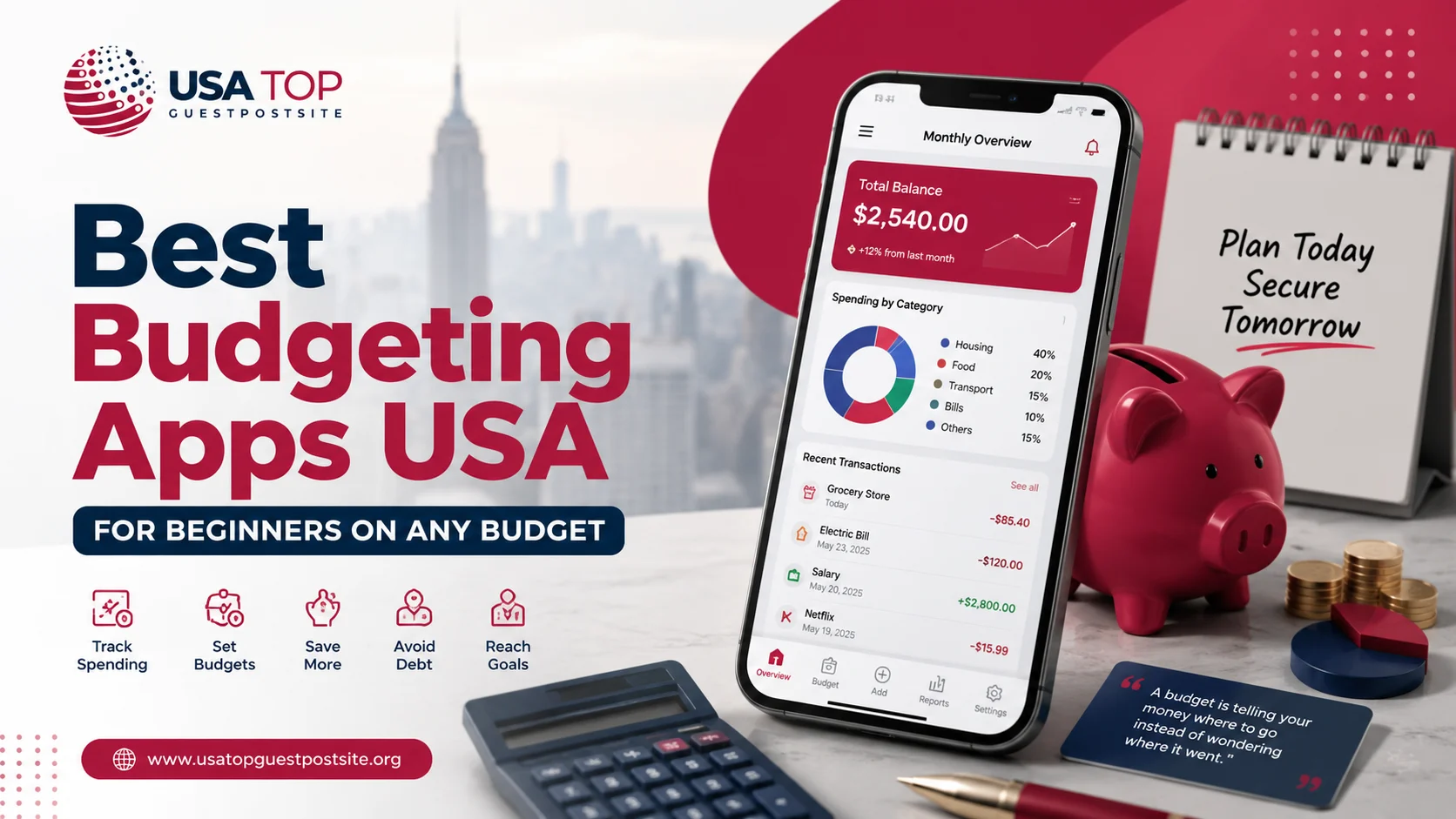
The right budgeting app should make your spending easier to understand and control. This guide compares the Best Budgeting Apps USA readers can use on different budgets. You will learn which features suit individuals, couples, families, and freelancers. We also cover account security, app costs, setup steps, and common mistakes. Our goal is to help you choose one practical tool and build a routine that lasts.
Why do beginners need a budgeting app?
A budget gives your income a clear job before everyday costs take control. Yet beginners often struggle with scattered bank accounts, rising subscriptions, irregular bills, and purchases that feel small until the month ends. In New York City, rent, commuting, food, and convenience spending can make that problem sharper. A useful app brings those numbers together and shows where your money goes.
This guide reviews the Best Budgeting Apps USA beginners can use without needing advanced financial knowledge. We compare budgeting apps by ease, cost, account connection, planning style, and practical value. Our purpose is not to name one universal winner. We want to help you choose a tool that matches your income, habits, privacy comfort, and goals, then use it consistently.
What makes a budgeting app beginner-friendly?
The best budget app should reduce confusion, not give you another system to manage. Beginners need a clean dashboard, clear spending categories, simple goals, and useful alerts. You should understand your available money quickly, even when your income changes or several bills arrive together.
- Fast setup: Add income, bills, debts, and savings goals without a steep learning curve.
- Clear categories: Separate needs, flexible spending, savings, and debt payments.
- Useful automation: Bank syncing and transaction rules save time while letting you correct mistakes.
- Flexible planning: Use zero-based, envelope, category, or simplified spending methods.
- Visible progress: Reports show whether your habits improve from week to week.
- Reasonable cost: Free features or a trial let you test the system before paying.

Our expert view is simple: choose the easiest tool you will review weekly. A feature-rich platform adds little value when its layout makes you avoid your budget.
The best budgeting apps USA beginners should compare
No single app fits every household. Rocket Money suits people who want automated spending and subscription visibility, while Pocket Guard emphasizes a safe-to-spend view. YNAB helps hands-on planners assign money intentionally.
Monarch Money offers flexible and category budgeting, and Good budget turns the envelope method into a digital system. Every Dollar follows a monthly zero-based approach. Quicken Simplify projects bills and spending, while Empower combines cash-flow tracking with a wealth dashboard. Use this comparison as a starting point, then confirm features and pricing with each provider.
| App | Best for | Budget option | Beginner note |
|---|---|---|---|
| Rocket Money | Subscriptions | Free and premium | Strong automation |
| PocketGuard | Spending limits | Trial and paid | Simple snapshot |
| YNAB | Active planning | Trial and paid | More learning |
| Monarch Money | Households | Paid | Flexible views |
| Goodbudget | Envelopes | Free and paid | Manual control |
| EveryDollar | Zero-based plans | Free and premium | Clear monthly flow |
| Simplifi | Forward planning | Paid | Useful projections |
| Empower | Wealth overview | Free tools | Less budget depth |
Your choice depends on behavior. If you dislike manual entry, prioritize syncing. If automation makes you disengage, choose an app that keeps you involved.
Best budgeting apps for different beginner needs
The right choice becomes clearer when you begin with your biggest money problem. Some American budgeting apps focus on spending awareness, while others ask you to plan every dollar. Match the tool to the habit you want to build.
- Subscription control — Rocket Money: It identifies recurring charges and supports category budgets, helping when monthly fees surprise you.
- Simple spending limits — PocketGuard: Its safe-to-spend approach can reduce the need to check several accounts before a purchase.
- Intentional planning — YNAB: Its method suits users who want to assign available money to priorities and adjust as life changes.
- Couples — Monarch Money: Shared views, goals, and flexible budgeting can support household conversations.
- Envelope budgeting — Goodbudget: Digital envelopes work well when you prefer firm category limits.
- Wider financial view — Empower: The dashboard combines spending, cash flow, balances, and investments.
Start with one problem and one app. Testing several platforms at once creates duplicate categories and confusion. Give your chosen system a full month before deciding whether it fits.
Free budgeting apps versus paid plans
Free budgeting apps can work well when you only need basic categories, manual tracking, or a simple spending overview. Rocket Money, Goodbudget, EveryDollar, and Empower provide free tools or plans, although each limits features differently. A best free budgeting app candidate should still let you understand cash flow without pushing you toward upgrades at every step.
Paid plans may justify their cost when they save time, support multiple users, improve bank connections, or offer deeper forecasts. For example, a busy freelancer with irregular deposits may value automatic imports more than a student with three predictable expenses. Before subscribing, use the trial, build a real monthly plan, and check whether the paid feature solves a problem you actually have.
Why app choice matters across New York and the USA?
Your budget must reflect the life you actually live. A New York renter may juggle high housing costs, transit, food delivery, and variable freelance income. A suburban family may focus on cars, childcare, utilities, and home repairs. The strongest personal finance apps USA users choose should let them rename categories, plan irregular expenses, and adjust targets without rebuilding everything.
Convenience also shapes results. Contactless payments, subscriptions, buy-now-pay-later plans, and multiple accounts can hide how quickly spending grows. Good expense tracking apps USA users rely on bring transactions into one view, but the app cannot make decisions for you. Review its numbers weekly, question unusual categories, and update your plan when income or priorities change. That routine matters more than a flashy dashboard.
How to check security and privacy before connecting accounts?
Budgeting software may handle sensitive transaction and account data, so convenience should never replace caution. The CFPB advises consumers to understand what data an app accesses, how it uses that information, and how to stop sharing it. Review these points before connecting a bank or card.
- Read the privacy policy and find clear explanations of collection, sharing, and deletion.
- Use a unique password and enable multifactor authentication whenever available.
- Confirm whether the app uses a secure connection provider instead of storing bank credentials directly.
- Check which accounts and data types you authorize, then limit access to what you need.
- Learn how to disconnect accounts and request data deletion before closing your profile.
- Review transactions regularly to spot incorrect imports or unfamiliar charges.
No app removes your responsibility to monitor accounts. Choose a provider you understand, protect your phone, and disconnect tools you no longer use.
How to choose and start the best budgeting app?
Step 1: Define your main goal. Decide whether you need to control daily spending, organize bills, pay debt, build savings, or coordinate household money. One clear goal prevents feature overload.
Step 2: List required features. Choose essentials such as bank syncing, manual entry, shared access, bill alerts, savings goals, or investment tracking. Separate needs from features that merely look impressive.
Step 3: Set your price limit. Compare free tools, trials, monthly and annual plans. A paid app should save enough time or money to justify its cost.
Step 4: Test real transactions. Add income, housing, transportation, groceries, debt payments, and subscriptions. Check whether the categories match your daily life.
Step 5: Review the first week. Correct duplicates, rename unclear categories, and set realistic limits. Do not judge the app before cleaning the imported data.
Step 6: Commit for one month. Review spending weekly and complete a month-end check. Keep the app when it improves decisions, not simply because you finished setting it up.

Common beginner mistakes that make budgeting apps fail
An app may organize transactions well and still fail to change your habits. Beginners often treat the first budget as a fixed promise, then quit when groceries, travel, or medical costs exceed the estimate. A useful plan should bend without hiding overspending. Move money between categories, record the reason, and improve next month’s estimate.
Another mistake is collecting data without acting on it. A colorful chart has little value when you never change a purchase, cancel a service, or increase savings. Keep the process small: review one week, fix one category, and choose one action. Progress comes from repeated decisions, not a perfect dashboard. Watch for these common problems:
- Setting unrealistic limits based on an ideal month rather than recent spending.
- Connecting every account before learning the app’s core workflow.
- Ignoring cash purchases, reimbursements, refunds, and shared expenses.
- Using too many categories, which makes every review feel like bookkeeping.
- Leaving incorrect automated labels unchanged.
- Paying for extras before using basic features consistently.
Feature checklist for beginners on any budget
Do not choose from a logo or popularity alone. Compare needed functions against effort and cost. This table turns common beginner problems into selection criteria.
| Your problem | Feature to seek | Why it helps | Good starting options |
| Spending disappears | Automatic categories | Shows patterns quickly | Rocket Money, PocketGuard |
| Bills surprise you | Recurring-payment view | Exposes timing and subscriptions | Rocket Money, Simplifi |
| You overspend categories | Envelope or zero-based plan | Sets limits before purchases | Goodbudget, YNAB, EveryDollar |
| Income changes monthly | Flexible targets and rollovers | Adapts without rebuilding | Monarch Money, YNAB |
| You budget with a partner | Shared household access | Keeps one source of truth | Monarch Money, YNAB |
| You want a wider picture | Cash flow and net worth | Connects spending with long-term goals | Empower, Monarch Money |
| You avoid complex tools | Safe-to-spend summary | Reduces daily calculations | PocketGuard |
Our recommendation is to score each option from one to five for ease, needed features, privacy comfort, and price. Choose the highest score, not the app with the longest feature list. Recheck your choice after thirty days because real use reveals hidden friction.
Build a weekly money routine that you can maintain
The app becomes useful when you turn its information into a short routine. Pick the same day each week and spend fifteen minutes checking what changed. You do not need to study every chart or rebuild your plan.
- Confirm that income and major payments imported correctly.
- Fix duplicate transactions and unclear merchant categories.
- Compare flexible spending with the amount left for the week.
- Move money between categories when priorities change.
- Review upcoming bills, subscriptions, and irregular expenses.
- Add a small amount to one savings or debt goal.
- Choose one action, such as cooking twice or canceling an unused service.
Consider a New York freelancer whose income arrives on different dates. A Friday review can separate tax money, fund next week’s essentials, and limit optional spending until another payment clears. Keep notes brief and focus on decisions. A consistent review builds awareness without turning personal finance into a second job.
Final thoughts
The Best Budgeting Apps USA beginners choose should make money decisions clearer, faster, and easier to repeat. Start with your main problem, compare only the features that solve it, and test the app with real income and expenses. Free tools may cover everything you need, while paid plans can add automation, collaboration, forecasts, or deeper reporting.
Your next step is simple: choose one platform, build a realistic monthly plan, and schedule a weekly review. Correct categories, adjust limits, and act on what the numbers show. No application can replace judgment, but the right system can help you notice problems earlier and direct more money toward savings, debt reduction, family priorities, or future goals. Review your choice after one full month and keep it only when it supports better habits.
FAQs
What is the best budgeting app for beginners in the USA?
The best choice depends on how you prefer to manage money. PocketGuard suits beginners who want a simple spending snapshot, while YNAB fits people who want a more active planning method.
Why should you use a budgeting app?
A budgeting app puts income, expenses, bills, and goals in one organized place. It can help you identify spending patterns, prepare for upcoming costs, and make decisions before your balance becomes a problem.
How do budgeting apps work?
Many apps connect to financial accounts and import transactions, while others let you enter spending manually. You then organize purchases into categories, set limits or goals, and review your progress.
When should you review your budget?
Review your budget once a week and complete a deeper check at the end of each month. Weekly reviews help you correct categories and adjust spending before small problems grow.
What do budgeting apps cost?
Some apps offer free plans, while others use trials or paid subscriptions. Rocket Money has free and premium options, Goodbudget offers a free plan, and YNAB provides a trial before its paid subscription.
What is the best free budgeting app?
The answer depends on your goal. Rocket Money may suit subscription tracking, Goodbudget supports envelope planning, EveryDollar offers free monthly budgeting, and Empower provides free tools for cash flow and a broader financial view.
Is it safe to connect a budgeting app to your bank?
It can be safe when you choose a reputable provider and use strong security practices, but no connection is risk-free. Review the data permissions, privacy policy, deletion process, and multifactor authentication before sharing financial information.
Is a paid budgeting app worth it?
A paid plan may be worthwhile when automation, shared access, projections, or stronger reporting saves you time and supports better decisions. Test the real workflow before subscribing instead of paying for features you may never use.
Which budgeting app is best for couples?
Monarch Money supports shared budgeting and financial collaboration, while YNAB allows subscription sharing and shared plans. Compare both based on your preferred budgeting method and how much detail each partner wants.
How long should you test a budgeting app?
Use the app for one complete monthly cycle whenever possible. That period lets you experience income deposits, recurring bills, variable spending, and the month-end review before deciding whether to keep it.


