
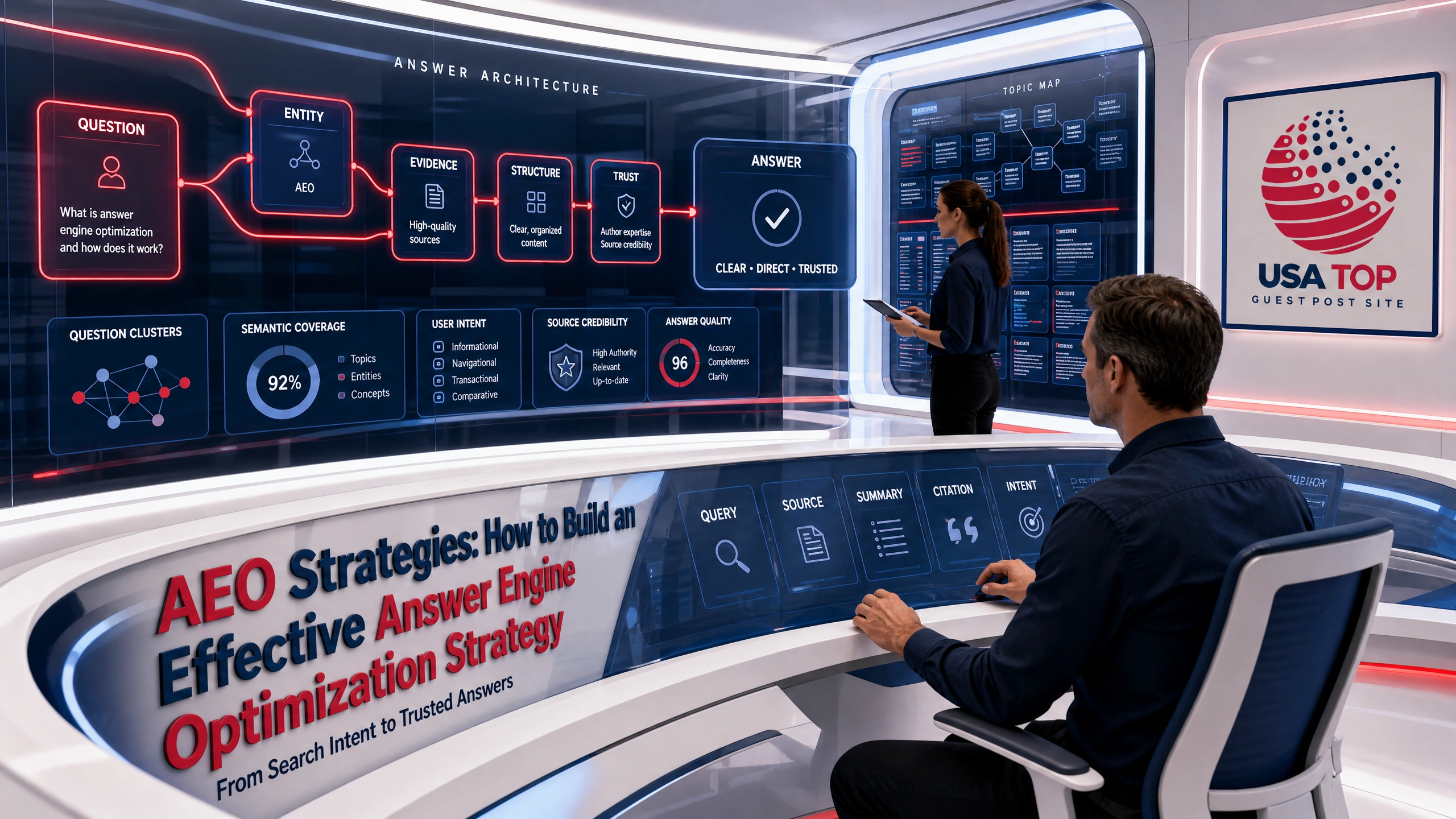
AEO strategies help make useful information easier for answer engines, search engines, and AI-powered search experiences to understand, retrieve, and present to users. Unlike a keyword-only approach, effective Answer Engine Optimization combines search intent, question research, answer-first content, semantic context, structured information, topical authority, technical SEO, trust signals, citations, and continuous measurement.
A modern AEO strategy should not replace SEO. Instead, it extends traditional search engine optimization into an environment where users increasingly ask conversational questions and expect direct answers.
A practical framework is:
Intent → Questions → Answerable Content → Structure → Context → Authority → Citations → Measurement
This approach can support visibility across traditional search results, featured snippets, People Also Ask, voice search, AI Overviews, AI Mode, and other AI-generated answers. However, no AEO technique guarantees a particular ranking, citation, or inclusion in an AI search result.
What Are AEO Strategies and How Do They Work?
AEO strategies are methods for organizing, optimizing, and strengthening content so answer-oriented search experiences can more easily understand the question being asked and identify useful information that answers it.
Traditional SEO often begins with keywords and rankings. AEO adds another layer: What question is the user actually asking, what answer do they need, and how clearly can the content provide it?
For example, a traditional keyword might be:
AEO strategies
A conversational searcher might instead ask:
How do I optimize my website for answer engines?
A strong AEO content strategy should address both because they represent the same broader topic from different search perspectives.
Effective Answer Engine Optimization strategies typically combine:
- Search intent analysis
- Question-based keyword research
- Long-tail keywords
- Conversational queries
- Natural language
- Answer-first content
- Clear content hierarchy
- Semantic relationships
- Entity optimization
- Topical authority
- Technical SEO
- Structured data
- Internal linking
- Trust and citations
- Performance measurement
- Content freshness
The objective is not to manipulate an answer engine. It is to make genuinely useful information easier to understand and retrieve.
Why Are AEO Strategies Important for Search in 2026?
AEO strategies matter because search is becoming increasingly conversational and answer-oriented. Users can now encounter direct responses, AI-generated summaries, featured snippets, People Also Ask results, voice answers, and AI-powered search experiences instead of relying only on traditional blue-link results.
This creates a broader definition of search visibility.
A successful page may need to be:
Discoverable → Understandable → Extractable → Trustworthy → Citable
That means ranking for one keyword is no longer the only useful measurement.
A modern search strategy should consider:
- Organic rankings
- Search visibility
- Featured snippet ownership
- AI Overview visibility
- AI citations
- Brand mentions
- AI search impressions
- AI referral traffic
- Conversions
- Search Console performance
The important distinction is that AEO does not mean abandoning traditional SEO. SEO remains the foundation, while AEO improves the way information is structured for answer-focused experiences.
How Is AEO Different From Traditional SEO?
AEO and SEO are complementary rather than competing strategies.
| Traditional SEO | AEO |
| Focuses on search rankings | Focuses on answer visibility |
| Often starts with keywords | Starts with questions and intent |
| Optimizes for search results | Optimizes for answer retrieval and understanding |
| Measures organic traffic | Also considers answers, citations, and mentions |
| Uses backlinks as authority signals | Uses authority, corroboration, and citations |
| Targets keyword-centric queries | Targets conversational and question-based queries |
| Optimizes pages for search engines | Makes information easier for answer engines to understand |
The best approach is:
SEO foundation → AEO extension
AEO therefore should not become a separate keyword campaign. It should strengthen the information architecture and answer quality of an existing SEO strategy.
For publishers working on broader search visibility, semantic SEO provides an important foundation because search systems increasingly need to understand relationships between topics, entities, intent, and supporting concepts.
How Does Answer Engine Optimization Actually Work?
Answer Engine Optimization works by improving the relationship between a user’s question and the information available on a page.
A useful model is:
Question → Direct Answer → Context → Evidence → Detail → Practical Takeaway
The direct answer should appear early enough that the reader does not have to search through a long introduction.
The supporting explanation can then provide nuance, examples, definitions, limitations, and related information.
For example:
Question: What are AEO strategies?
Direct answer: AEO strategies are methods for creating and structuring content so answer engines can better understand questions, identify relevant information, and surface useful answers.
The rest of the section can then explain search intent, question research, content structure, authority, citations, and measurement.
This is more useful than repeating the phrase “AEO strategies” throughout a paragraph.
What Types of Search Results Can AEO Influence?
AEO can be relevant to several answer-oriented search experiences, although visibility is never guaranteed.
AI Overviews
Google AI Overviews can provide synthesized answers alongside links to supporting sources. Content that clearly addresses a query and provides useful, trustworthy information may be easier for search systems to understand.
AI Mode
AI Mode supports more conversational and exploratory interactions. Users can ask follow-up questions, refine their intent, and explore a topic across multiple steps.
This makes comprehensive topical coverage increasingly useful.
Featured Snippets
Featured snippets provide concise answers extracted from web pages.
Clear definitions, short explanatory paragraphs, lists, tables, and question-based sections can make information easier to identify.
People Also Ask
People Also Ask reflects related questions users may have around a search topic.
Answering closely related questions can expand topical coverage and address follow-up intent.
Voice Search
Voice search often uses natural-language and conversational queries.
Question-based content can therefore help cover the way people verbally search for information.
AI-Generated Answers
Generative AI systems can synthesize information from multiple sources.
For this reason, content should be clear, factually consistent, context-rich, and supported by credible information where appropriate.

How Do You Build an Effective AEO Strategy?
A complete AEO strategy should move from research to implementation, validation, measurement, and continuous improvement.
1. Understand Search Intent
First, determine what the user wants.
Common intent types include:
- Informational
- Navigational
- Commercial investigation
- Transactional
For AEO, also ask whether the user is looking for a definition, explanation, comparison, process, recommendation, list, or direct solution.
2. Research Questions
Identify the actual questions people ask.
Useful sources include:
- Google suggestions
- People Also Ask
- Search Console queries
- Keyword research
- Competitor content
- Customer questions
- Forums
- Reddit discussions
- Audience research
The objective is to discover the language and concerns surrounding the topic rather than collect keywords without context.
3. Identify Content Gaps
Compare your coverage against competing pages.
Look for:
- Missing questions
- Missing subtopics
- Weak explanations
- Outdated information
- Missing examples
- Missing comparisons
- Missing evidence
- Weak trust signals
- Poor answer structure
This is where competitor gap analysis becomes strategically useful.
4. Create Answer-First Content
Answer the question before providing a long explanation.
A good answer block can often be concise, while the surrounding article provides the depth needed for comprehensive coverage.
The point is not to make the entire article 40–60 words. Long-form content can still perform well when answers are easy to find and the information is genuinely useful.
5. Structure the Content Clearly
Use:
- Question-based H2s
- Descriptive H3s
- Short answer blocks
- Tables where comparisons help
- Logical sections
- Bullets where they improve scanning
- FAQs for genuine user questions
6. Strengthen Topical Authority
Cover the topic comprehensively instead of creating multiple thin pages that answer nearly identical questions.
Related concepts, entities, examples, limitations, processes, and practical guidance help establish topical context.
7. Build Authority and Corroboration
Important claims should be supported by reliable evidence where appropriate.
External authority can include relevant publications, industry sources, reviews, communities, original research, digital PR, and other credible mentions.
For an informational article, these should support the educational purpose rather than turn the page into a commercial sales pitch.
8. Monitor AI Citations and Visibility
Track whether your content is being surfaced, cited, or mentioned in relevant AI and search experiences.
Monitor changes rather than assuming that publishing the article automatically creates AI visibility.
9. Measure Results
Use Search Console and other appropriate analytics to evaluate organic performance, visibility, engagement, and conversions.
For AI search, also consider citation frequency, brand mentions, AI referral traffic, and AI visibility where reliable measurement is available.
10. Continuously Update
AEO is not a one-time optimization.
Search behavior changes. Search features change. AI systems change. Information becomes outdated.
Refresh important pages when facts, examples, terminology, search intent, or industry practices change.
How Do You Find the Questions Your Audience Is Asking?
Question research is one of the most important AEO strategies because answer engines respond to questions, not simply isolated keywords.
Start with the questions already appearing around your target topic.
Google suggestions can reveal common search patterns. People Also Ask can expose related questions. Search Console can reveal queries that already generate impressions. Customer questions can identify practical problems that keyword tools may miss.
Competitor research is equally valuable.
If competing pages consistently answer questions that your article ignores, those questions represent potential content gaps.
Forums and Reddit can provide another layer because users often describe problems in natural language rather than formal keyword phrases.
The strongest question set usually combines:
Search data + competitor research + customer questions + audience language
How Should You Choose Keywords for an AEO Strategy?
Keyword selection for AEO should focus on meaning and intent rather than repetition.
Important keyword groups include:
- AEO strategies
- Answer Engine Optimization strategies
- AEO strategy
- Answer Engine Optimization
- AEO optimization
- AEO content strategy
- AEO SEO strategy
- Answer Engine Optimization strategy
- Answer engines
- AI search
- AI-powered search
- AI-generated answers
- Search visibility
- Direct answers
- Zero-click search
- Featured snippets
- People Also Ask
- Voice search
- Conversational search
- AI Overviews
- AI Mode
Long-tail keywords and question-based queries are especially useful because they more closely resemble natural user questions.
Semantic variations should appear where they genuinely clarify the topic.
Do not force the exact primary keyword into every heading.
A page becomes stronger when the language reflects the subject naturally.
How Should You Structure Content for Answer Engines?
The strongest general structure is:
Question → Direct Answer → Context → Evidence → Detail
For example:
What Is Answer Engine Optimization?
Answer Engine Optimization is the practice of making useful information easier for answer-oriented search systems to understand, retrieve, and present in response to user questions. It combines search intent, question research, clear answers, content structure, semantic context, authority, and technical accessibility.
The explanation can then expand into how AEO works, where it appears, how to optimize content, and how to measure results.
This structure supports both human readers and machine interpretation because the relationship between the question and answer is explicit.
How Long Should an AEO Answer Be?
There is no universal word count that guarantees AEO visibility.
A concise answer block can be useful when the question has a straightforward answer, while complex topics require more explanation.
A practical approach is to make the initial answer brief enough to understand quickly, then provide supporting detail below it.
Do not shorten an article simply to chase a specific answer length.
The priority should be:
Clarity first → completeness second → unnecessary repetition last
This also prevents keyword stuffing because the content is written around meaning rather than word-count targets.
How Do Question-Based Headings Improve AEO Content?
Question-based headings make the relationship between search intent and page content more explicit.
Compare:
AEO Benefits
with:
Why Are AEO Strategies Important for Search in 2026?
The second heading tells both the reader and the content-processing system exactly what the section is intended to answer.
Useful question patterns include:
- What is…?
- Why does…?
- How does…?
- How can…?
- When should…?
- What is the difference between…?
- Does…?
- How do you…?
Question-led content is especially useful for conversational search and long-tail queries.
How Do You Optimize Content for Google AI Overviews?
Optimizing for AI Overviews should begin with strong SEO fundamentals rather than a separate “AI keyword” formula.
Focus on:
- Helpful and original information
- Clear answers
- Strong search-intent alignment
- Logical content structure
- Accurate claims
- Relevant entities
- Semantic context
- Strong internal linking
- Crawlable pages
- Mobile-friendly experiences
- Good page performance
- Appropriate structured data
- Trustworthy supporting information
Do not assume that adding “AI Overview” or “Google AI” repeatedly will increase visibility.
The content needs to answer the underlying question.
How Do You Optimize Content for ChatGPT and Other AI Search Platforms?
There is no reliable keyword-stuffing formula that guarantees visibility in ChatGPT, Gemini, Claude, Perplexity, or another AI system.
A stronger approach is to create information that is:
Clear + Accurate + Relevant + Structured + Contextual + Trustworthy
Important concepts include:
- AI search
- AI-powered search
- AI-generated answers
- AI citations
- Brand mentions
- Entity clarity
- Topical authority
- Contextual relevance
- Authoritative information
- Extractable answers
The goal is to make your content useful to people and understandable to systems that retrieve and synthesize information.
For broader AI-driven content workflows, an AI content generator can assist with drafting and research, but human editing, fact-checking, originality, and editorial judgment remain essential.
Does Schema Markup Help With AEO?
Structured data can help search systems understand specific types of information on a page, but schema markup should not be treated as an AEO ranking hack.
Depending on the content, relevant structured data may include:
- Article
- FAQPage
- HowTo
- Organization
- Other appropriate Schema.org types
The markup should accurately represent visible page content.
The correct principle is:
Structured data supports understanding; it does not guarantee rankings or AI citations.
Technical AEO should therefore include structured data alongside crawlability, accessibility, page speed, mobile usability, metadata, internal links, and strong content.
How Important Are Topical Authority and Entity Signals for AEO?
Topical authority helps establish that a website consistently covers a subject with useful depth.
Entity optimization helps search systems understand what people, organizations, concepts, products, technologies, and other identifiable subjects are being discussed.
For an AEO article, relevant entities can include:
Google Search, AI Overviews, AI Mode, ChatGPT, Gemini, Claude, Perplexity, Search Console, Schema.org, Knowledge Graph, SEO, AEO, GEO, answer engines, and large language models.
But simply listing entities is not enough.
The important part is the relationship between them.
For example:
SEO supports discoverability.
AEO improves answer-oriented visibility.
GEO addresses generative AI visibility.
Authority and citations strengthen trust and corroboration.
This semantic relationship creates a more understandable topical ecosystem.
How Does Off-Page SEO Support an AEO Strategy?
Off-page authority can strengthen how a topic, organization, or brand is understood beyond its own website.
Potential sources include:
- Industry publications
- Third-party sources
- Relevant reviews
- Comparison articles
- Community discussions
- Guest contributions
- Co-authored content
- Original research
- Proprietary data
- Surveys
- Digital PR
- Media relations
The goal is not to manufacture mentions.
Instead, create useful information that can legitimately earn references, citations, discussion, or coverage.
A high-quality backlink can be valuable, but AEO should not be reduced to backlink volume.
How Do You Build Trust and Citations for AI Search?
Trust and comprehension are related but different problems.
If an AI system cannot understand the content, the problem may be comprehension.
If the information is understandable but poorly supported, the problem may be trust.
A strong AEO strategy addresses both.
Improve comprehension through:
- Clear headings
- Direct answers
- Logical structure
- Entity clarity
- Semantic relationships
- Plain language
Improve trust through:
- Credible sources
- Accurate information
- Transparent claims
- Original research
- Updated content
- Author expertise
- Expert review where appropriate
- Real examples
- Appropriate citations
This distinction is one of the strongest ways to move beyond the simplistic idea that AEO is only “short answers + FAQs + schema.”
How Do You Measure AEO Performance?
AEO performance should be evaluated using multiple signals rather than one ranking number.
Useful measurements include:
| Measurement Area | Examples |
| Organic visibility | Rankings, impressions, clicks |
| Answer visibility | Featured snippets, People Also Ask |
| AI visibility | AI Overview presence, AI search impressions |
| Citations | Citation frequency, cited URLs |
| Brand presence | Brand mentions |
| Traffic | Organic and AI referral traffic |
| Engagement | Page engagement and useful actions |
| Business impact | Leads, conversions, revenue where applicable |
| Technical health | Crawlability, page speed, mobile usability |
| Content quality | Freshness, accuracy, completeness |
Google Search Console can help measure impressions, clicks, CTR, and average position.
For AI visibility, maintain a consistent set of relevant validation prompts and monitor whether visibility, citations, sentiment, and accuracy change over time.
What Is an AEO Audit and How Does It Work?
An AEO audit should identify where a site currently performs well, where it is difficult for answer engines to understand the information, and where trust or visibility gaps exist.
A practical audit can follow:
Audit → Opportunity → Comprehension/Trust Problem → On-Page → Off-Page → Validation → Measurement
What Should an AEO Audit Check?
Review:
- Existing content
- Search intent
- Question coverage
- Content gaps
- Answer-first structure
- Entity clarity
- Semantic coverage
- Internal linking
- Technical accessibility
- Structured data
- Authority signals
- Existing citations
- Brand mentions
- Competitor coverage
How Should Audit Findings Become Actions?
Ask three questions:
Do we already have a page that answers the question?
If yes, improve and expand it.
Where else should this concept be mentioned?
Add natural contextual references across relevant pages.
Do we have a genuine content gap?
If yes, create a useful resource rather than duplicating an existing page.
This creates an audit-to-action workflow instead of leaving the audit as a report that produces no implementation.

What Are the Most Common AEO Mistakes to Avoid?
Keyword Stuffing
Repeating “AEO strategies” excessively does not make a page more authoritative.
Writing Only for AI
Content should be useful to people first.
Vague Answers
A section that takes several paragraphs to reach a simple answer is less useful than one that answers directly and then explains.
Hiding the Answer
Do not bury the core answer underneath unnecessary introductions.
Ignoring Search Intent
A page should solve the problem behind the query.
Publishing Outdated Information
AEO content should be reviewed when important information changes.
Using Weak Sources
Important factual claims need appropriate evidence.
Overusing FAQs
FAQs should answer genuine questions rather than become a collection of keyword variations.
Treating Schema as a Ranking Hack
Structured data can provide context, but it does not guarantee visibility.
Ignoring Traditional SEO
AEO works best when built on strong SEO fundamentals.
Ignoring Off-Page Authority
For topics where trust and corroboration matter, third-party evidence can strengthen credibility.
What Is the Difference Between AEO and GEO?
AEO and GEO overlap, but they emphasize different outcomes.
AEO → answer visibility and retrieval
GEO → generative AI visibility, mentions, and recommendations
AEO is especially concerned with making a clear answer available for answer-oriented search.
GEO considers the broader generative environment, where AI systems may synthesize information from multiple sources and form an answer or recommendation.
When Should You Prioritize AEO Over GEO?
Prioritize AEO when your primary objective is to make direct answers, question-based content, featured snippets, voice-search responses, and answer-oriented information easier to retrieve.
Can AEO and GEO Work Together?
Yes.
A strong strategy can use:
SEO → Discoverability
AEO → Answer Visibility
GEO → Generative AI Visibility
Authority → Trust and Citations
How Do You Build a Unified AEO and GEO Strategy?
Start with strong SEO foundations.
Then:
- Research search intent.
- Build question clusters.
- Create answer-first content.
- Strengthen semantic and entity relationships.
- Improve topical authority.
- Add appropriate structured data.
- Strengthen internal context.
- Build legitimate external authority.
- Monitor AI citations and mentions.
- Measure and update continuously.
This avoids creating separate pages simply because one is labeled AEO and another GEO.
How Can You Combine AEO, SEO, and GEO Into One Strategy?
A modern search strategy can be viewed as one connected system:
SEO → AEO → GEO → Authority → Measurement
SEO helps people discover the content.
AEO makes important answers easier to identify.
GEO helps prepare information for generative search environments.
Authority and corroboration strengthen trust.
Measurement shows whether the strategy is actually producing useful visibility and business outcomes.
For publishers, this integrated approach is more sustainable than chasing isolated algorithm trends.
Your site’s broader marketing strategy should likewise connect audience research, content, channels, measurement, and business objectives instead of treating SEO as an isolated activity.
What Does a Complete AEO Strategy Look Like?
A complete AEO strategy can be summarized as:
Research → Intent → Questions → Content → Structure → Technical → Authority → Citations → Monitoring → Updating
Each stage supports the next.
Research discovers what people need.
Intent explains why they are searching.
Questions translate that intent into answerable topics.
Content provides useful information.
Structure makes the information easier to understand.
Technical optimization makes the page accessible.
Authority and citations strengthen trust.
Monitoring identifies changes.
Updating keeps the resource relevant.
This turns AEO from a content formatting tactic into a repeatable search optimization process.
How Often Should You Update an AEO Strategy?
There is no universal update interval.
Update content when:
- Important facts change
- Search behavior changes
- Search features evolve
- Competitors introduce stronger coverage
- Your page becomes outdated
- New evidence becomes available
- Your Search Console queries reveal new intent
- AI visibility changes significantly
A useful practice is to monitor important pages continuously and perform deeper reviews periodically.
Freshness should mean meaningful improvement, not changing a publication date without improving the content.
What Are the Most Important AEO Strategies to Prioritize First?
If resources are limited, prioritize these seven areas:
- Search intent: Understand the real problem behind the query.
- Question research: Identify the questions users actually ask.
- Answer-first content: Give clear answers before unnecessary detail.
- Semantic and entity coverage: Establish relationships between concepts.
- Technical accessibility: Make important content crawlable, fast, and mobile-friendly.
- Authority and trust: Strengthen evidence, expertise, citations, and credibility.
- Measurement: Track visibility, citations, traffic, and meaningful outcomes.
These priorities create a strong foundation before more advanced experimentation.
AEO Strategies FAQs
What Is the Most Important AEO Strategy?
The most important AEO strategy is to understand search intent and provide a clear, accurate answer in a structure that is easy for both users and search systems to understand.
Does AEO Replace SEO?
No. AEO complements traditional SEO. SEO remains the foundation for discoverability, while AEO adds stronger emphasis on questions, direct answers, conversational search, and answer-oriented visibility.
Does AEO Help With Google AI Overviews?
AEO can support the creation of content that is easier to understand and retrieve, but no AEO strategy guarantees inclusion in Google AI Overviews.
Can AEO Help Content Appear in ChatGPT?
AEO can improve the clarity and usefulness of content for AI-oriented discovery, but there is no guaranteed method for making a specific page appear in ChatGPT or another generative AI system.
Does AEO Require Schema Markup?
No. Schema markup can provide structured context, but AEO does not depend on schema alone. Helpful content, search intent, structure, technical accessibility, authority, and factual accuracy remain important.
Are Long-Tail Keywords Important for AEO?
Yes. Long-tail keywords often represent specific questions and conversational intent, making them useful for identifying the information users actually want.
How Do I Start an AEO Strategy?
Start by auditing existing content, researching search intent and questions, identifying competitor gaps, creating answer-first sections, strengthening semantic coverage, improving technical accessibility, and establishing a measurement process.
How Do I Measure AEO Success?
Measure organic visibility, featured snippets, AI Overview visibility where observable, AI citations, brand mentions, AI referral traffic, Search Console data, conversions, and changes in relevant search queries.
Final Takeaway
The strongest AEO strategies are not built around repeating the phrase “Answer Engine Optimization” or creating a page filled with artificial AI-related keywords.
They are built around a more complete model:
Intent + Questions + Answerable Content + Structure + Context + Authority + Citations + Measurement
That means understanding what users want, researching real questions, creating direct answers, building semantic and entity relationships, strengthening topical authority, maintaining technical accessibility, supporting important claims with appropriate evidence, and measuring what happens after publication.
AEO should also work together with traditional SEO and GEO.
SEO helps establish discoverability.
AEO improves answer visibility.
GEO addresses generative AI visibility.
E-E-A-T strengthens experience, expertise, authoritativeness, and trustworthiness.
Technical SEO makes content accessible and understandable.
Internal linking creates contextual relationships across the site.
Measurement and updating turn the strategy into an ongoing optimization process.
Most importantly, there is no guaranteed formula for reaching position one on Google or appearing in every AI-generated answer. The sustainable objective is to create information that is more useful, more complete, more clearly structured, more trustworthy, and more directly aligned with user intent than competing resources.
That is what turns AEO from a keyword tactic into a genuine search and content strategy.


