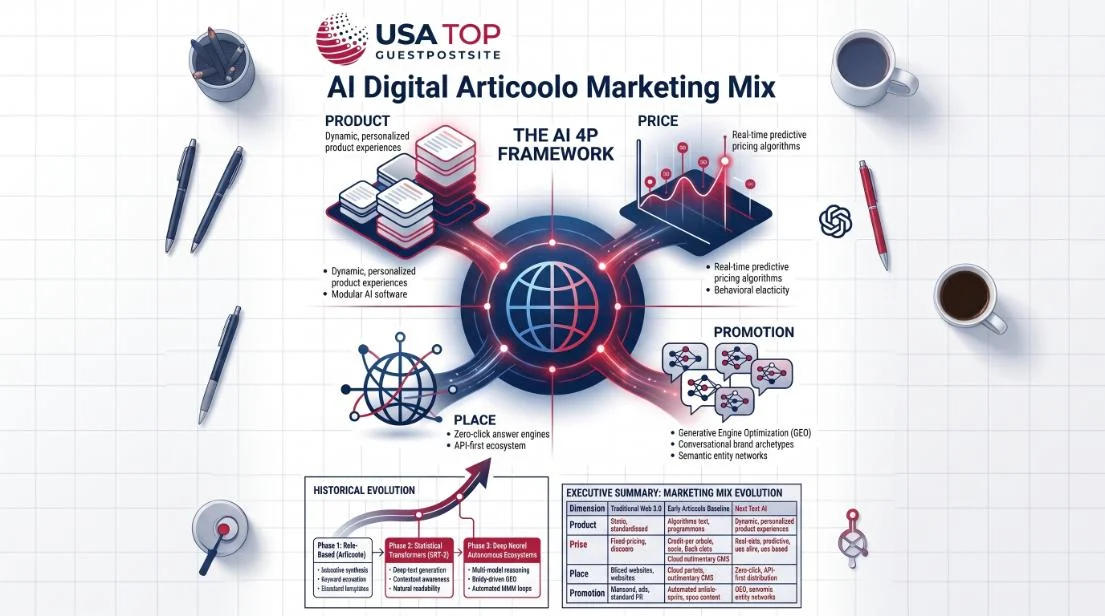
The convergence of algorithmic content generation, machine intelligence, and strategic brand positioning has permanently disrupted conventional marketing. At the centre of this transition sits the AI digital Articoolo marketing mix—an evolutionary framework bridging early automated content engines with modern Large Language Models (LLMs), predictive data systems, and multi-channel distribution.
To capture search visibility across modern engines—including Google’s core index, Search Generative Experience (SGE / AI Overviews), ChatGPT Search, Claude, and Perplexity—brands cannot treat AI as merely a tactical drafting shortcut. Success requires re-engineering the traditional marketing mix (Product, Price, Place, Promotion) around machine intelligence, automated natural language generation (NLG), and authoritative brand archetypes.
Executive Summary: What Is the AI Digital Articoolo Marketing Mix?
The term originates from academic literature and industry case studies analysing Articoolo—one of the earliest commercial Natural Language Generation (NLG) platforms—as an empirical model for how artificial intelligence intersects with the marketing mix.
In classic academic research, such as “Marketing Artificial Intelligence: Creating the AI Archetype”, early platforms like Articoolo were evaluated through two distinct strategic lenses:
- Marketing of AI: How automated intelligence tools position, price, distribute, and promote themselves to build human trust.
- Marketing by AI: How autonomous content engines reconfigure the traditional 4Ps (Product, Price, Place, Promotion) to scale digital operations, automate customer journeys, and drive organic reach.
Examining these systems provides a foundation in marketing artificial intelligence, showing how early content algorithms paved the way for modern generative systems. The AI revolution Digital Marketing landscape is shifting from manual content production to automated, continuous campaign orchestration. In this modern context, the 2026 articoolo lineage serves as a historical benchmark for how automated content production evolved from basic keyword extraction into complex semantic ecosystems.
Today, the AI Digital Articoolo Marketing Mix has evolved into a strategic framework. It represents the synthesis of algorithmic content architecture and predictive marketing mix modelling (MMM) to deploy brand assets that rank on search engines while simultaneously training generative answer engines to cite your brand as an authority. Understanding these baseline principles serves as an effective guide to Ai for Beginners seeking to master algorithmic positioning and scale their digital marketing strategies.
Key Comparisons: Traditional Marketing Mix vs. AI Digital Articoolo Framework
| Marketing Mix Dimension | Traditional Digital Marketing (Web 2.0) | Early Algorithmic Era (Articoolo Baseline) | Next-Gen AI Marketing Mix (Modern LLMs & MMM) |
| Product | Static physical or digital assets; standardized value propositions. | Algorithmic text generation; keyword-focused programmatic content. | Dynamic, personalized product experiences; programmatic solutions; modular AI software. |
| Price | Fixed pricing models, seasonal discounts, and manual margin adjustments. | Credit-per-article pricing; transactional software-as-a-service (SaaS) tiers. | Real-time predictive pricing algorithms; dynamic willingness-to-pay modelling; usage-based compute pricing. |
| Place (Distribution) | Siloed websites, social channels, and manual retail partnerships. | Cloud portals, automated API delivery, and rudimentary CMS plugins. | Zero-click answer engines (AIO, ChatGPT, Perplexity), omni-channel automated syndication, API-first ecosystem distribution. |
| Promotion | Manual advertising campaigns, static PR outreach, human-drafted SEO blogs. | Rule-based automated spun articles and programmatic content velocity. | Conversational brand archetypes, Generative Engine Optimization (GEO), semantic entity networks, automated hyper-personalized ad creative. |
The Historical Evolution: From Articoolo to Modern Large Language Models
To master the AI marketing mix, marketers must understand its technical evolution. In the mid-to-late 2010s, tools like Articoolo, Quill, and Wordsmith pioneered algorithmic writing for major media and corporate brands, proving that artificial intelligence revolutionising content workflows was an achievable commercial reality.
| Phase 1: Rule-Based Algorithm (Articoolo) • Extractive synthesis • Keyword extraction • Structural templates |
Phase 2: Statistical Transformers (GPT-3)
• Deep text generation |
Phase 3: Deep Neural Autonomous Ecosystems • Multi-modal reasoning • Entity-driven GEO • Automated MMM loops |
1. The Articoolo Era: Extractive & Algorithmic Synthesis
Early automated writing platforms relied on algorithmic text analysis. When given a prompt or keyword, Articoolo analysed related materials across the open web, extracted core concepts, replaced text with contextually relevant synonyms, and assembled a structured piece of writing. While revolutionary for its era, the output suffered from structural rigidity, mechanical phrasing, and an inability to deliver deep nuance.
2. The Transformer Shift: Generative Contextual Fluidity
The introduction of the Transformer architecture shifted the paradigm from mechanical extraction to probabilistic next-token generation. Models trained on vast internet-scale datasets could produce fluid, stylistically coherent prose indistinguishable from human writing across diverse domains.
3. The Modern Era: Entity-Based Generative Engine Optimization (GEO)
Modern search visibility no longer depends on keyword repetition. Google’s Search Generative Experience, ChatGPT Search, and Perplexity utilize knowledge graphs, retrieval-augmented generation (RAG), and semantic entity relationships. Modern AI marketing mixes do not simply produce volume; they anchor brands within authoritative industry taxonomies so AI systems interpret them as canonical sources.
Deconstructing the 4Ps: The AI Digital Articoolo Framework
Integrating artificial intelligence into your business requires systematically mapping algorithmic intelligence across all four dimensions of the marketing mix.

1. Product: Algorithmic Augmentation & Intelligent Deliverables
Within the AI marketing mix, the “Product” ceases to be static. Whether selling consumer goods, B2B enterprise software, or digital information products, artificial intelligence transforms the core offering into an augmented, learning solution:
- Algorithmic Personalization: The product dynamically conforms to individual user behaviours in real time (e.g., personalized dashboards, adaptive interfaces).
- Predictive Utility: Advanced Machine learning models identify user friction and automatically trigger real-time interventions before churn occurs.
- Intelligent Content as Product: In the Articoolo tradition, automated content generation operates as an on-demand software feature, turning complex analytical inputs into digestible, automated reports.
2. Price: Predictive Elasticity & Value-Based Algorithms
Traditional pricing relies on historic competitor matching and static markup calculations. The AI digital mix shifts pricing into a continuous, real-time feedback loop:
- Dynamic Price Optimization: Algorithmic systems monitor external market demand, supply chain constraints, competitor availability, and micro-moment purchase intent to adjust price points dynamically.
- Willingness-to-Pay (WTP) Predictive Modelling: Natural language processing assesses customer sentiment across reviews, social data, and sales transcripts to identify specific feature sets that justify premium margins.
- Compute vs. Value Alignment: SaaS pricing moves away from rigid per-seat licensing toward hybrid usage-based metrics tied directly to compute output and AI value delivered.
3. Place: The Shift to Generative Discovery & Decoupled Distribution
“Place” refers to where and how the target audience discovers, evaluates, and consumes your brand offering. In an ecosystem dominated by LLMs and zero-click search features, the digital storefront has decoupled:
- Conversational AI Touchpoints: Buyers bypass traditional search engine results pages (SERPs) entirely, choosing to ask natural-language questions to assistants like ChatGPT, Claude, and Gemini. If your brand is not embedded within their training corpora or accessible via real-time web retrieval, you do not exist in the buyer’s digital “Place.”
- API-Driven Syndication: Content and product data must be structured so automated agents, aggregators, and answer bots can ingest, parse, and cite your data cleanly without UI obstacles.
- Decoupled Omnichannel Presence: Automated distribution engines feed syndicated assets across high-authority third-party networks, email sequences, and active social media marketing feeds.
4. Promotion: Entity Optimization, GEO, and the “AI Archetype”
Promotion within the Articoolo framework represents the largest operational divergence from traditional marketing. In academic research analysing Articoolo’s market positioning, researchers identified the concept of the AI Archetype: assigning deliberate, recognizable human personality traits to machine intelligence to overcome human scepticism and foster trust.
For modern marketing teams, automated promotion relies on three pillars:
- Generative Engine Optimization (GEO): Structuring informational assets with clear semantic entity definitions, schema markup, and verifiable claims that LLMs can extract during search-augmented retrieval.
- Hyper-Personalized Creative: Automated ad copy generation and predictive creative testing that match exact user intent signals in real time.
- Data-Backed Thought Leadership: Using automated research synthesis to produce deep, data-rich reports that build brand trust and secure backlinks.
The AI Archetype: Building Human Trust in Algorithmic Systems
A central contribution of early academic research into Articoolo was addressing human resistance to automated software. When brands deploy automated content engines, conversational agents, or algorithmic recommendations, consumers frequently demonstrate subconscious hesitation—often referred to as the “uncanny valley” of marketing.
To overcome this friction, the AI marketing mix utilizes Archetype Design:
| THE 4 CORE AI BRAND ARCHETYPES |
| Archetype | Core Personality | Strategic Application |
| The Sage (The Expert) | Objective, factual, research-driven | Data-heavy B2B insights, compliance, technical SEO |
| The Assistant (The Reliable Aide) | Humble, fast, hyper-responsive | Customer support agents, operational automation |
| The Creator (The Visionary) | Creative, adaptive, non-traditional | Narrative copywriting, campaign ideation |
| The Magician (The Automator) | Effortless speed, friction-free power | Instant content engines, zero-click operations |
When building an automated marketing system, you must define which archetype governs your system’s output. If an AI system acts with unwarranted familiarity (an Assistant pretending to be a human friend), user trust degrades. Conversely, if your automated marketing systems position the AI as an objective Sage—validating every claim with structured statistics and verified empirical sources—user confidence and engagement increase.
Technical Blueprint: How to Build an AI-Driven Content Engine
Modern organizations require a systematic workflow that blends computational velocity with human editorial authority. Deploying unedited automated content leads to search engine devaluations and brand erosion.
The following blueprint outlines the enterprise standard for an Algorithm-Human-Algorithm (A-H-A) content generation engine:

Step 1: Algorithmic Research & Entity Mapping
Bypass basic keyword planners. Use natural language APIs and semantic clustering algorithms to map the complete semantic entity network of your topic. Identify:
- Canonical entity definitions recognized by Google’s Knowledge Graph.
- Unanswered questions in LLM output (Perplexity citation gaps, ChatGPT Search query fallbacks).
- Common competitor structural patterns to build comprehensive content architectures.
Step 2: Generative Drafting (The Articoolo Lineage)
Modern marketing teams are continuously Using Ai tools to orchestrate prompt chains rather than relying on brittle single prompts. This streamlined production pipeline ultimately Boosts Content Growth by allowing teams to deliver thorough coverage across their topical hubs without sacrificing editorial quality. Instruct the system to construct dedicated components:

- Structured comparison tables evaluating specific variables.
- Clear code snippets or ASCII visual diagrams illustrating complex workflows.
- Precise, declarative definitions that can be extracted cleanly as answer engine snippets.
Step 3: Human-in-the-Loop (E-E-A-T Injection)
This is the quality control stage where automated drafts transform into high-ranking editorial assets. Subject Matter Experts (SMEs) must:
- Validate every data point and remove algorithmic hallucinations.
- Inject first-party company research, proprietary data sets, and candid commentary.
- Refine tone to align directly with your chosen AI Archetype.
Step 4: Algorithmic Optimization & Multi-Channel Distribution
Prior to publication, feed the draft back through analytical optimization software:
- Inject structured Schema markup (e.g., Article, TechArticle, FAQPage, Dataset).
- Programmatically configure contextual internal links across your topical cluster.
- Distribute content modularly across CMS hubs, social platforms, and newsletters using intelligent webhook automation.
Generative Engine Optimization (GEO): Ranking on ChatGPT, Claude, and Perplexity
Securing visibility on classic search engine results pages is only half the battle. Digital discovery is shifting toward conversational answer engines that synthesize information from their internal weights and real-time retrieval-augmented generation (RAG).
To rank within AI Overviews, Perplexity, and ChatGPT Search, your content mix must adhere to the principles of Generative Engine Optimization (GEO):

1. Information Density Over Word Count
Generative answer engines evaluate the factual density of a source. While legacy SEO tactics rewarded verbose phrasing to inflate page length, LLM scrapers prioritize text that delivers dense, verifiable facts per token. Eliminate circular introductions and lead immediately with direct answers.
2. Extractive Scaffolding (Tables, Bullets, Definition Blocks)
RAG pipelines chunk text into small vector segments. When text is organized into structured Markdown tables, sequential numbered steps, and standalone bold definitions, embedding models index and match these chunks to user search queries with higher accuracy.
3. Clear Authoritative Citations
To be cited by Perplexity or Search Generative Experience, text must include verifiable assertions. Frame findings around industry data, academic journals, official documentation, or proprietary operational benchmarks. LLMs cross-reference claims against other authoritative web documents before generating a citation link.
4. Semantic Entity Clarity
Avoid ambiguous pronouns when introducing key concepts. Instead of writing “It provides many strategic benefits to teams,” write “The AI digital Articoolo marketing mix reduces content production cycle times for corporate marketing teams.” This ensures vector databases associate the positive attribute directly with the target brand entity.
Navigating Risks: Quality Signals, Ethics, and Compliance
Deploying automated intelligence across your digital marketing mix carries operational and reputational risks that demand strict governance.
1. Google’s Helpful Content & Quality Systems
Google’s search guidelines do not penalize AI-generated content simply for being automated. However, Google’s algorithms ruthlessly target low-quality, derivative, unedited programmatic content produced purely to manipulate rankings. If your content merely restates information found across top competitors without contributing original analysis, first-party data, or unique insight, your visibility will decay.
2. Algorithmic Hallucinations and Legal Exposure
Early tools like Articoolo frequently produced non-sequiturs due to synonym replacement. Modern LLMs exhibit a more dangerous issue: plausible hallucinations. They can fabricate legal statutes, market statistics, or technical steps with complete grammatical confidence. In regulated industries—such as legal services, finance, and healthcare—unverified automated content creates significant legal and regulatory liability.
3. Preserving the Human Brand Moat
If every company in your market runs the same automated prompts using the same underlying models, all published marketing materials converge into homogeneous, predictable consensus text. Your unique human experience, contrary viewpoints, and hard-won operational stories are what differentiate your brand. Automation should handle the foundation and distribution; human strategic intellect must guide the overarching vision.
To build an agile, future-proof digital marketing strategy, organizations must integrate an AI driven workflow that continuously analyses the live behaviour of your customer. By applying enterprise-grade predictive analytics, marketing teams can anticipate market demand shifts and deploy resources proactively. For an empirical look at the latest developments in machine intelligence and algorithmic frameworks, researchers frequently consult the MIT Computer Science & Artificial Intelligence Laboratory to benchmark ongoing advances in neural computation and automated systems.
Frequently Asked Questions (FAQ)
What is the marketing mix in Digital Marketing?
The marketing mix in digital marketing is the operational framework used to position, price, distribute, and promote products across internet ecosystems. Traditionally structured around the 4Ps (Product, Price, Place, Promotion), modern digital executions incorporate algorithmic tools, real-time analytics, and automated personalization engines to adjust each variable continuously based on market dynamics.
Is there any AI for Digital Marketing?
Yes, AI is integrated across virtually every discipline of digital marketing. Key applications include generative natural language systems for drafting copy (e.g., ChatGPT, Claude), programmatic ad-bidding algorithms (e.g., Google Performance Max), conversational bots for automated user intake, predictive lead-scoring models, and automated content frameworks evolved from early pioneers like Articoolo.
What are the 5 marketing mix strategies?
The 5 marketing mix strategies adapt traditional product placement into actionable operational vectors:
- Product Personalization: Leveraging machine learning to tailor digital products or service features to individual user behavior.
- Dynamic Value-Based Pricing: Adjusting prices in real time using automated algorithms that track inventory, competitor rates, and demand elasticity.
- Omnichannel Multi-Surface Distribution (Place): Distributing content and storefronts across websites, conversational agents, and zero-click answer platforms.
- Algorithmic & Entity-Driven Promotion: Combining Generative Engine Optimization (GEO) with hyper-personalized advertising creative.
- Audience Co-Creation (People & Positioning): Establishing authentic brand archetypes to build trust during automated customer touchpoints.
What are the 7 p’s in the marketing mix?
The 7 Ps represent the extended services marketing mix, which is especially applicable to software platforms, service agencies, and digital consultancies:
- Product: The physical good, SaaS platform, or automated deliverable provided to the customer.
- Price: The pricing tiers, subscription models, or dynamic usage-based rates applied.
- Place: The distribution platforms, web portals, APIs, and AI conversational interfaces where the solution is accessed.
- Promotion: The combination of SEO, GEO, paid media, and automated content syndication used to attract buyers.
- People: The human team, customer success managers, and AI brand archetypes representing the business.
- Process: The automated and manual workflows that deliver consistent value to the customer.
- Physical Evidence: The digital verification signals, case studies, security certifications, and social proof that confirm the brand’s legitimacy.
What is Articoolo and how did it influence AI content marketing?
Articoolo was an early automated content creator that used algorithmic text analysis and keyword extraction to generate articles. It analyzed web sources, extracted key themes, and reconstructed text for human readers. It became an important case study in academic research examining how artificial intelligence functions within the digital marketing mix and how automated tools must build user trust through archetypal brand design.
What is the difference between SEO and Generative Engine Optimization (GEO)?
Traditional Search Engine Optimization (SEO) focuses on ranking web pages within a list of blue links on search engines like Google by optimizing for keywords, page speed, and backlinks. Generative Engine Optimization (GEO) focuses on optimizing content so AI models (such as ChatGPT, Perplexity, and Google AI Overviews) extract, synthesize, and cite your brand as an authoritative source within real-time generated answers.
Strategic Synthesis and Future Trajectory
The AI digital Articoolo marketing mix represents the ongoing transition from static, manual digital marketing to dynamic, algorithmic commerce. By moving past simple generative drafting shortcuts and viewing artificial intelligence through the comprehensive lens of Product, Price, Place, and Promotion, modern organizations can build scalable, sustainable competitive advantages.
As conversational search continues to change how users find and consume information online, the brands that thrive will not be those that flood the internet with unvetted automated copy. Success belongs to organizations that deploy intelligent algorithmic pipelines, anchor their authority through clear entity optimization, and maintain the human expertise required to deliver genuine value to their audience.