
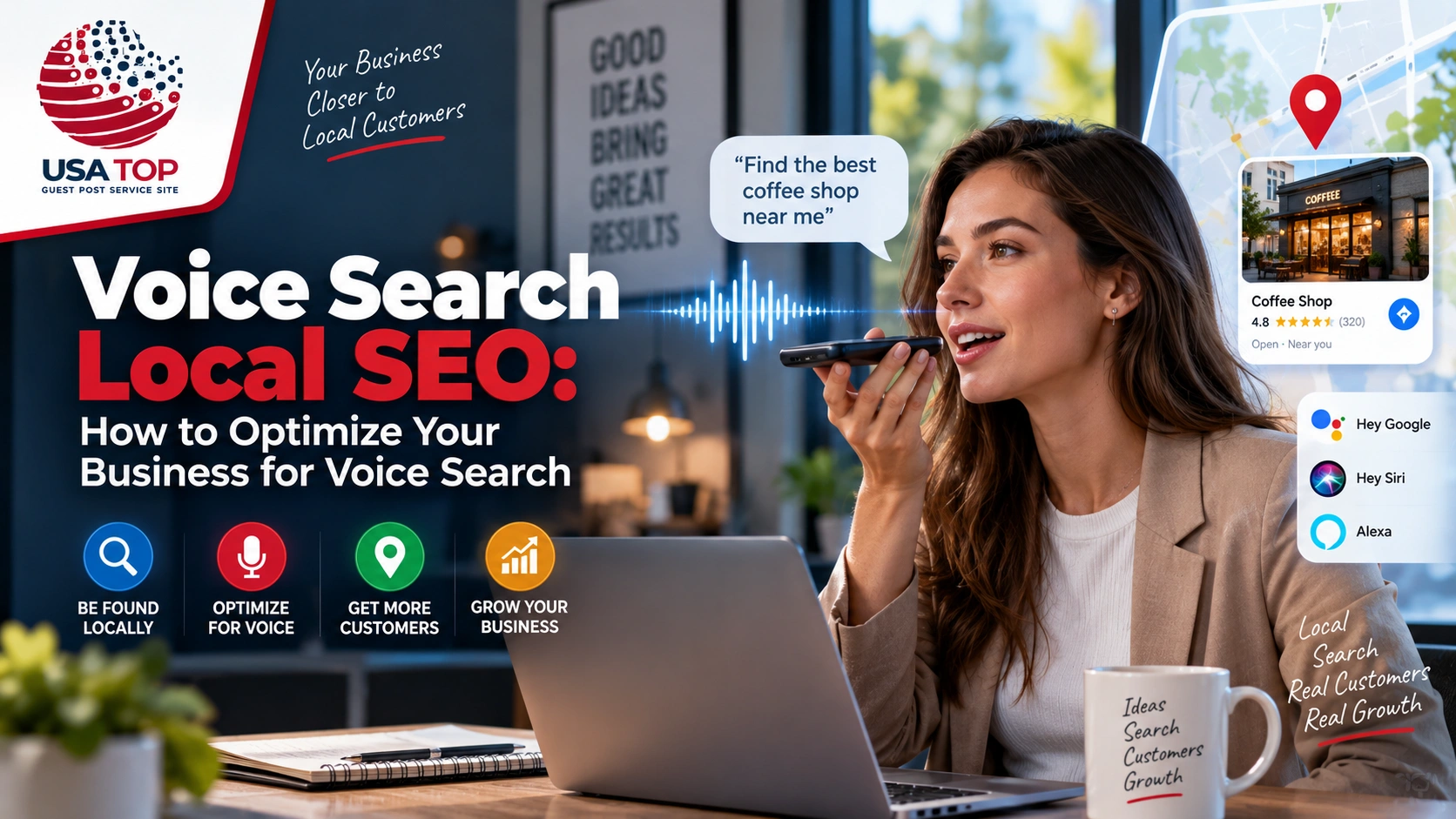
Voice search local SEO helps businesses become easier to discover when people use natural, conversational searches to find nearby products, services, and businesses. A strong strategy combines local SEO, Google Business Profile optimization, conversational content, customer reviews, structured data, mobile performance, and location-focused information rather than relying on keyword repetition alone.
People no longer search only with short phrases such as “plumber near me” or “best restaurant nearby.” They increasingly ask complete questions such as “Who can repair my water heater near me?” or “What roofing company is open today?” That shift makes voice search optimization closely connected with local search, mobile SEO, and answer-focused content.
What Is Voice Search Local SEO and Why Does It Matter?
Voice search local SEO is the process of improving a business’s online presence so it can better satisfy conversational, location-based searches made through voice assistants and search platforms. It combines voice search SEO with local relevance, accurate business information, useful answers, reviews, and a website that clearly explains what the business does and where it operates.
Voice Search and Traditional SEO
Voice search does not require a completely separate SEO system. The same fundamentals that help search engines understand a website—useful content, clear structure, relevant entities, crawlability, internal links, and accurate business information—also support voice-friendly search experiences.
The difference is primarily in how people phrase their searches. Typed searches are often short, while spoken searches tend to be longer and more conversational.
For example:
- Typed: “dentist near me”
- Voice: “Where can I find a dentist near me today?”
- Typed: “roof repair”
- Voice: “Who repairs leaking roofs in my area?”
This makes natural language and search intent especially important.
How Do Voice Searches Differ From Typed Searches?
Voice searches often use complete sentences, questions, conversational wording, and stronger immediate intent. Instead of targeting only short keywords, businesses should understand the questions customers naturally ask before, during, and after choosing a service.
Conversational Search Intent
A good voice SEO strategy should cover several types of intent:
Informational: “What is voice search optimization?”
Local: “What SEO company is near me?”
Commercial: “What is the best local SEO service for a small business?”
Availability: “Which HVAC company is open now?”
Transactional: “Where can I book a local cleaning service?”
This is why voice search keywords should be mapped to customer intent rather than simply added to paragraphs.
Natural Language Matters
Terms such as how to optimize for voice search, how does voice search work, how to rank for voice search, and how voice search affects SEO are useful because they represent genuine questions.
They should appear where the content actually answers those questions.
That is much stronger than placing variations such as “voice search SEO,” “voice SEO,” and “SEO voice search” repeatedly in every paragraph.

How Does Google Determine Which Local Business to Show?
For local searches, relevance, distance, and prominence are important considerations. A business therefore needs more than a page containing the phrase “voice search local SEO.” Search engines need clear information about the business, its services, its location, and its reputation.
Business Relevance
Your website should clearly explain:
- What services you provide
- Who you serve
- Which locations you serve
- What problems you solve
- How customers can contact you
This creates stronger relationships between the business entity, service entity, and location entity.
Local Prominence
Reviews, legitimate local references, consistent business information, and useful local content can all contribute to a stronger local presence.
This is where local SEO, voice search SEO, and reputation management begin to overlap.
How Important Is Google Business Profile for Voice Search?
A complete and accurate Google Business Profile is an important part of a local voice search strategy because it provides structured business information that can help people discover and evaluate a local company. Businesses should keep their category, services, hours, contact information, location, website, and other profile details accurate and consistent.
Optimize Your Core Business Information
Review your:
- Business name
- Primary category
- Services
- Address or service area
- Phone number
- Opening hours
- Website
- Photos
- Business description
Do not add keywords to your business name unless they are genuinely part of the business’s real-world name.
Keep Website and Profile Information Consistent
Your website, Google Business Profile, directories, and other legitimate listings should communicate the same core business identity.
That consistency strengthens the connection between your local business entity and its online presence.
For broader local SEO planning, our SEO action plan for small businesses also covers Google Business Profile, local citations, reviews, mobile SEO, and content planning.
How Do “Near Me” Voice Searches Work?
“Near me” searches combine a customer’s need with geographic intent. Voice search makes these queries especially natural because people can simply ask an assistant to find a nearby business, service, restaurant, or professional.
Local Intent and Proximity
Queries may include:
- voice search near me
- local voice search
- businesses near me
- best service near me
- open now
- available today
- closest service provider
- service + city
- emergency service + location
A business cannot control every proximity-based result, but it can make its relevance much clearer through accurate business information, service pages, location content, reviews, and legitimate local signals.

How Should You Optimize Content for Voice Search?
The strongest voice search optimization approach is to answer real customer questions clearly and naturally. Use conversational language where appropriate, place direct answers near the beginning of relevant sections, and then provide supporting details, examples, factors, and practical guidance.
Use Question-Based Content
Useful questions may include:
- What is voice search?
- How do I optimize my website for voice search?
- How can my business rank for voice searches?
- Does voice search help local SEO?
- How important are reviews for local voice search?
- How do I optimize my Google Business Profile?
These questions naturally support AEO, because they give search systems clear question-and-answer relationships.
Keep Answers Direct
A strong answer-first section can begin with a concise explanation of roughly 40–60 words before expanding into deeper information.
This structure helps readers quickly understand the answer while giving search systems clearly organized supporting context.
How Should Service Pages Be Optimized for Voice Search?
Voice search optimization should not exist only on a blog post called “voice search SEO.” Your service pages are often much closer to the customer’s actual conversion intent, so they should answer conversational questions related to the service.
Build Service-Specific Answers
A local service page can answer:
- What does this service include?
- How much does it usually cost?
- How quickly can the service be provided?
- Do you serve my area?
- What situations require this service?
- How do I request an estimate?
- What should I do before the appointment?
For example, a business offering legal services could naturally connect its local SEO strategy with a page about local SEO services for lawyers, where location, service intent, Google Business Profile, semantic SEO, entity optimization, AEO, and GEO are discussed together.
This creates a useful relationship between voice search queries and transactional service pages.
How Do Location Pages Support Local Voice Search?
Location pages can support voice search when they provide genuinely useful local information rather than repeating a city name throughout the page.
Create Unique Local Relevance
A useful location page can explain:
- Services available in the area
- Actual service coverage
- Local customer needs
- Relevant neighborhoods or communities
- Location-specific FAQs
- How customers can contact or book the business
Avoid creating dozens of nearly identical city pages with only the location name changed.
That creates thin, repetitive content rather than meaningful local relevance.
How Can FAQ Content Improve Voice and AI Visibility?
FAQ content works well for voice search because many spoken searches are naturally phrased as questions. A strong FAQ section should answer real customer questions directly, use plain language, and provide enough context to be genuinely useful.
Build FAQs Around Customer Journeys
Useful categories include:
Definition questions:
“What is voice search local SEO?”
How-to questions:
“How do I optimize my website for voice search?”
Local questions:
“How do I rank for near me searches?”
Business questions:
“Does Google Business Profile affect voice search?”
Technical questions:
“Does schema markup help voice search?”
AI questions:
“Can voice search content appear in AI search results?”
FAQ content should not be created simply to insert more keywords. Every question should exist because a real customer could reasonably ask it.
Do Featured Snippets Still Matter for Voice Search?
Featured snippets and other answer-focused search features are useful concepts when creating content for conversational searches because they reward clear, concise answers. However, no page structure can guarantee a featured snippet or voice result.
Format Answers for Clarity
Use:
- Clear question headings
- Direct answers
- Short explanatory paragraphs
- Lists where appropriate
- Definitions
- Step-by-step instructions
- Supporting examples
This is also useful for AEO and GEO because the relationship between a question and its answer becomes easier to understand.
Does Schema Markup Help Voice Search?
Schema markup can help search engines understand the entities and information represented on a page, but it should not be treated as a shortcut for voice search rankings. Structured data should accurately represent visible page content and use the appropriate schema type for the information being marked up.
Useful Structured Data
Depending on the page and business, relevant types can include:
- LocalBusiness
- Organization
- Service
- WebPage
- BreadcrumbList
- FAQPage where appropriate
The goal is better machine understanding—not creating a fictional “voice search ranking signal.”
Is Speakable Markup Worth Using for Local Businesses?
Speakable markup is a specialized topic within voice search optimization, but it should not become the foundation of a local SEO strategy. Most local businesses should prioritize accurate business information, useful content, mobile usability, reviews, service pages, and conversational answers first.
Prioritize the Fundamentals
Before worrying about specialized voice markup, make sure the website has:
- Accurate local information
- Strong service content
- Clear headings
- Useful FAQs
- Mobile-friendly pages
- Fast performance
- Consistent business details
- Strong internal linking
This approach is more practical and sustainable.
How Do Reviews Influence Local Voice Search?
Customer reviews are an important local trust signal because they help people evaluate businesses before calling, visiting, or booking. Reviews can also naturally contain service and location language that reinforces the relationship between a business, its services, and its local market.
Build Authentic Review Signals
Encourage genuine customers to share their experience without asking them to insert artificial keywords.
A review that naturally says a company repaired a roof in a specific area is much more valuable than a forced sentence stuffed with phrases such as “best voice search SEO company.”
Authenticity matters more than keyword density.
How Important Are Local Citations and NAP Consistency?
Local citations can help reinforce a business’s identity across legitimate directories and relevant platforms. Your business name, address, and phone number should remain accurate and consistent wherever the business is legitimately listed.
Strengthen Entity Consistency
Think of citations as supporting references for the business entity:
Business Name → Address → Phone → Website → Category → Service → Location
Avoid low-quality directory spam simply for the purpose of creating more citations.
Does Mobile SEO Affect Voice Search?
Mobile usability matters because voice searches frequently lead users to mobile search experiences where they need fast answers and easy actions. A voice-friendly local website should therefore be responsive, readable, fast, and easy to navigate.
Make the Next Action Obvious
Important actions can include:
- Call
- Request a quote
- Book an appointment
- Get directions
- View services
- Contact the business
A technically optimized page that makes customers struggle to take action is still a poor user experience.
How Does Voice Search Connect With AI Overviews and AI Mode?
Voice search and AI search are not identical technologies, but they share an important characteristic: users increasingly ask search systems complete questions and expect useful answers. That makes clear topical coverage, direct answers, strong entities, and trustworthy information valuable across modern search experiences.
Voice Search, AEO, and GEO
A modern content strategy can connect:
Voice query → Search intent → Direct answer → Supporting entity information → Local relevance → Service page → Conversion
This is why voice search local SEO should be treated as part of a broader search visibility strategy rather than an isolated keyword tactic.
AI systems also benefit from content that clearly explains relationships between concepts. For example:
Business → Service → Location → Customer problem → Solution → Evidence → Contact
That structure is much stronger than repeating the same keyword throughout a page.
What Are the Biggest Voice Search Local SEO Mistakes?
The most common mistakes are usually strategic rather than technical. Businesses often focus too heavily on repeating voice search keywords while neglecting the information users actually need.
Avoid These Problems
- Keyword stuffing
- Repeating the same phrase in every heading
- Creating thin location pages
- Ignoring Google Business Profile
- Using inaccurate business information
- Writing generic FAQs
- Publishing unsupported statistics
- Creating fake reviews or case studies
- Ignoring service pages
- Overusing schema
- Treating voice SEO as a completely separate algorithm
- Ignoring mobile usability
- Writing for search engines instead of customers
A strong voice search SEO strategy should make the page more useful even if the user never performs a voice search.
How Should a Local Business Build a Voice Search Strategy?
A practical voice search optimization strategy starts with customer questions and then connects those questions to the website’s existing SEO architecture.
Step 1: Research Real Queries
Collect conversational searches, Google suggestions, customer questions, PAA-style queries, and competitor topics.
Step 2: Map Search Intent
Separate informational, local, commercial, availability, and transactional queries.
Step 3: Improve Google Business Profile
Make business information accurate, complete, and consistent.
Step 4: Optimize Service and Location Pages
Answer service-specific and location-specific questions naturally.
Step 5: Build Answer-First FAQs
Give direct answers before deeper explanations.
Step 6: Strengthen Local Trust
Develop authentic reviews, legitimate citations, local relevance, and useful business information.
Step 7: Improve Technical SEO
Maintain crawlability, mobile usability, page speed, accessibility, internal linking, and appropriate structured data.
Step 8: Measure and Improve
Monitor organic visibility, local queries, calls, leads, conversions, and relevant search performance rather than focusing only on rankings.
For businesses looking at the broader relationship between SEO, local search, AI, and voice optimization, our guide to SEO speakers and modern SEO topics also covers local SEO, technical SEO, AI, and voice search optimization.
What Should a Voice Search Local SEO Checklist Include?
A practical checklist should cover the complete search journey:
- Primary voice search intent identified
- Conversational keyword research completed
- Google Business Profile accurate
- Business category relevant
- Services clearly listed
- NAP information consistent
- Service pages optimized
- Location pages genuinely useful
- Customer questions answered
- FAQ content developed
- Reviews managed authentically
- Local citations accurate
- Mobile experience optimized
- Page speed reviewed
- Accessibility considered
- Internal links strengthened
- Appropriate schema implemented
- AI/AEO/GEO query coverage reviewed
- Search performance monitored
- Business conversions tracked
How Should You Measure Voice Search and AI Visibility?
Voice search success should not be measured by a single ranking position. A better approach connects search visibility with actual customer behavior.
Track Meaningful Outcomes
Monitor:
- Organic impressions
- Search queries
- Local search visibility
- Question-based queries
- Website clicks
- Phone calls
- Quote requests
- Bookings
- Direction requests
- Conversion rates
- Branded and non-branded searches
The goal is not simply to “rank for voice search.” The goal is to become a useful answer when customers are searching for a real need—and then make it easy for those customers to take action.
What Is the Future of Voice Search Local SEO?
The future of voice search local SEO is likely to become increasingly connected with conversational search, mobile experiences, maps, AI-generated answers, local business entities, and direct actions such as calling or booking.
Build for Search Evolution
Businesses do not need to chase every new voice search SEO trend. A stronger long-term strategy is to maintain accurate business information, publish useful content, answer real questions, strengthen local trust, and keep the website technically healthy.
The most durable voice search optimization strategy is therefore not keyword stuffing. It is building a website that clearly communicates:
Who you are → what you offer → where you operate → why customers should trust you → how they can take the next step.
Frequently Asked Questions About Voice Search Local SEO
What is voice search local SEO?
Voice search local SEO combines conversational search optimization with local SEO so businesses can better satisfy spoken searches for nearby services, products, and businesses. It involves useful content, accurate business information, Google Business Profile optimization, reviews, local relevance, mobile usability, and clear answers to customer questions.
How do I optimize my website for voice search?
Use natural conversational language, answer real customer questions directly, create useful service and location pages, improve mobile usability, maintain accurate local information, and build clear internal links. Focus on search intent rather than repeatedly inserting the exact phrase “voice search SEO.”
Does Google Business Profile affect voice search?
Google Business Profile is an important part of local visibility because it provides key business information such as category, services, location, hours, phone number, and website. Keeping this information accurate and consistent helps establish a clearer local business entity.
How do I rank for “near me” voice searches?
You cannot guarantee a “near me” ranking, but you can strengthen local relevance by maintaining an accurate Business Profile, clear service and location information, authentic reviews, legitimate citations, and a useful mobile website. Relevance and geographic proximity are important parts of local search.
Does voice search help AI Overviews?
Voice search and AI Overviews are different search experiences, but both increasingly involve conversational queries and direct answers. Content that clearly addresses user questions, establishes entities, provides useful context, and demonstrates trust can support visibility across multiple modern search experiences.
Is voice search SEO different from local SEO?
Voice search SEO is not a completely separate SEO system. For local businesses, the two overlap heavily because many spoken searches have local intent. Strong local business information, conversational content, reviews, service pages, mobile usability, and technical SEO can support both.
Do FAQs help voice search?
Well-written FAQs can help because they directly answer questions users may ask conversationally. The FAQ should be based on genuine customer needs and provide concise, useful answers rather than serving as a container for repetitive keywords.


