
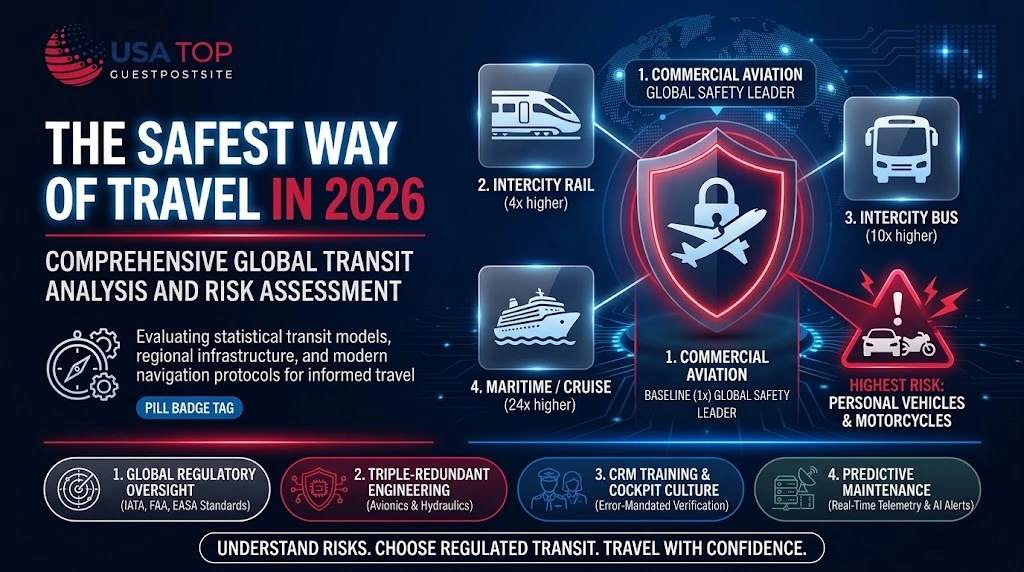
Every trip begins with a calculation of risk. Whether planning a cross-continental voyage, boarding a high-speed train, taking an ocean cruise, or driving a car, travellers balance convenience against physical safety. When choosing how to get from point A to point B, evaluating statistical transit models, regional infrastructure, and modern navigation protocols is essential for making informed travel decisions.
When assessing the safest way of transit, safety benchmarks rely on three primary metrics: fatalities per billion passenger-miles (or passenger-kilometres), fatalities per million journeys, and fatalities per hour of travel. Across data published by major regulatory bodies—including the International Air Transport Association (IATA), the National Safety Council (NSC), and the European Transport Safety Council (ETSC)—the comparative risk hierarchy remains consistent.
Definitive Transit Safety Hierarchy
The following table summarizes the primary modes of transportation ranked from lowest to highest risk based on distance-travelled fatality metrics:
| Transportation Mode | Fatalities per Billion Passenger-Miles | Fatalities per 100 Million Passenger-Hours | Comparative Risk Factor (vs. Commercial Air) |
| Commercial Aviation | ~0.05 | ~2.5 | Baseline (1x) |
| High-Speed / Intercity Rail | ~0.20 | ~8.0 | 4x higher |
| Commercial Intercity Bus | ~0.50 | ~15.0 | 10x higher |
| Commercial Maritime / Cruise | ~1.20 | ~25.0 | 24x higher |
| Personal Automobile (Car/SUV) | ~6.50 | ~220.0 | 130x–700x higher |
| Two-Wheeled Transport (Motorcycle) | ~150.00+ | ~6,000.0+ | 3,000x+ higher |
1. Commercial Aviation
Statistically, scheduled commercial aviation remains the safest form of passenger transportation in human history. With fatal accident rates between 0.04 and 0.07 deaths per billion passenger-miles, stepping onto a scheduled commercial flight is mathematically safer than almost any other daily activity. Rigorous global regulatory oversight, triple-redundant fly-by-wire avionics, and standardized Crew Resource Management (CRM) have made catastrophic failure a rare statistical anomaly.
2. High-Speed and Intercity Rail
Rail transit represents the safest ground-based transportation network available. Modern high-speed corridors across Europe (TGV, ICE, AVE) and Asia (Japan’s Shinkansen, South Korea’s KTX) maintain safety records that rival aviation. Because trains run on isolated, dedicated rights-of-way that eliminate head-on traffic and road-level crossings, ground collision risks are largely mitigated by automated train control systems.
3. Commercial Motor Coach and Intercity Bus
Traveling by shared motor coach or intercity bus is substantially safer than driving a personal car. Professional drivers operate under mandatory duty-hour limits that curb driver fatigue, and the sheer mass and reinforced passenger cells of 45-foot motor coaches protect occupants during traffic collisions.
4. Commercial Ocean Cruises and Maritime Transit
Modern maritime travel features double-hulled designs, automated fire-suppression networks, and satellite-guided route navigation that steers around major ocean storm systems. While onboard medical facilities are limited in critical trauma scenarios and localized infections can circulate, catastrophic marine losses on commercial cruise lines are rare per passenger-day.
5. Personal Motor Vehicles
Personal automobiles, pickup trucks, and SUVs account for more than 90% of all transportation fatalities globally. While modern vehicle structural engineering and Advanced Driver Assistance Systems (ADAS) have improved survivability, driving remains inherently hazardous due to uncontrolled human factors: distracted driving, speeding, alcohol and drug impairment, and unpredictable opposing traffic on shared roadways.
6. Motorcycles and Mopeds
Motorcycles represent the highest-risk transport category on public thoroughfares. Lacking an enclosed cabin, seatbelts, or crumple zones, riders absorb the entire kinetic force of an impact. Per vehicle-mile travelled, motorcycle operators experience a fatality rate over twenty to thirty times higher than passenger car occupants.
When planning international trips and evaluating overall transit risks, travellers can consult detailed global destination safety insights to ensure comprehensive trip preparation. Navigating new environments also demands practical modern lifestyle travel tips for smooth transit transitions, while staying informed on broader international tourist advisories and trends ensures ongoing situational awareness across any itinerary.
Statistical Deep Dive: Distance vs. Journey-Based Calculations
A common question in risk modelling is whether commercial aviation appears safer simply because an airplane covers massive distances quickly.
Even when examined on a per-trip basis—treating a short 15-minute neighbourhood drive identically to a 10-hour intercontinental flight—aviation remains the safer choice. Most critical flight events occur during the initial climb or final landing phases; cruising at 35,000 feet is an extraordinarily calm, monitored environment. In contrast, every single minute spent driving exposes vehicle occupants to hundreds of uncontrolled, intersecting variables, erratic drivers, and unexpected surface hazards.

Why Commercial Aviation Leads Global Safety Metrics
Aviation’s safety record is built on decades of non-punitive incident investigations and structural engineering redundancies.
Redundancy in Modern Aircraft Design
Commercial passenger jetliners are engineered so that no single mechanical, hydraulic, or electrical point of failure can disable the aircraft.
- Engine Redundancy (ETOPS): Modern twin-engine aircraft operate under strict Extended-range Twin-engine Operational Performance Standards, certifying them to fly safely on a single operational engine for up to 180 to 370 minutes over remote oceans or polar terrain.
- Hydraulics and Actuators: Triple-redundant hydraulic circuits, backed by secondary electrical actuators and deployable Ram Air Turbines (RAT), ensure pilots retain full flight-control surface authority even in the event of primary system blackouts.
- Navigational Sensor Cross-Checking: Avionics systems cross-reference data from multiple independent pitot-static tubes, inertial reference units, and satellite navigation feeds every millisecond to prevent erroneous sensor readouts from destabilizing autopilot systems.
Predictive Maintenance and Real-Time Telemetry
Modern commercial aircraft continuously stream hundreds of operational parameters—such as turbine temperature, compressor vibration, and hydraulic pressure—via satellite to ground-based maintenance facilities. Predictive artificial intelligence flags minute irregularities long before a part reaches its operational fatigue limit, allowing maintenance crews to swap components proactively during routine turnaround windows.
Cockpit Culture: Crew Resource Management (CRM)
Aviation safety changed when regulatory agencies recognized that the majority of historic accidents stemmed from human communication breakdowns rather than mechanical flaws. Crew Resource Management (CRM) removed the traditional authoritarian hierarchy from the cockpit. First officers are trained and legally mandated to challenge captains whenever an operational deviation occurs. Mandatory two-person verification callouts for every critical switch, flap setting, and altitude adjustment ensure that errors are caught before compounding into accidents.
High-Speed Rail: The Continental Alternative
For trips ranging from 200 to 800 miles, high-speed rail matches the door-to-door convenience of aviation while maintaining an exceptional safety profile.
| Safety Pillar | Implementation in High-Speed Rail Systems |
| Grade Isolation | Elevated viaducts, tunnels, and secure perimeter fencing that eliminate all road-level vehicle crossings |
| Digital Signaling | Automatic Train Control (ATC/ETCS Level 2) monitors speed continuously, overriding human driver errors. |
| Seismic Warnings | Trackside seismograph arrays automatically cut power and engage emergency brakes before shockwaves hit. |
Dedicated high-speed tracks feature complete physical grade separation. By removing all level road crossings, high-speed rail avoids the primary cause of conventional rail accidents: collisions with road vehicles. Additionally, digital cab signaling systems automatically slow or stop the train if an operator misses a track signal or approaches an occupied block too quickly.
The Automobile Dilemma: Examining Ground Transportation Risk
Most travelers step into a personal vehicle daily without hesitation, yet feel a sense of unease when boarding a commercial airliner. Psychologists call this the illusion of control: gripping a steering wheel gives the driver an intuitive sense of control over their fate, whereas boarding an aircraft requires placing one’s trust in pilots and air traffic controllers.
However, road safety statistics highlight a different reality:
PRIMARY CAUSES OF FATAL PASSENGER VEHICLE ACCIDENTS

Modern cars feature significant safety innovations, including Automated Emergency Braking (AEB), blind-spot detection, lane-centering systems, and reinforced safety cells. Yet, vehicles cannot eliminate the largest source of danger on the road: the unpredictability of other human drivers. Because drivers share unseparated roadways with speeding, distracted, and impaired motorists, personal car travel remains substantially riskier than air or rail transit.
Regional Safety Variations and Infrastructure Quality
Transit safety varies depending on where you travel. The single largest determining factor in trip safety is the regulatory rigor, road infrastructure, and emergency response capabilities of the destination country.
REGIONAL SAFETY PROFILES (Commercial Aviation & Road Infrastructure)
| Region | Commercial Aviation Risk | Road Traffic Fatality Rates |
| Western Europe | Near-zero fatal accident rate | ~3.8 deaths per 100k people |
| North America | Near-zero fatal accident rate | ~12.5 deaths per 100k people |
| East Asia / Oceania | Near-zero fatal accident rate | ~4.0 to 8.0 per 100k people |
| Latin America | Moderate safety compliance | ~16.0 to 22.0 per 100k people |
| Southeast Asia | Mixed safety compliance | ~20.0 to 32.0 per 100k people |
| Sub-Saharan Africa | Developing safety performance | ~27.0+ deaths per 100k people |
When planning international trips, reviewing an updated travel risk map provides a clearer picture of medical, infrastructural, and geopolitical security by country. Checking an official government travel advisory helps identify localized civil unrest, infrastructure disruptions, and regional transit hazards before departure.
Actionable Travel Safety Guidelines
Regardless of how you travel, following practical, data-backed safety habits helps reduce transit risks:
- Prioritize Direct Flights: The majority of rare aviation incidents occur during take-off, climb, approach, and landing. Booking non-stop flights reduces exposure to these critical phases.
- Keep Seatbelts Fastened in Flight: Clear-air turbulence is invisible to onboard radar and represents the leading cause of non-fatal injuries in commercial aviation. Keep your seatbelt secured whenever you are seated, even if the overhead sign is off.
- Count Rows to Emergency Exits: When boarding an aircraft, count the physical seatbacks between your seat and the two closest exits. If emergency lighting is obscured by smoke, you can navigate out by touch.
- Choose Mid-Train Coaches on Rail Journeys: When booking train travel, aim for the middle cars. In the rare event of a derailment or collision, the front and rear coaches absorb the initial impact forces.
- Avoid Night-time Highway Travel in Remote Regions: Highway fatality rates rise sharply between 11:00 PM and 5:00 AM due to reduced visibility, driver fatigue, and impaired motorists.
Before embarking on any major overseas journey, verifying current destination guidelines via the official U.S. Department of State Travel Warnings provides critical safety updates on geopolitical stability, local health infrastructure, and emergency consular services.
Frequently Asked Questions
What is the safest place to travel in 2026?
According to international security benchmarks—including the Global Peace Index (GPI) and independent risk assessments—the safest countries in the world continue to be led by Iceland, New Zealand, Switzerland, Ireland, Singapore, and Denmark. These nations maintain exceptionally low rates of violent crime, stable political environments, modern road infrastructure, and well-funded emergency medical systems. Popular travel destinations with strong safety reputations also include Japan, Canada, and Australia.
Which destinations should I avoid traveling to in 2026?
Travelers should avoid nations and regions experiencing active armed conflict, state collapse, or severe civil unrest. Countries categorized under “Do Not Travel” advisories by international foreign offices include Sudan, Yemen, Syria, Ukraine, Haiti, Somalia, and Afghanistan. Always consult current governmental travel advice from sources like the U.S. Department of State or the UK Foreign, Commonwealth & Development Office (FCDO) before booking travel to volatile regions.
Which date is not safe to travel in 2026?
There is no single calendar date that is inherently dangerous for transit. However, specific travel windows carry higher statistical risk:
- Major Holiday Travel Peaks: Peak holiday getaway days (such as Thanksgiving eve, Christmas Eve, and New Year’s Day) see a substantial surge in highway vehicle volume, driver fatigue, and alcohol-related accidents.
- Severe Weather Seasons: Traveling through hurricane-prone corridors (e.g., the Caribbean from August through October) or winter-storm belts during peak freeze cycles increases the likelihood of transit disruptions, road closures, and hazardous conditions.
What is the absolute safest way to travel?
Statistically, scheduled commercial flying on a major airline is the safest way to travel. With a fatality rate of roughly 0.05 deaths per billion passenger-miles, commercial aviation is hundreds of times safer than driving and twice as safe as passenger rail. For medium-distance domestic trips (under 500 miles), high-speed rail running on dedicated, grade-separated tracks is the safest ground alternative.
What is the safest way to travel in solo travel?
For solo travel, the safest option is utilizing commercial air travel combined with established public transportation networks (such as high-speed trains, subways, and licensed commuter rail) rather than renting personal cars or hailing unverified roadside taxis. Solo travelers should keep emergency contacts updated with an active itinerary, secure comprehensive travel insurance with medical evacuation coverage, and rely on certified rideshare applications that provide GPS tracking and driver verification.
What is the best safest way to travel with family?
When traveling with family, intercity rail and commercial air travel remain the safest options. Trains allow children and parents to move around freely without the safety risks of driving while distracted. If family road trips are necessary, use a modern vehicle equipped with an 5-star crash safety rating and Advanced Driver Assistance Systems (automatic emergency braking and lane keeping). Ensure children are properly secured in age-appropriate, professionally installed car seats, and avoid long driving stretches at night.
What is the best way to travel a long distance?
For journeys exceeding 500 miles, booking a commercial plane is the safest, most efficient, and most reliable option. Long-distance road trips significantly increase your exposure to fatigued driving, high-speed highway collisions, and changing weather conditions. Taking a commercial flight minimizes travel time while keeping you inside an engineered, professionally monitored, and regulated safety environment.
The statistical data is conclusive: commercial aviation remains the safest way to travel worldwide, with modern high-speed rail serving as the safest option for continental ground transit. By understanding comparative travel risks, choosing regulated public transit over personal driving whenever possible, and practicing simple safety habits, travelers can explore the world with confidence and peace of mind.


