
Choosing a career can feel confusing today.
You may worry about AI. You may worry about job safety. You may also worry about college costs, income, and long-term growth.
That is normal.
The good news is simple. Many future careers still offer strong value in the USA. You only need to know which jobs may grow, which skills matter, and which path fits your life.
This guide explains the best future careers for students, parents, job seekers, and career changers. It covers healthcare, technology, AI, green energy, skilled trades, and careers without a four-year degree.
What Are Future Careers and Why Do They Matter?
Future careers are jobs that may grow or stay valuable as technology, healthcare, business, and society change.
These careers matter because the USA job market keeps shifting. AI tools, automation, remote work, digital systems, and clean energy are changing how people work. Some jobs may shrink. Other jobs may become more important.
You should not choose a job only because it sounds popular. You should choose a path with real demand, useful skills, and long-term value. A strong career should match your goals, budget, strengths, and lifestyle.
From an expert view, the strongest careers of the future solve real problems. They help people. They protect systems. They support businesses. They also keep homes, communities, and services running.
What Are the Best Future Careers in the USA?
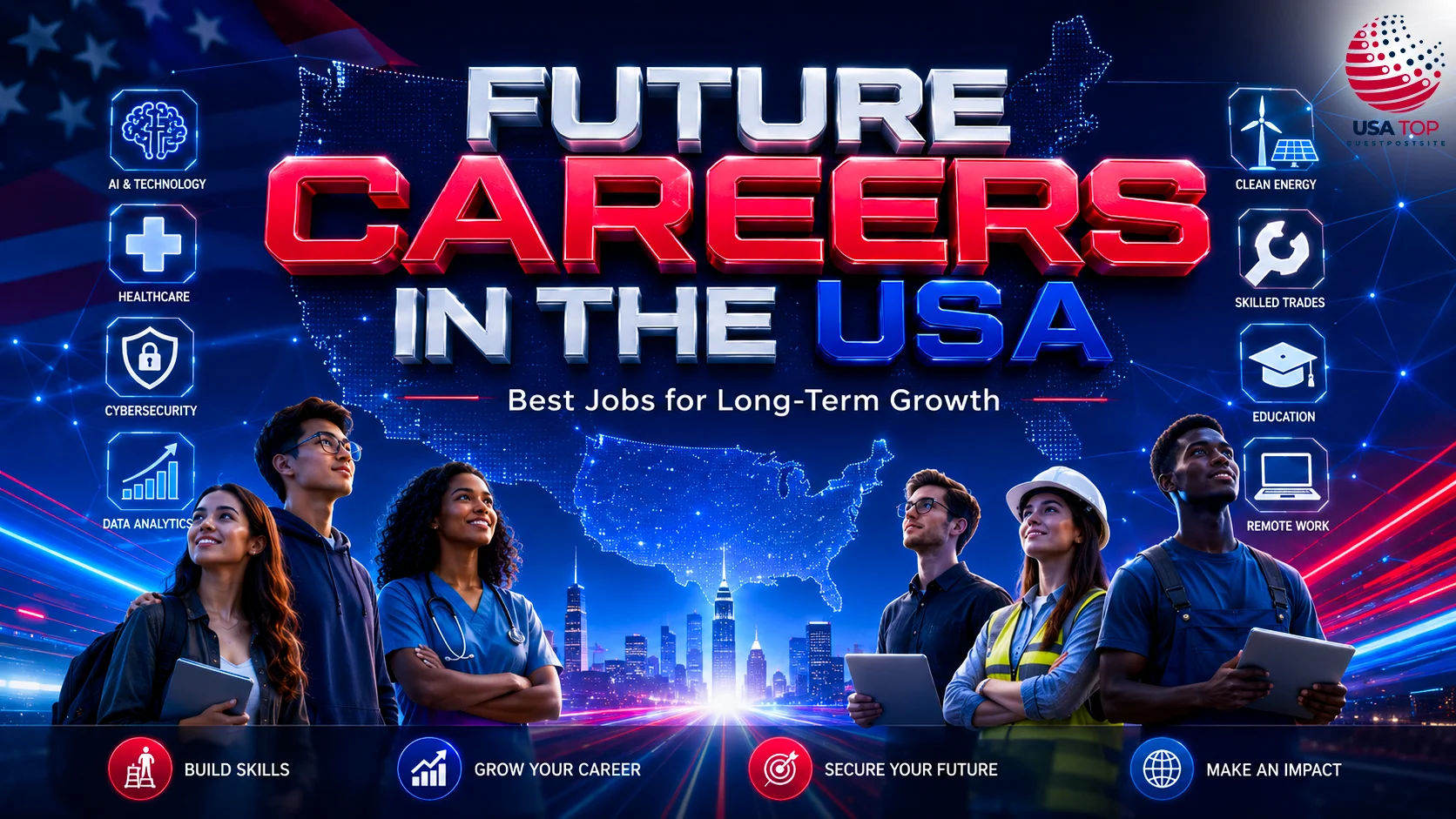
The best future careers in the USA are often found in healthcare, technology, AI, data, cybersecurity, green energy, and skilled trades.
These fields are strong because people need them. Healthcare supports patients and older adults. Technology helps businesses run. Cybersecurity protects data. Green energy supports new infrastructure. Skilled trades keep buildings and homes working.
Some of the best future careers need a college degree. Others need certificates, trade school, apprenticeships, or hands-on practice. That gives you more ways to build a stable future.
| Career Field | Example Jobs | Why It Has Future Demand |
| Healthcare | Nurse, medical assistant, therapy aide | People always need care |
| Technology | Software developer, IT support | Businesses need digital tools |
| AI and Data | Data analyst, AI specialist | Companies need smarter systems |
| Cybersecurity | Security analyst, cyber technician | Online threats keep growing |
| Green Energy | Solar installer, wind technician | Clean energy needs workers |
| Skilled Trades | Electrician, plumber, HVAC tech | Buildings need repair and service |
These future careers in the USA can fit many learners. You can choose a degree path. You can also choose a faster skills-based path.
Which Careers Will Be in Demand in the Next 10 Years?
Careers in healthcare, AI, data, cybersecurity, renewable energy, and skilled trades may stay in high demand in the next 10 years.
These jobs match long-term needs in the USA. Healthcare grows because people need care. Cybersecurity grows because digital risks keep rising. AI and data grow because companies want faster decisions. Skilled trades stay useful because real homes, offices, and cities need support.
High demand does not always mean easy entry. You still need training, practice, and proof of skill. A certificate, internship, project, course, or apprenticeship can help you start.
Some strong examples include:
- Nurse practitioners, registered nurses, medical assistants, and home health aides
- Data analysts, cybersecurity specialists, AI support workers, and software developers
- Solar installers, wind turbine technicians, electricians, plumbers, and HVAC technicians
These high-demand future careers can fit different goals. Some paths work well for college students. Some fit trade school learners. Others fit adults who want a better career change.

What Future Careers Are Best for Students After High School?
The best future careers for students depend on interests, skills, budget, training time, and long-term goals.
You do not need to know your whole future after high school. You only need a smart first step. Some students choose college. Others choose community college, trade school, online courses, or apprenticeships.
A student who likes computers may start with IT support. A student who enjoys helping people may start with healthcare support. A hands-on learner may prefer electrician work, plumbing, HVAC, or welding.
Good future careers for students may include healthcare support, IT support, web development, nursing paths, digital marketing, data analytics, electrical work, and HVAC services.
Before choosing, compare pay, training time, job demand, and daily tasks. Also think about your personality. Do you enjoy people, tools, computers, numbers, writing, or problem-solving? Your answer can guide your next move.
What Future Careers Are Growing in Technology and AI?
Future careers in technology and AI include software, data, cybersecurity, cloud support, automation, and AI-related roles.
AI is changing work. It does not replace every worker. In many cases, it changes daily tasks first. People who learn AI tools may have better options than people who ignore them.
Strong future careers in technology include software developer, data analyst, cybersecurity analyst, cloud support specialist, IT project coordinator, and automation support worker.
Strong future careers in AI may include AI specialist, machine learning support, prompt workflow assistant, AI product support, and data quality specialist.
In my opinion, tech learners need two key strengths. You need tool skills. You also need clear communication. Companies value people who can solve problems and explain technical ideas in simple words.
What Future Careers Are Strong in Healthcare?
Future careers in healthcare are strong because people always need treatment, care, and support.
Healthcare is one of the most stable fields in the USA. It serves children, adults, older people, and people with long-term health needs. That makes it a strong career area for many learners.
This field also offers many entry points. Some roles need advanced degrees. Others need short training, certificates, or associate degrees. That helps students and career changers choose flexible routes.
Strong future careers in healthcare may include:
- Nurse practitioner, registered nurse, and medical assistant
- Home health aide, therapy assistant, and mental health support worker
- Health information technician and healthcare support specialist
If you enjoy helping people, healthcare may fit your future. It can offer purpose, growth, and steady demand.
What Future Careers Can You Start Without a 4-Year Degree?
Many future careers do not require a four-year degree, but they still need skill, training, and commitment.
This matters for many USA readers. College can cost a lot. You may want faster job entry. You may also prefer hands-on work instead of long classroom study.
Strong non-degree paths can still lead to good income and career growth. These jobs often use trade schools, apprenticeships, certificates, community colleges, and real job training.
Examples include electrician, plumber, HVAC technician, medical assistant, IT support specialist, cybersecurity technician, solar installer, wind turbine technician, web developer, and welder.
These future career opportunities may help you start faster. They may also help you avoid heavy student debt. Still, non-degree does not mean low skill. You must learn, practice, and improve.
What Are the Highest Paying Future Careers?
Some of the highest-paying future careers are in healthcare, technology, AI, data, finance, engineering, and leadership.
These roles often pay well because they solve complex problems. They also need advanced skills, strong training, experience, or proven results.
Examples may include physician assistant, nurse practitioner, software engineer, data scientist, cybersecurity manager, AI engineer, cloud architect, financial manager, engineering manager, and product manager.
Still, you should not chase salary alone. Pay matters, but lifestyle matters too. Check stress, work hours, education cost, and long-term demand before choosing.
A good career should support your life. It should not only look impressive online.
Which Future Careers Are Safer From AI and Automation? Future-proof careers often need human judgment, care, creativity, leadership, hands-on work, and emotional intelligence.
No job is fully safe from change. AI can affect many tasks. Still, some careers depend on human skill too much to disappear easily.
AI-resistant areas may include healthcare roles, skilled trades, mental health support, education, cybersecurity, leadership, human services, and complex repair work.
A nurse must read patient needs. A plumber must solve problems inside real homes. A teacher must guide real people. A cybersecurity worker must respond to new threats.
You should not fear AI. You should learn how to use it. AI can help you research, plan, write, organize, and analyze. Your human skill still matters most.
What Skills Do You Need for Future Careers?
The most useful skills for future careers include digital literacy, problem-solving, communication, AI awareness, adaptability, and technical skills.
Job titles may change over time. Strong skills keep you ready. That is why you should build both hard skills and soft skills.
Important hard skills include coding basics, data basics, cybersecurity awareness, AI tools, healthcare knowledge, technical repair, project management, and digital marketing.
Important soft skills include communication, teamwork, leadership, emotional intelligence, time management, and critical thinking.
For example, a data analyst needs numbers. They also need clear writing. A nurse needs clinical skills. They also need patience. An electrician needs technical skills. They also need safety habits.
These future career trends show one clear lesson. Balanced skills matter more than ever.
How Can You Choose the Right Future Career Path?
You can choose the right career path by matching job demand, personal strengths, training time, income goals, and lifestyle needs.
Start with your strengths. Ask what you enjoy doing. Do you like helping people? Do you like solving problems? Do you enjoy computers, tools, numbers, writing, or hands-on work?
Then research the job. Check salary range, training cost, education needs, local demand, and entry-level roles. You should also talk to people who already work in that field.
A simple step-by-step process can help:
- Know your strengths and interests
- Research job demand and salary
- Compare degree, certificate, or training needs
- Learn beginner skills through a course or project
- Test the field through an internship or job shadow
This process can help you choose with more confidence. It can also reduce the risk of wasting time and money on the wrong path.

What Future Career Trends Should USA Readers Watch?
USA readers should watch AI, healthcare growth, green energy, cybersecurity, remote work, skilled trades, and online learning.
These future career trends are shaping jobs across the country. AI is changing office tasks. Healthcare is growing because care needs keep rising. Green energy is creating new field roles. Cybersecurity is expanding because digital risks keep growing.
Remote work is also changing career access. You may work for a company in another state. That can create more options. It can also create more competition.
Online learning makes skill-building easier. You can learn technology, business, marketing, writing, design, data, or project management from home.
Still, learning alone is not enough. You need proof. Build projects, earn certificates, create samples, gain experience, and show your skills clearly.
Are Future Careers Worth Planning for Now?
Yes, future careers are worth planning for now because early planning can help you make smarter career choices.
You do not need to plan your whole life today. You only need to take the next useful step. That step may be a course, certificate, internship, trade program, or research plan.
Students can use career planning to choose stronger majors. Parents can use it to guide children. Job seekers can use it to move into better fields. Career changers can use it to protect future income.
The best future careers match three things. They match market demand. They match your strengths. They also match your lifestyle.
If you keep learning and adapting, you can build a career with more confidence. For more USA-focused career, business, technology, and growth guides, explore helpful content on USATopGuestPostSite.org.
Top 5 Short FAQs About Future Careers
What are the best future careers in the USA?
The best future careers often include healthcare, technology, cybersecurity, data, renewable energy, and skilled trades. These fields support long-term demand.
Which career is best for the future?
The best career depends on your skills, goals, and budget. Healthcare, AI, data, cybersecurity, and skilled trades are strong options.
What jobs will be in demand in the next 10 years?
Healthcare, clean energy, technology, data, and skilled trade jobs may stay in demand. These roles solve real needs.
What future careers do not require a degree?
Many non-degree paths can still be strong. Examples include IT support, electrician work, HVAC, medical assistant, solar installer, and web development.
What skills are needed for future careers?
You need digital skills, communication, problem-solving, adaptability, AI awareness, and technical knowledge. The exact skills depend on your field.


