
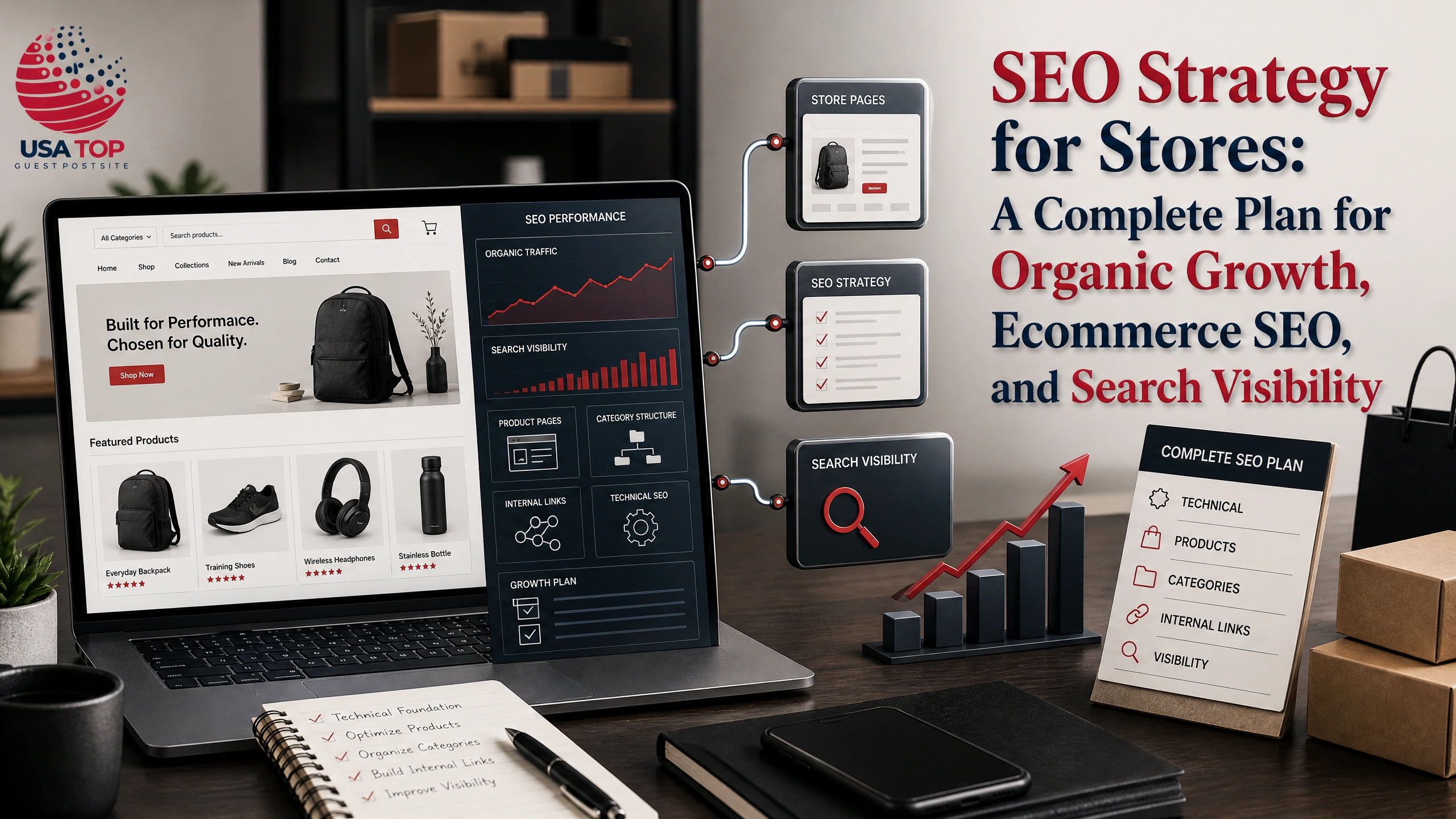
A successful SEO Strategy for Stores is a complete system for helping the right customers find the right products, categories, locations, and information through organic search. It combines keyword research, search intent, keyword mapping, ecommerce site architecture, product page optimization, category SEO, technical SEO, internal linking, content marketing, local SEO, trust signals, and ongoing performance measurement.
The strongest strategy does not treat SEO as a process of placing the same keyword throughout a page. Instead, it connects the way people search with the pages that can best satisfy those searches. A person looking for a specific product needs a different page from someone comparing several options, learning how to choose a product, or searching for a nearby store.
For that reason, a strong SEO strategy for online stores begins with understanding the customer journey and then building a website around it. Product pages should serve specific buying intent. Category pages should support broader commercial searches. Informational content should answer questions and help people make decisions. Physical stores should also consider local search when location matters to the customer.
This guide explains how to build an effective SEO Strategy for Stores for ecommerce businesses, retail websites, physical stores, and businesses that operate both online and offline.
What Is an SEO Strategy for Stores?
An SEO Strategy for Stores is a structured plan for improving a store’s organic visibility by matching relevant search queries with the right pages and making those pages useful, understandable, accessible, and easy to navigate.
For an e-commerce store, the strategy may focus heavily on product pages, category pages, search intent, website architecture, duplicate content, structured information, and transactional search behavior. A physical retailer may also need local SEO, location pages, accurate business information, customer reviews, and visibility for location-based searches.
The strategy becomes stronger when all of these areas work together.
A simple framework looks like this:
Customer search → Search intent → Keyword cluster → Correct page type → Useful content → Clear internal links → Technical accessibility → Measurement and improvement
For example, a search for “waterproof hiking backpack” may be best served by a category page, while “40L waterproof hiking backpack” may be more appropriate for a specific product page. A query such as “how to choose a hiking backpack” has a different purpose and may deserve an informational guide.
Understanding this relationship is one of the foundations of effective semantic SEO and topical relevance.
Why Do Stores Need an SEO Strategy?
Stores need an SEO strategy because customers do not all search in the same way.
Some people already know exactly what they want to buy. Others are comparing options, researching features, checking prices, solving a problem, or looking for a nearby business. A store that creates only product pages may miss valuable informational searches. A website that publishes only blog posts may fail to connect that traffic with relevant commercial pages.
Without a clear strategy, stores often face problems such as multiple pages targeting the same search intent, thin category pages, duplicate product descriptions, weak internal linking, poor website hierarchy, orphan pages, crawlability issues, or content that attracts traffic without helping users move toward a useful next step.
A well-planned retail SEO strategy solves these problems by giving each important page a clear role.
The objective is not simply to generate more visits. The goal is to attract relevant visitors and help them move from search to information, comparison, product discovery, purchase, contact, or store visit.
How Is SEO for Stores Different From Traditional SEO?
SEO for stores is more complex than optimizing a simple informational website because store websites often manage large numbers of products, categories, filters, variations, prices, availability changes, and transactional pages.
A traditional informational website may primarily focus on answering questions. An e-commerce or retail website must also consider product discovery, category hierarchy, duplicate content, faceted navigation, transactional search intent, product attributes, internal linking, and the relationship between commercial and informational pages.
A practical store SEO system often follows this path:
Keyword research → Search intent → Keyword mapping → Site architecture → Category pages → Product pages → Supporting content → Internal linking → Technical SEO → Trust and authority → Measurement
The important point is that not every keyword should become a separate page.
Closely related searches with the same intent can often be served by one strong page. A different search intent may require a separate URL even when the keywords are closely related.
| Search Query | Search Intent | Best Page Type |
| Best hiking backpack for beginners | Commercial investigation | Buying guide |
| Hiking backpacks | Commercial | Category page |
| 40L waterproof hiking backpack | Transactional | Product page |
| How to choose a hiking backpack | Informational | Blog guide |
| Hiking backpack store near me | Local | Location or store page |
This type of keyword-to-page mapping helps prevent keyword cannibalization and gives every important page a clearer purpose.
How Do You Build an SEO Strategy for a Store?
The best SEO Strategy for Stores starts with the business itself, not a random list of keywords.
First, identify what the store sells, who the customers are, how they search, which products or categories matter most, and whether the business operates online, from a physical location, or through both channels.
Then build the strategy around the following process.
Understand Your Store, Customers, and Search Opportunities
Start with the products, services, categories, customer problems, and buying decisions that are most important to the business.
Look at the language customers use when they search. They may search by product type, brand, feature, material, size, problem, use case, price, comparison, or location.
This creates the foundation for ecommerce keyword research and search intent analysis.
Identify the Search Intent Behind Each Keyword
A keyword is not useful simply because it has search volume.
You also need to understand what the searcher expects to find.
A useful intent framework includes:
Informational intent for questions, education, and problem solving.
Commercial investigation for comparisons, recommendations, and buying decisions.
Transactional intent for specific products or purchase-focused searches.
Local intent for searches where visiting or contacting a physical business matters.
The same product can appear across all four stages.
For example, someone may first search for “how to choose a hiking backpack,” later search “best hiking backpacks for beginners,” then search a specific product, and finally search for a local retailer.
A strong strategy gives these searches appropriate destinations instead of forcing them all onto one product or category page.
Map Keywords to the Correct Pages
Keyword mapping is one of the most important parts of store SEO.
Each important keyword cluster should be assigned to the page type that can best satisfy the search.
A simple structure may include:
Homepage for broad brand and business relevance.
Category pages for broader commercial product searches.
Subcategory pages for more specific product groups.
Product pages for individual products and specific transactional searches.
Buying guides and blog content for informational or comparison queries.
Location pages for relevant local searches.
This approach supports a clearer content ecosystem and makes internal linking more purposeful.

How Should Ecommerce Stores, Physical Stores, and Hybrid Businesses Approach SEO?
The right SEO Strategy for Stores depends partly on how the business operates.
An ecommerce-only business usually needs to focus heavily on product discovery, category optimization, product page SEO, technical performance, internal linking, and content that supports buying decisions.
A physical retailer should add local search considerations when customers can visit the business. Accurate business information, location pages, reviews, local relevance, and Google Business Profile management can become important parts of the strategy.
A hybrid business should connect both systems. Its product and category pages should support ecommerce discovery, while location pages and local information should help customers who want to visit or interact with a physical store.
The following framework can help determine where to focus.
| Store Type | Primary SEO Focus |
| Ecommerce only | Product SEO, category SEO, technical SEO, site architecture, content |
| Physical store | Local SEO, location pages, business information, reviews, local content |
| Ecommerce and physical | Product and category SEO, local visibility, location architecture, content, technical SEO |
This distinction prevents businesses from applying local tactics where they are not relevant or ignoring local opportunities when physical presence matters.
How Do You Find the Right Keywords for an Online Store?
The right keywords are the searches that are relevant to the store’s products, customer needs, search intent, and business goals.
Start by collecting keywords around products, categories, features, attributes, use cases, customer problems, comparisons, and questions.
Then group them by meaning rather than treating every wording variation as a completely separate target.
Product Keywords
Product keywords usually describe a specific item or a highly specific product need.
They may include:
Product names, models, sizes, materials, features, compatibility, colors, or use cases.
These keywords often belong on product pages when the page genuinely matches the search.
Category Keywords
Category keywords represent broader groups of products.
For example, “hiking backpacks” may belong to a category page, while a specific model belongs to an individual product page.
The category page should help users browse, compare, and narrow their options.
Informational Keywords
Informational keywords usually represent questions or research needs.
Examples include:
How to choose the right product.
What is the difference between two product types?
Which feature matters most?
How to use or maintain a product.
These searches can support blog articles, guides, comparison pages, and educational content.
Commercial and Transactional Keywords
Commercial searches often involve evaluation, while transactional searches usually show a stronger interest in a specific product or purchase.
Terms such as “best,” “compare,” “price,” “buy,” and specific product names can provide useful context, but the entire query and search results should be considered before deciding which page to create.
The goal is not to collect the largest possible keyword list. The goal is to understand the topics and search behaviors that matter to the store.
How Do You Avoid Keyword Stuffing While Using Relevant SEO Keywords?
The safest way to avoid keyword stuffing is to use a keyword only when it helps communicate the meaning of the sentence.
A page can naturally cover a primary keyword, keyword variations, related terms, product attributes, user questions, entities, and supporting concepts without repeating the same exact phrase in every paragraph.
For example, an article about a store SEO strategy can naturally discuss ecommerce SEO, retail SEO, online store optimization, product pages, category pages, keyword mapping, search intent, technical SEO, local visibility, structured data, internal linking, and content marketing because these concepts are genuinely connected to the topic.
The key is context.
Instead of repeatedly inserting the exact target phrase, vary the language according to what the section is actually discussing. When the topic is product optimization, discuss product page SEO. When the focus is local visibility, discuss local SEO. When explaining search architecture, use terms such as category hierarchy, navigation, crawlability, and internal links.
This creates semantic depth without making the content sound artificial.
How Should You Structure a Store Website for SEO?
A strong ecommerce site architecture helps users and search engines understand how the website is organized.
A simple structure may look like this:
Homepage → Main category → Subcategory → Product
Supporting content can connect to relevant commercial pages when that connection helps the reader.
For example, imagine a store that sells outdoor equipment.
Homepage
→ Hiking Backpacks
→ Waterproof Hiking Backpacks
→ 40L Waterproof Hiking Backpack
The supporting content could include:
How to Choose a Hiking Backpack
Best Hiking Backpacks for Beginners
30L vs. 40L Hiking Backpacks
These informational pages can link naturally to the relevant category when readers are ready to explore products.
A logical architecture should focus on clear navigation, useful categories, reasonable click depth, crawlable links, breadcrumbs, and contextual internal linking.
The site should not create hundreds of thin pages simply to target minor keyword variations.
How Do You Optimize Product Pages for SEO?
A product page should provide enough useful and unique information to help a customer understand the product and make a decision.
An effective product page may include a clear product title, unique description, important features, specifications, materials, size or compatibility information, relevant use cases, accurate availability details, product images, descriptive alt text, genuine reviews where available, related products, and helpful internal links.
The content should answer questions such as:
What is this product?
Who is it for?
What problem does it solve?
What features or specifications matter?
How does it differ from related options?
What should the customer know before purchasing?
Avoid relying entirely on generic manufacturer descriptions when the same wording appears across many websites.
Unique product content can help differentiate the page while giving customers a clearer reason to trust the information.
A product page does not need unnecessary text. It needs the information that helps users understand the product and complete their task.
How Do You Optimize Category Pages for SEO?
Category pages often have significant SEO potential because they can target broader commercial searches.
A useful category page should do more than display a collection of products.
Depending on the search intent, it may provide a clear category title, a concise introduction, useful subcategory links, logical filtering, product options, buying considerations, relevant frequently asked questions, and links to supporting guides.
For example, a hiking backpack category page might help users understand the difference between daypacks, travel backpacks, waterproof options, and larger hiking packs before directing them toward the most relevant products.
The amount of content should depend on what users need.
Adding text only to increase word count does not automatically improve a category page. The content should help visitors browse, compare, and make better decisions.
How Can Internal Linking Improve Store SEO?
Internal linking connects the important parts of a store’s website and helps users move between related information, categories, and products.
A useful internal linking system might follow these relationships:
Informational guide → Relevant category page
Category page → Subcategory or product page
Product page → Related products
Product page → Helpful buying or usage guide
Location page → Relevant store or category page
The anchor text should describe what the reader can expect after clicking.
For example, an article explaining content strategy can naturally connect to a relevant guide on building a complete marketing strategy when the topic moves from organic search into broader business growth.
Similarly, content about the customer journey can connect naturally to a complete marketing funnel guide when explaining how informational, commercial, and transactional searches can represent different stages of decision-making.
The purpose of internal linking is not to insert as many links as possible. Each link should provide a useful next step.
What Technical SEO Issues Can Affect Store Visibility?
Technical SEO helps ensure that important pages can be discovered, crawled, understood, and indexed appropriately.
For stores, several areas deserve regular attention.
Crawlability and Indexability
Important pages should be accessible to search engines when they are intended to appear in search.
Broken internal links, incorrect robots directives, poor navigation, unnecessary URL patterns, and technical errors can make important content harder to discover.
Canonicalization and Duplicate Content
Stores can create similar or duplicate URLs through product variations, filters, sorting options, parameters, and repeated product information.
Canonicalization can help indicate the preferred version when multiple similar URLs exist.
The correct approach depends on the website structure and the purpose of each page.
Faceted Navigation
Filters can improve the shopping experience, but uncontrolled combinations may create a large number of low-value URLs.
Before allowing a filtered page to become an important search destination, consider whether it serves a distinct and meaningful search intent.
| Filtered Page Situation | Strategic Consideration |
| Distinct search demand and useful product selection | May deserve a dedicated SEO approach |
| Near-duplicate filter combinations | Avoid unnecessary indexable pages |
| Temporary sorting parameters | Usually not a separate search target |
| Valuable product variation with clear intent | Evaluate whether a dedicated landing page is useful |
Page Speed and User Experience
Slow pages can create friction, especially on mobile devices.
Review image delivery, unnecessary resources, page weight, scripts, templates, and other performance factors based on actual testing.
Mobile Optimization
Store navigation, product filters, images, descriptions, buttons, and conversion paths should remain easy to use on smaller screens.
XML Sitemaps and Site Discovery
An XML sitemap can help communicate important URLs, but it should support rather than replace logical navigation and internal linking.
Technical SEO is most effective when it supports a clear content and website strategy.

How Can Content Marketing Support Store SEO?
Content marketing can help a store reach people before they are ready to purchase.
Useful content may include buying guides, product comparisons, how-to articles, maintenance guides, troubleshooting resources, use-case content, and answers to common questions.
A strong content strategy connects these resources with relevant commercial pages.
For example:
A user searches for “how to choose a hiking backpack.”
The guide explains the important factors.
The guide then naturally directs the reader toward the relevant backpack category.
The category page helps the user browse available options.
The product page provides the details needed to evaluate or purchase a specific item.
This creates a connected journey:
Question → Helpful answer → Comparison or exploration → Relevant category → Product decision
This type of relationship can also support a broader content and marketing strategy for business growth by connecting search visibility with the customer’s overall decision process.
The goal is not to publish large volumes of unrelated articles. A better approach is to build topic clusters around products, customer problems, comparisons, and buying decisions.
How Can Stores Build Trust, Authority, and E-E-A-T?
Trust should be visible throughout the website rather than added as an afterthought.
For a store, useful trust signals may include accurate business information, clear product details, genuine customer reviews, transparent policies, identifiable authors or editors for informational content, relevant expertise, and content that is reviewed or updated when necessary.
Informational content should clearly reflect who created it and why the source is qualified to discuss the subject when that information is available.
Stores should avoid fake reviews, invented case studies, fabricated statistics, or unsupported claims.
Authority can also grow through useful resources, relevant industry relationships, editorial mentions, partnerships, original research where genuinely available, and content that other websites or users have a reason to reference.
The strongest authority strategy is based on genuine relevance and usefulness rather than collecting large numbers of low-quality links.
How Should Physical Stores Use Local SEO?
Physical stores should use local SEO when location is relevant to how customers discover, contact, or visit the business.
A local strategy may involve accurate business information, location pages, customer reviews, consistent business details, local relevance, and Google Business Profile management.
An online-only business without a customer-facing location usually has different priorities. Its main focus may be ecommerce SEO, product discovery, category visibility, content, and technical performance rather than location-based optimization.
A hybrid business can combine both approaches.
For example, an outdoor retailer that sells products online and operates physical stores can optimize category and product pages for broader search visibility while maintaining useful location pages for customers searching for a nearby store.
This creates a clearer connection between the business’s online presence and its real-world locations.
How Can Structured Data Support Store SEO?
Structured data can provide additional context about the information on a page when it accurately represents the visible content.
Different page types may have different structured information needs.
| Page Type | Relevant Structured Information |
| Informational article | Article-related markup |
| Product page | Product information |
| Breadcrumb navigation | Breadcrumb information |
| Organization pages | Organization information |
| Eligible review content | Relevant review information |
The most important rule is accuracy.
Structured information should match what users can actually see on the page. It should not be used to represent information that is hidden, misleading, or unsupported.
Structured data can help search systems understand content more clearly, but it should be treated as part of a broader SEO strategy rather than as a guaranteed ranking method.
How Can Stores Improve Visibility in AI-Powered Search?
Stores can improve their chances of being understood in AI-powered search by creating useful, well-structured, original, and context-rich content that answers real customer questions.
There is no need to create a separate list of artificial “AI keywords.”
Instead, focus on making important information easy to understand.
A useful section can follow this structure:
Question → Direct answer → Explanation → Example → Condition or exception where relevant
For example:
A store should create separate pages for different search intents when one page cannot fully satisfy all of those needs. A broad category search, a specific product search, and an informational question often require different page types because the searcher expects different information.
The explanation can then provide examples and show how the pages connect.
This structure helps create self-contained answers while also providing enough context for readers who want more detail.
Use Natural Customer Questions
A strong store SEO resource should cover questions such as:
What is an SEO strategy for stores?
How does SEO work for an online store?
How do you choose ecommerce keywords?
How do you match store keywords with search intent?
What is the difference between a product keyword and a category keyword?
Should every product page have unique content?
How do canonical tags help with duplicate content?
When does a store need local SEO?
What type of content can support product discovery?
How should stores measure SEO performance?
These questions should not be added only as a keyword list. Each one should appear where it naturally fits into the topic.
Provide Complete Context
A short answer can be useful, but context makes it more valuable.
For example, saying “physical stores need local SEO” is incomplete.
A better explanation identifies when local SEO is relevant, what type of business can benefit, and how a hybrid business can combine local and ecommerce strategies.
Conditions, comparisons, examples, and exceptions help create a more complete resource.
Use Consistent Entity and Topic Relationships
A store SEO strategy naturally connects several important concepts:
Search intent
Keyword research
Keyword mapping
Product pages
Category pages
Website architecture
Internal linking
Technical SEO
Content marketing
Local SEO
Structured information
Trust and authority
Performance measurement
These concepts should appear where they help explain the topic rather than being inserted artificially.
What Are the Most Common Store SEO Mistakes?
Several mistakes can weaken an otherwise strong SEO Strategy for Stores.
Targeting Every Keyword on One Page
Different keywords can represent different intents.
Trying to satisfy informational, transactional, commercial, and local searches with one page often creates an unfocused result.
Repeating Keywords Unnaturally
Using the same phrase repeatedly can make content difficult to read.
A better approach is to explain the topic completely and use related terminology where it naturally belongs.
Creating Thin Product or Category Pages
Important commercial pages should provide enough information to help users understand products, compare options, and take the next step.
Ignoring Duplicate Content
Product variations, filters, copied descriptions, and URL parameters can create unnecessary duplication.
Publishing Isolated Blog Content
Informational content should connect naturally with relevant products, categories, or other useful resources when appropriate.
Ignoring Technical SEO
Important pages cannot perform as intended if search systems struggle to discover or access them.
Applying Local SEO Without Real Local Relevance
Location pages and local targeting should reflect genuine business relevance rather than being created only to target additional cities.
Chasing AI Visibility With Keyword Tricks
AI visibility is better approached through clear answers, useful information, original examples, logical structure, strong topical relationships, and accessible content.
No content structure can guarantee a specific ranking position or guaranteed inclusion in an AI-generated result.
How Do You Measure the Performance of a Store SEO Strategy?
SEO performance should be measured across the entire system rather than through a few individual keyword rankings.
Review search visibility, page performance, technical health, and business outcomes.
Search Visibility
Monitor organic clicks, impressions, click-through rate, query trends, and changes in the visibility of important topics.
Page Performance
Review how product pages, category pages, informational content, and location pages perform.
Look for pages that receive impressions but few clicks, pages that attract traffic without supporting business goals, and pages that have lost visibility.
Technical Health
Monitor indexing issues, crawl errors, broken pages, important site changes, mobile usability, and other technical problems that affect important URLs.
Business Impact
Where relevant, connect SEO performance with organic conversions, leads, revenue, product discovery, or other meaningful outcomes.
The most useful KPI depends on the store’s business model and goals.
A broader understanding of customer progression can also be supported by mapping the stages of the marketing funnel, especially when informational content, commercial pages, and transactional pages serve different stages of the decision process.
How Should You Update an SEO Strategy for a Store?
An SEO strategy should evolve when the website, products, customer behavior, or search environment changes.
Do not update content simply to change the publication date.
Update it when there is a meaningful reason.
| Update Trigger | What to Review |
| Organic traffic declines | Search intent, content quality, competitor changes |
| CTR drops | Title, description, search-result alignment |
| New product or category | Keyword mapping, page structure, internal links |
| Important rankings decline | Content gaps, search intent, technical issues |
| Website changes | Crawlability, indexing, redirects, internal links |
| New customer questions | Supporting content and FAQ coverage |
| Outdated information | Accuracy, examples, recommendations |
A useful update process is:
Measure → Identify the gap → Understand the cause → Improve the page → Monitor the result
This makes SEO maintenance more strategic than rewriting content without a clear reason.
What Is the Best SEO Strategy for Stores?
The best SEO Strategy for Stores is a connected system rather than a single optimization tactic.
It starts with understanding the store, its customers, products, locations, and business goals. It then uses keyword research and search intent to determine which pages should target which opportunities.
Product pages should satisfy specific transactional needs. Category pages should support broader commercial searches. Informational content should answer relevant questions and help users make decisions. Physical stores should add local search strategies when location matters.
A strong strategy also requires logical site architecture, useful internal linking, technical accessibility, accurate structured information, trust signals, relevant content, and regular performance measurement.
The most sustainable approach is not to optimize a store around a list of repeated keywords.
It is to build a useful search experience around the products people want, the questions they ask, the comparisons they make, and the decisions they need to make before taking the next step.
When search intent, keyword mapping, semantic relevance, product and category optimization, internal linking, technical SEO, local relevance, content quality, trust, and measurement work together, a store has a much stronger foundation for long-term organic growth and broader search visibility.
Frequently Asked Questions About SEO Strategy for Stores
What is an SEO strategy for stores?
An SEO strategy for stores is a structured plan for improving organic visibility through keyword research, search intent analysis, keyword mapping, product and category optimization, technical SEO, internal linking, useful content, local SEO where relevant, trust signals, and performance measurement.
How does SEO work for an online store?
SEO helps an online store match customer searches with relevant pages. Specific product searches can lead to product pages, broader commercial searches can lead to category pages, and informational questions can be answered through guides or supporting content.
How do you match store keywords with search intent?
Start by identifying what the searcher wants to accomplish. Then assign the keyword cluster to the page type that best satisfies that need, such as a product page, category page, buying guide, informational article, or location page.
What is the difference between a product keyword and a category keyword?
A product keyword is usually more specific and may describe an individual item, model, feature, or variation. A category keyword represents a broader group of related products and is often better suited to a category or subcategory page.
Should every product page have unique content?
Important product pages should provide useful information that accurately describes the individual product. Unique descriptions, relevant specifications, features, use cases, and other helpful details can make the page more useful than relying entirely on generic text that appears across multiple websites.
How do product descriptions affect SEO?
Product descriptions help explain what the product is, who it is for, and which features or attributes matter. The description should be written for customers first while naturally including relevant product terminology and information.
How do canonical tags help stores manage duplicate content?
Canonicalization can help indicate the preferred version of a page when multiple similar URLs exist. Stores often need to review product variations, filters, parameters, and other URL patterns to determine the appropriate canonical approach.
Does an online store need local SEO?
An online-only store does not necessarily need a location-focused strategy. Local SEO becomes more relevant when customers can visit, contact, or interact with a genuine physical business location.
Can ecommerce content appear in AI-powered search results?
Useful ecommerce content can be understood and surfaced across different search experiences when it clearly answers relevant questions, provides accurate context, remains accessible to search systems, and offers information that helps users make decisions. However, no strategy can guarantee inclusion in a particular AI-generated result.
What type of store content is useful for AI-powered search?
Buying guides, comparisons, how-to resources, product explanations, troubleshooting content, and clearly structured answers can all be useful when they address genuine customer questions and provide enough context to be understood independently.
How long does store SEO take?
SEO timelines vary based on competition, website condition, existing content, technical issues, site authority, available resources, and the scope of the strategy. Progress should be measured over time rather than based on a guaranteed ranking deadline.


