What Are Irish Travelers?
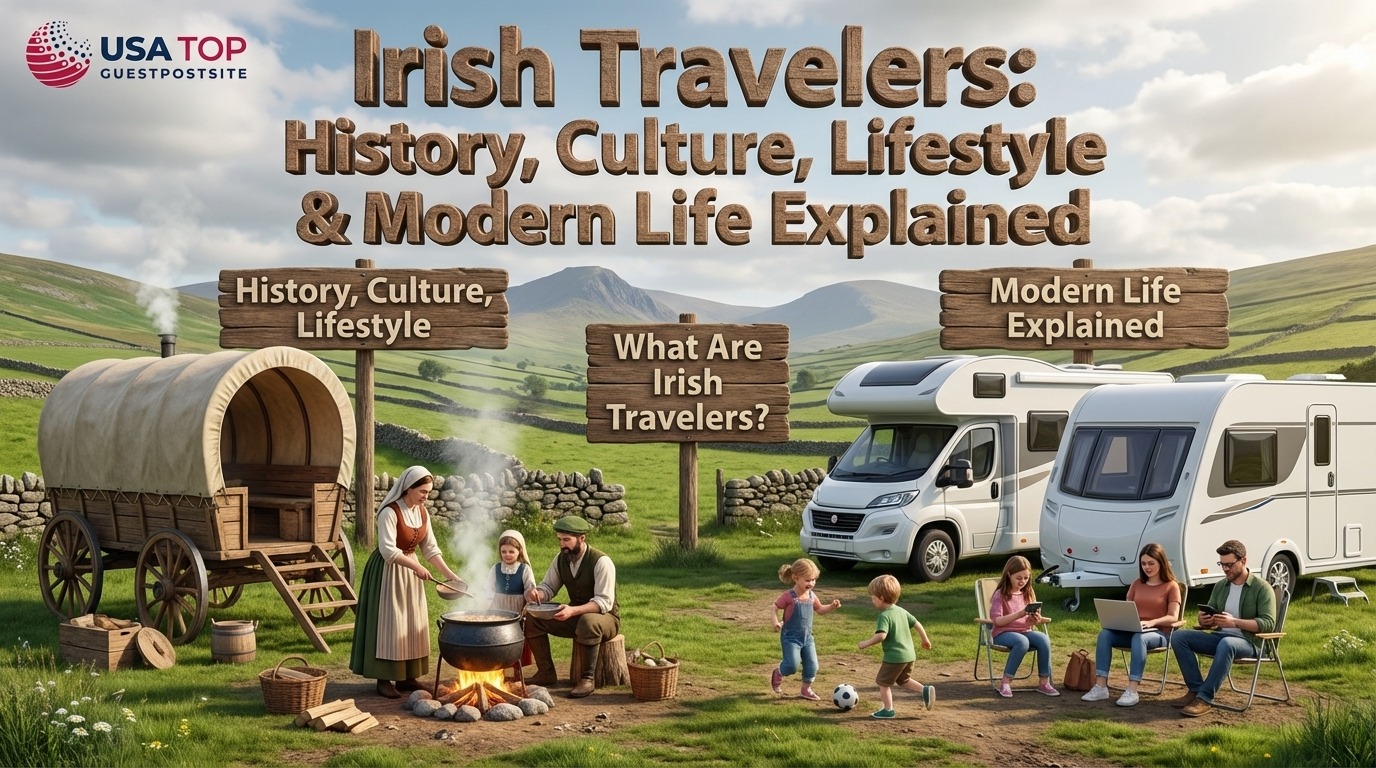
Irish Travelers are a distinct ethnic group with deep roots in Ireland, recognized officially for their unique identity, customs, and traditions. They are not simply people who travel — they are a community with their own social structures, language, and cultural heritage that stretches back centuries.
The term covers a broad and diverse population. Some Irish Travellers maintain a traditionally nomadic or semi-nomadic lifestyle. Others have settled into permanent homes while continuing to preserve their cultural identity. What unites them is a shared heritage that sets them apart from the general Irish population — and from other nomadic groups with whom they are often, incorrectly, conflated.
What Is an Irish Traveler and Where Did They Come From?
An Irish Traveler is a member of a historically nomadic community originating in Ireland. The precise origins of the community have been debated for generations, with various theories pointing to displacement during historical periods of famine and social upheaval, ancient craft-based traveling trades, or pre-Celtic nomadic traditions.
What’s clear is that Irish Travellers have existed as a distinct community for several centuries, developing their own culture, language, and way of life independently of the settled Irish population. Their identity isn’t defined by poverty or circumstance — it’s defined by a rich and continuously evolving cultural tradition.
Are Irish Travelers an Ethnic Group?
Yes, and this is an important distinction. Irish Travelers were formally recognized as a distinct ethnic group in Ireland in 2017 — a milestone that the community had long advocated for. This recognition acknowledges that they have a shared history, culture, and identity that qualifies them for ethnic group status under international human rights frameworks.
In the United Kingdom, Irish Travelers had already received ethnic minority recognition earlier. This legal status matters practically — it provides a framework for addressing discrimination and ensures cultural rights are protected under law.
Are Irish Travelers the Same as Gypsies or Romany People?
No, and the distinction matters. Irish Travelers and Romany people are two entirely separate ethnic communities. Romany people trace their origins to Northern India and migrated westward through Persia and into Europe over many centuries. Irish Travelers have distinct Irish origins and a completely different linguistic and cultural background.
The word “gypsy” is often applied loosely and inaccurately to both groups. Many members of both communities find the term offensive. Understanding the difference is a basic form of respect — and a necessary starting point for anyone genuinely interested in either culture.
What Language Do Irish Travelers Speak?
Irish Travelers traditionally speak Shelta, a unique language that blends elements of Irish Gaelic and English in ways that produce a distinctly separate tongue. Linguists have studied Shelta with significant interest because of its unusual structure and the way it encodes cultural meaning.
Shelta has historically served as both a practical communication tool within the community and a marker of cultural identity — a way of speaking that maintains community cohesion and privacy in interactions with the settled world. While English is the primary language of daily life for most Irish Travellers today, Shelta remains culturally significant and is still spoken within many families.
What Is Irish Traveler Culture and Tradition Like?
Irish Traveler culture is centered on family, faith, and community. Family bonds are extraordinarily strong — extended family networks provide the primary social structure, support system, and sense of belonging for most Irish Travellers. Large family gatherings for weddings, funerals, and religious celebrations are central to community life.
Marriage is a particularly significant cultural institution. Weddings are major occasions, typically celebrated with large gatherings and strong family involvement. They reflect both the community’s Catholic faith and its emphasis on family continuity and social connection.
Religion plays a central role — the vast majority of Irish Travelers follow Roman Catholicism, and faith shapes their values, their celebrations, and their approach to life and death in meaningful ways.
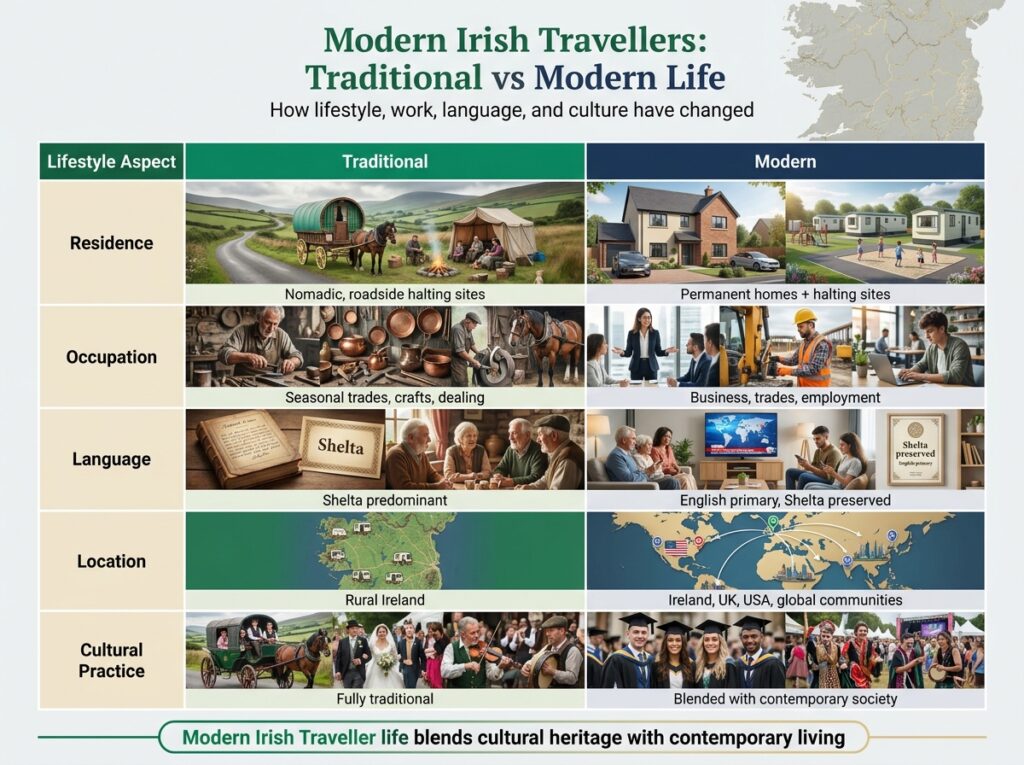
How Do Modern Irish Travelers Live Today?
| Lifestyle Aspect | Traditional | Modern |
| Residence | Nomadic, roadside halting sites | Mix of permanent homes and halting sites |
| Occupation | Seasonal trades, crafts, and dealing | Varied: business, trades, employment |
| Language | Shelta predominant | English primary; Shelta preserved culturally |
| Location | Primarily rural Ireland | Ireland, UK, USA, and globally |
| Cultural practice | Fully traditional | Blended with contemporary society |
The modern Irish Traveler lifestyle is genuinely diverse. Many families have settled into permanent accommodation in Ireland, the United Kingdom, and further abroad, while others continue traveling seasonally or permanently. The community isn’t frozen in time — it’s adapting, as all living cultures do, while working to preserve the traditions and values that define its identity.
Where Do Irish Travelers Live Today, Including the USA?
Irish Travelers in America represent a fascinating dimension of the community’s global spread. Communities of Irish Travellers in the United States exist in several states, most notably in South Carolina, with the town of Murphy Village being perhaps the best-known concentration. These communities have maintained strong cultural ties across generations while integrating into American life in their own distinctive ways.
Beyond the USA, significant Irish Traveler populations exist across the United Kingdom, particularly in England and Scotland, as well as in Australia and other countries where Irish emigration created lasting communities.
What Challenges Do Irish Travelers Face Today?
Irish Travelers continue to face significant challenges. Discrimination in housing, employment, and access to services remains a serious and documented reality. Social exclusion, lower life expectancy, and limited educational attainment relative to the settled population are persistent issues that advocacy organizations and the community itself are actively working to address.
Recognition of these challenges doesn’t reduce the community to its difficulties — Irish Travelers are a resilient, culturally rich group with much to offer. But honest acknowledgment of the barriers they face is part of understanding who they are in the contemporary world.
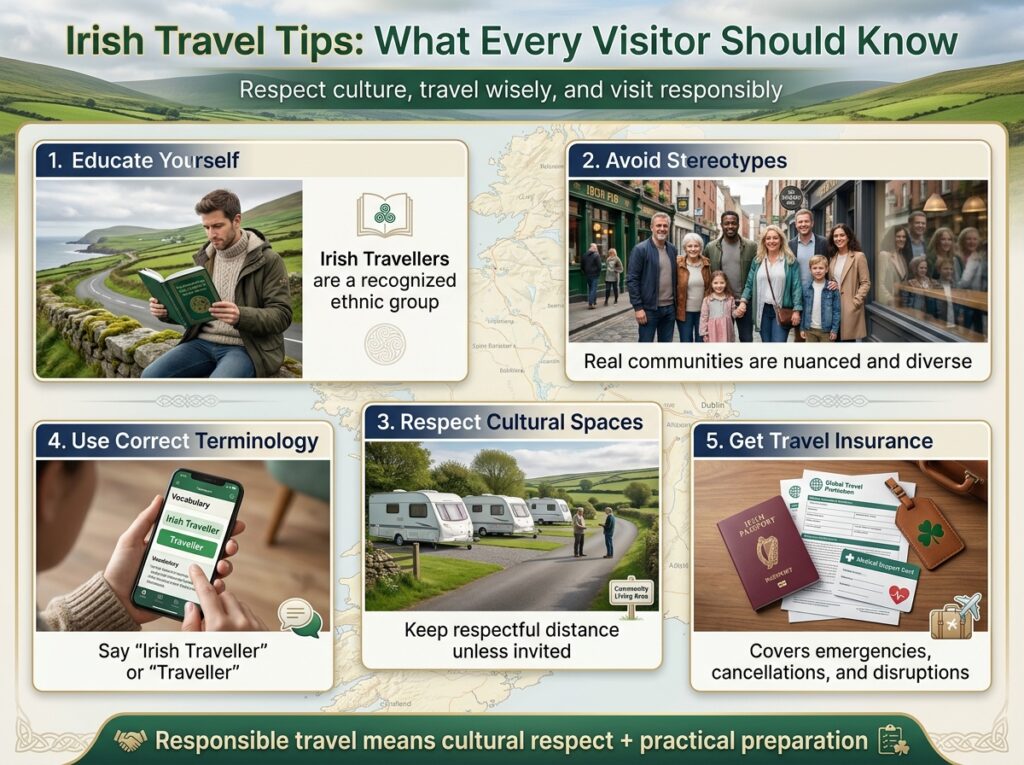
Irish Travel Tips: What Every Visitor Should Know
Here is a practical guide for visitors to Ireland who want to engage with the country’s full cultural landscape respectfully:
- Educate yourself before you go — Understanding that Irish Travellers are a recognized ethnic group with a distinct culture prevents the casual ignorance that leads to offense.
- Avoid stereotypes — Media portrayals have been consistently reductive. Real Irish Traveler communities are far more nuanced than any television program suggests.
- Respect cultural spaces — If you encounter a halting site or Traveler community, approach with the same respectful distance you’d extend to any community that hasn’t invited your presence.
- Use correct terminology — “Irish Traveler” or “Traveler” is the appropriate term. Avoid outdated or offensive labels.
- Get Irish travel insurance — For practical trip protection, Irish travel insurance covers medical emergencies, cancellations, and disruptions, and is recommended for all international visitors regardless of travel purpose.
FAQs
1. What are Irish travelers, and where do they come from?
Irish travelers are a distinct ethnic group originating in Ireland with a long history of nomadic traditions. They have their own culture, customs, and language, and today they live in Ireland as well as in countries like the United States and the UK.
2. Are Irish travelers the same as gypsies or Romany people?
No, Irish travelers are not the same as Romany people. Although both have nomadic traditions, Irish travelers have different origins, cultural practices, and language, making them a separate and unique ethnic group.
3. What language do Irish travelers speak?
Irish travelers traditionally speak Shelta, a unique language that blends Irish Gaelic and English. Many also speak standard English, especially in modern Irish traveler communities.
4. Where do Irish travelers live today?
Irish travelers live primarily in Ireland and the UK, but there are also established communities of Irish travelers in America and the United States, where they maintain cultural traditions while adapting to modern life.
5. What is the modern Irish traveler’s lifestyle like?
Modern Irish travelers may live either nomadic or settled lives. While some continue traveling, many live in permanent homes, balancing traditional customs with contemporary lifestyles in Ireland and abroad.