
The travel industry stands at a crossroads. For years, we’ve focused on sustainable tourism—reducing our footprint, minimizing harm, and preserving what’s already there. But what if we could do more? What if your next vacation could actually improve the places you visit, leaving them healthier and more vibrant than before you arrived?
Welcome to the world of regenerative tourism, where travel becomes a force for healing rather than harm. Recent studies show that 66% of travelers want to leave destinations better than they found them. This isn’t just a trend—it’s a fundamental shift in how we think about exploring our world.
What is Regenerative Tourism and Why is Everyone Talking About It?
Think of a beautiful meadow filled with wildflowers. Traditional tourism might trample those flowers. Sustainable tourism would teach you to tiptoe carefully around them. But regenerative tourism? That’s where you water the flowers, plant new seeds, and help the meadow flourish.
Regenerative tourism goes beyond doing less harm. It actively restores and enriches the places we visit. This approach transforms travelers from passive observers into active participants in healing communities and ecosystems.
The concept has gained remarkable momentum recently. Industry leaders are embracing this model because it addresses a simple truth: maintaining the status quo isn’t enough when many destinations are already degraded. We need travel that creates a positive impact in tourism, not just neutral outcomes.
What makes this approach revolutionary is its holistic vision. It considers environmental health, cultural vitality, and economic prosperity as interconnected goals. When you choose regenerative experiences, you’re investing in a destination’s future while creating deeper, more meaningful memories for yourself.
How Does Regenerative Tourism Differ From Sustainable Tourism?
Many people use these terms interchangeably, but they represent fundamentally different philosophies. Understanding this distinction helps you make better travel choices.
Sustainable tourism operates on a “do no harm” principle. It focuses on conservation, resource management, and minimizing negative impacts. Think of it as playing defense—protecting what exists and preventing further damage.
Regenerative tourism plays offence. It actively improves conditions, restores damaged ecosystems, and strengthens communities. The goal isn’t just to sustain current conditions but to make things better.
Here’s a practical comparison:
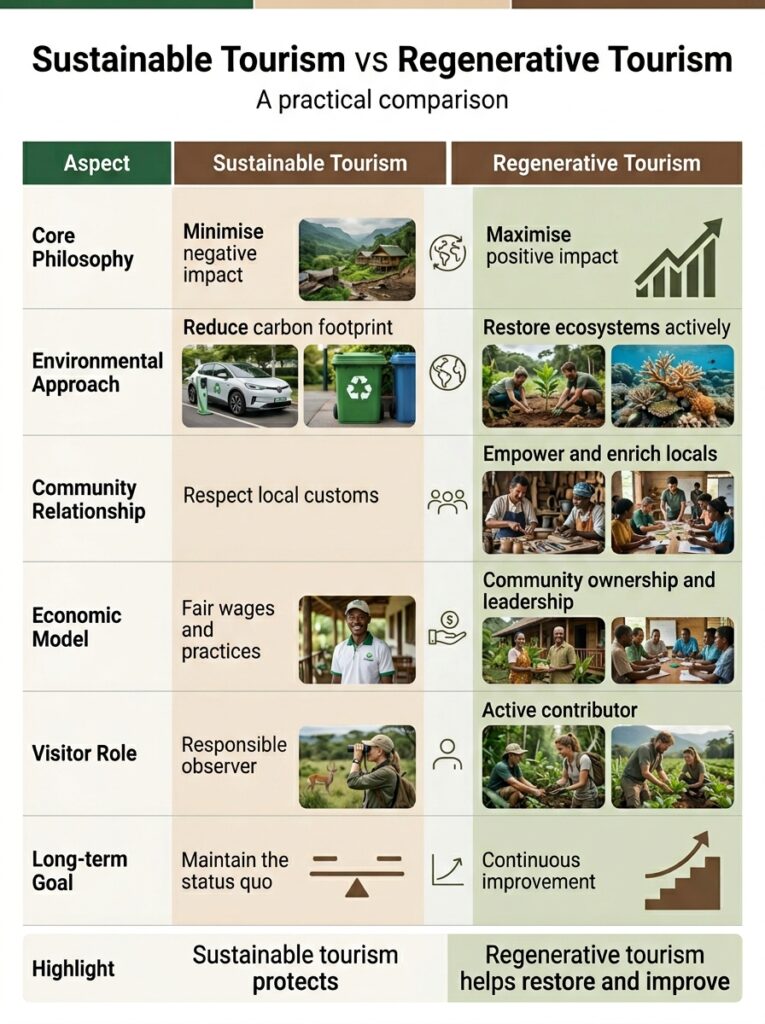
| Aspect | Sustainable Tourism | Regenerative Tourism |
| Core Philosophy | Minimize negative impact | Maximize positive impact |
| Environmental Approach | Reduce carbon footprint | Restore ecosystems actively |
| Community Relationship | Avoid exploitation | Empower and enrich locals |
| Economic Model | Fair wages and practices | Community ownership and leadership |
| Visitor Role | Responsible observer | Active contributor |
| Long-term Goal | Maintain the status quo | Continuous improvement |
Consider a coastal destination struggling with coral reef degradation. A sustainable resort might reduce water pollution and educate guests about reef conservation. A regenerative resort does all that, plus organises guest participation in coral restoration projects, funds marine biology research, and trains local youth as conservation guides.
This distinction matters because our planet needs more than preservation. Many destinations require active healing, and tourism can provide the resources and motivation to make that happen.
What Are the Key Principles Behind Regenerative Tourism?
Regenerative tourism rests on several foundational principles that guide how destinations, businesses, and travelers approach this model.
Active environmental restoration forms the cornerstone. This means going beyond reducing pollution to actively cleaning up waterways, replanting forests, and rebuilding habitats. Tourism becomes a funding mechanism for conservation projects that might otherwise lack resources.
Community empowerment ensures local voices lead decision-making. Indigenous groups and local residents determine how tourism develops in their areas. They’re not just employees—they’re partners and leaders who shape the visitor experience while protecting their cultural heritage.
Cultural preservation takes priority over commercialization. Rather than creating staged performances for tourists, regenerative approaches support authentic cultural exchange. Visitors learn traditional crafts from master artisans, participate in genuine ceremonies when invited, and contribute to preserving disappearing traditions.
The holistic impact perspective considers how every decision affects the entire system. A new hotel doesn’t just create jobs—it becomes part of the community fabric, supporting local suppliers, protecting nearby ecosystems, and contributing to long-term resilience.
These principles work together to create tourism that builds rather than depletes. They transform the relationship between visitors and destinations from extractive to reciprocal.
Why Does Regenerative Tourism Create More Positive Impact Than Traditional Travel?
The benefits of this approach ripple outward, touching communities, environments, and travelers themselves in profound ways.
For local communities, regenerative models create genuine economic opportunities. When tourism dollars flow directly to family-owned guesthouses, local restaurants, and community-led tours, they strengthen the entire local economy. Studies show that 69% of travelers actively want their money to support local communities rather than international corporations.
This approach builds economic resilience. Communities develop diverse income streams tied to their unique cultural and natural assets. They’re not dependent on a single resort or tour operator. Instead, they control their tourism narrative and benefit directly from sharing their home with visitors.
For the environment, the transformation is equally dramatic. Traditional tourism often depletes natural resources—think overcrowded beaches, polluted trails, and stressed wildlife populations. Sustainable travel solutions reduce these problems, but regenerative approaches actually improve environmental conditions.
Imagine a rainforest destination where visitor fees fund reforestation projects. Each tourist contributes to planting native trees, removing invasive species, and creating wildlife corridors. The forest becomes healthier because of tourism, not despite it. Carbon-negative destinations are already proving this model works.
For travellers, the rewards go beyond pretty photos and relaxation. Regenerative experiences offer something modern life rarely provides: genuine connection and purpose. You’re not just seeing a place—you’re contributing to its story and its future.
These experiences stick with you. Learning traditional cooking methods from a grandmother in her home kitchen creates memories no five-star restaurant can match. Planting trees alongside local conservationists gives you a living connection to that place that endures long after you’ve returned home.
The emotional satisfaction of making a positive impact in tourism transforms how you think about travel itself. You return home not just rested, but renewed and inspired.
What Are Some Successful Examples of Regenerative Tourism in Action?
Real-world examples show how these principles translate into transformative experiences.
Indigenous-led tourism in Guyana demonstrates the power of community control. At Reva Village, 300 community members protect 350 square kilometers of pristine rainforest. Visitors stay in community-run lodges, learn about traditional forest management, and contribute directly to conservation funding. Every tourist helps maintain one of Earth’s most biodiverse ecosystems while supporting sustainable livelihoods.
Panama’s PACTO program represents a national-level commitment to regeneration. Launched in 2020, the Panama Alliance for Community Tourism selected ten Indigenous communities to develop regenerative tourism experiences. The results have been remarkable—a 40% increase in visitors to participating communities, direct economic benefits flowing to local families, and strengthened cultural preservation efforts.
One Naso community member, Virginia Sososo, explains the impact: “For hundreds of years, we’ve fought for our land and culture. Finally, we have the chance to share it with others through community tourism. When people stay and spend time with us, it creates connections that respect our heritage rather than extract from it.”
Amsterdam’s innovative approach shows how cities can embrace regeneration. After residents voiced concerns about over tourism, the city adopted the Doughnut Economics framework. This model balances social needs with ecological limits, creating a “safe and just space” for both residents and visitors. While still developing specific policies, this framework signals a fundamental shift in urban tourism planning.
Carbon-neutral flight programs are making air travel part of the solution. Over 50 airlines now offer passengers options to offset emissions through verified conservation projects. These programs fund reforestation, renewable energy development, and community-based climate solutions. While imperfect, they represent the aviation industry’s recognition that travel must contribute to environmental healing.
Eco-lodges leading by example include properties like Six Senses Resorts, which go beyond sustainable building standards to create educational experiences. Guests tour organic gardens, learn about water conservation systems, and participate in hands-on environmental projects. The Four Seasons Maui offers volunteer programs where visitors catalogue cultural artefacts and join shoreline cleanups, earning loyalty rewards while making meaningful contributions.
These examples span different scales and contexts, but they share common elements: local leadership, environmental restoration, cultural respect, and genuine visitor engagement.
Which Destinations Are Leading the Way in Regenerative Tourism?
Several destinations worldwide have emerged as pioneers in this movement, offering blueprints other places can follow.
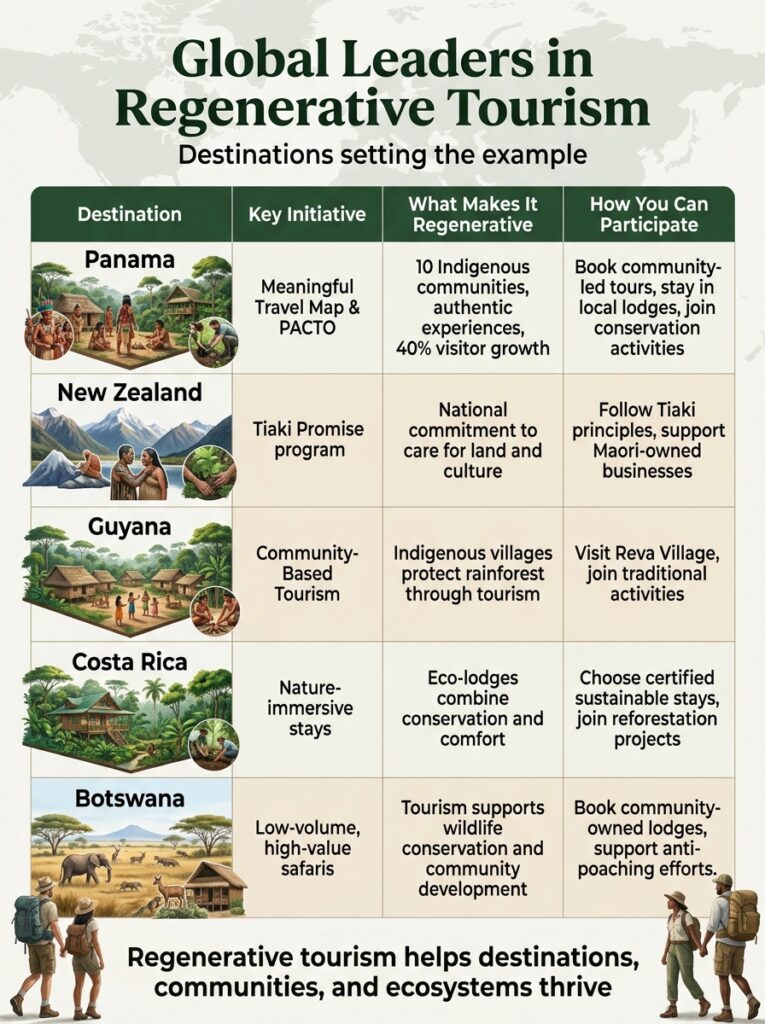
| Destination | Key Initiative | What Makes It Regenerative | How You Can Participate |
| Panama | Meaningful Travel Map & PACTO | Ten Indigenous communities offer authentic experiences; 40% visitor growth | Book community-led tours, stay in local lodges, and join conservation activities |
| New Zealand | Tiaki Promise program | National commitment to care for land and culture | Follow Tiaki principles, support Māori-owned businesses |
| Guyana | Community-Based Tourism | Indigenous villages protect rainforest through tourism | Visit Reva Village, participate in traditional activities |
| Costa Rica | Nature-immersive stays | Eco-lodges integrate conservation and comfort | Choose certified sustainable accommodations, join reforestation projects |
| Botswana | Low-volume, high-value safaris | Tourism funds wildlife conservation and community development | Book with community-owned lodges, support anti-poaching efforts |
Panama stands out for its comprehensive approach. The Tourism Authority created a Master Plan for Sustainable Development that priorities community-based tourism over traditional mass tourism models. Their Meaningful Travel Map showcases 20 vetted organizations offering regenerative experiences, from hiking ancestral trails to learning traditional chocolate-making.
New Zealand’s Tiaki Promise invites visitors to act as guardians of the land, embracing Māori values of environmental stewardship. This cultural framework transforms tourists into temporary kaitiaki (guardians) responsible for protecting the places they visit.
Costa Rica has long led in eco-tourism, but many operators now embrace fully regenerative models. Nature-immersive stays connect guests with biodiversity while funding conservation research and habitat restoration.
These destinations prove that regenerative tourism works at scale. They’ve moved beyond pilot projects to system-wide transformation, showing that economic success and environmental healing can advance together.
How Can I Practice Regenerative Tourism on My Next Trip?
Embracing this approach doesn’t require expert knowledge—just intentional choices that align with regenerative principles.
Choose accommodations wisely. Look for locally-owned properties that employ community members and support conservation initiatives. Eco-lodges with organic gardens, renewable energy systems, and waste reduction programs often embrace regenerative values. Certifications like B-Corp status or Travel Ife partnership indicate a verified commitment to positive impact in tourism.
Support local economies directly. Eat at family-owned restaurants serving locally-sourced food. Buy handicrafts from the artisans who made them. Book tours with community-based guides who share their cultural knowledge authentically. When money stays in local hands, it builds long-term economic resilience.
Go beyond “leave no trace” thinking. While minimizing your impact remains important, look for ways to actively contribute:Join beach cleanups organized by local conservation groups • Participate in tree-planting activities or coral restoration projects
Engage authentically with culture. Take cooking classes from local chefs who teach traditional recipes using indigenous ingredients. Attend artisan workshops where you learn ancient crafts. Join Indigenous-led nature walks that share traditional ecological knowledge. These experiences preserve cultural heritage while creating meaningful connections.
Make sustainable travel choices. Select airlines offering carbon offset programs. Pack reusable water bottles, utensils, and shopping bags to reduce plastic waste. Choose slower transportation methods when possible—trains over flights, walking tours over bus tours. These choices reduce your footprint while enhancing your experience.
Become an advocate. Share your regenerative travel experiences on social media, highlighting local businesses and conservation efforts. Write reviews that mention regenerative practices. Encourage friends and family to travel responsibly. Every conversation spreads awareness and creates demand for better tourism.
The beauty of this approach is that small actions compound. You don’t need to overhaul your entire trip—just make thoughtful choices that align with regenerative values.
What Should I Look for When Booking a Regenerative Travel Experience?
- When booking a regenerative travel experience, start by checking transparency because this helps you avoid greenwashing and choose genuinely responsible travel options. A trusted regenerative tourism business should clearly explain its environmental and social impact with real details, such as how many trees it has planted, how many local people it employs, or what community projects it supports. Be careful with vague claims like “eco-friendly” or “sustainable” if there is no proof behind them.
- Look closely at community involvement before booking. Ask who owns the business, who benefits financially, and whether local people have a real voice in decision-making. The best regenerative travel experiences put local communities in leadership roles, not only in low-level jobs. If the experience supports local ownership, fair wages, and strong community partnerships, that is a positive sign.
- Check the company’s conservation commitments to see whether it actively restores nature or simply reduces harm. A genuine regenerative business should support specific environmental restoration projects, partner with local conservation organizations, and explain how travelers can participate in activities like tree planting, reef restoration, wildlife protection, or habitat cleanup during the visit.
- Pay attention to cultural respect and how traditions are shared with visitors. Authentic regenerative tourism should allow local or Indigenous communities to control how their culture, stories, rituals, crafts, and heritage are presented. Avoid experiences where cultural traditions feel staged only for tourist entertainment, especially if there is no education about cultural meaning, proper behavior, or community benefit.
- Review the pricing structure carefully because real regenerative travel often costs more than mass tourism. Fair wages, local investment, environmental programs, and community development require resources. If a trip price seems suspiciously low, ask what may be missing, such as fair staff pay, conservation funding, safety standards, or authentic local benefit.
- Use this quick regenerative travel assessment framework before booking: green flags include detailed impact reports with specific metrics, local ownership or strong community partnerships, guest participation in conservation activities, cultural experiences led by community members, transparent pricing that reflects fair wages, and partnerships with local conservation organization’s. Red flags include vague environmental claims without data, international chains with no local ties, no mention of environmental programs, staged cultural performances, suspiciously low prices, and no visible community benefit.
- Before confirming your booking, ask direct questions such as: How does this experience benefit the local community? What environmental restoration projects do you support? Do you work with local conservation organizations? Are local guides, artisans, or Indigenous communities involved in leading the experience? A genuine regenerative travel operator will welcome these questions and answer them clearly, confidently, and enthusiastically.
What Are the Main Challenges Facing Regenerative Tourism Today?
Like any transformative movement, this approach faces obstacles that require honest acknowledgement and creative solutions.
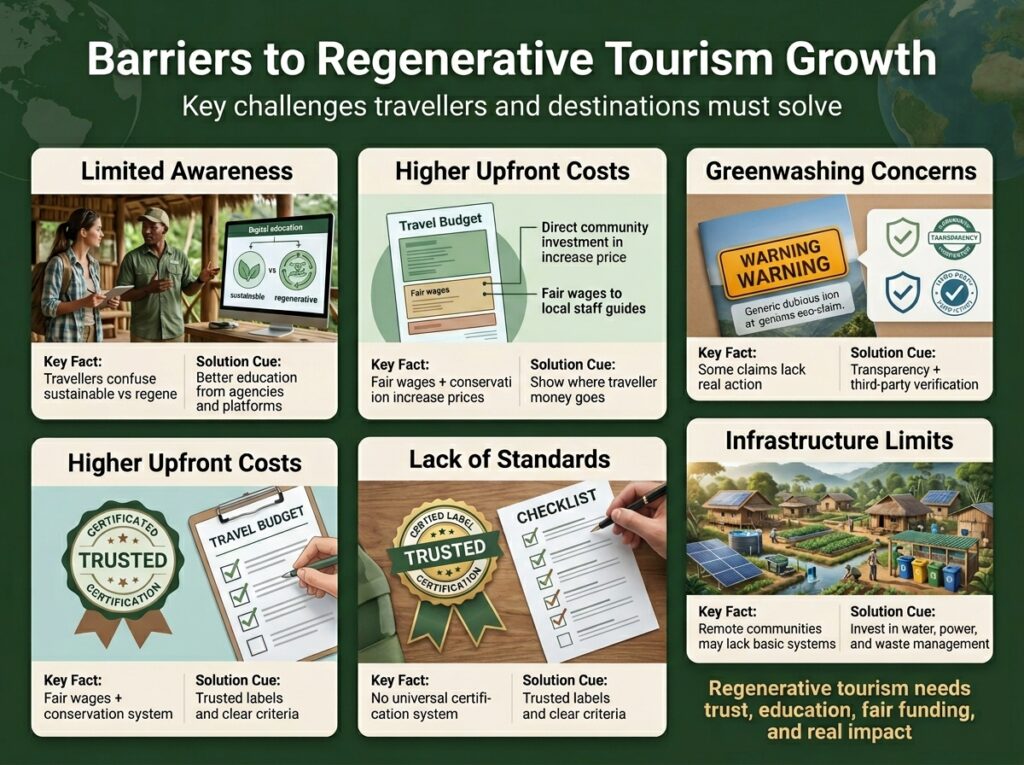
Limited awareness remains a primary barrier. Many travelers still confuse regenerative with sustainable, missing the deeper commitment to active restoration. Even well-intentioned tourists may not know how to find or evaluate regenerative options. Education—through travel agencies, online platforms, and destination marketing—can bridge this knowledge gap.
Higher upfront costs can deter budget-conscious travelers. Regenerative experiences often cost more than conventional tourism because they priorities fair wages, environmental programs, and community investment over profit maximization. However, the long-term value—both for destinations and for traveler satisfaction—justifies this investment. Clear communication about where money goes helps travelers understand why these experiences cost more.
Lack of standardization creates confusion. Unlike organic food or LEED building certification, no universal standard that defines regenerative tourism. This allows businesses to make unverified claims. The industry needs recognized certification systems that travelers can trust, similar to how Fair Trade labelling helps consumers make ethical purchases.
Greenwashing concerns undermine confidence. Some businesses claim regenerative practices without meaningful action, exploiting growing consumer interest in sustainable travel solutions. Combating this requires transparency, third-party verification, and consequences for false claims.
Infrastructure limitations constrain growth in many communities. Remote villages may lack reliable electricity, clean water systems, or waste management necessary for hosting visitors sustainably. Addressing these gaps requires investment, often from tourism revenue itself—creating a chicken-and-egg challenge.
Despite these obstacles, progress continues. Industry conferences increasingly focus on regenerative models. Destinations are developing comprehensive frameworks. Technology platforms connect conscious travelers with verified regenerative experiences. Each challenge represents an opportunity for innovation and improvement.
How Can the Tourism Industry Better Support Regenerative Practices?
Systemic change requires action from all industry stakeholders—governments, businesses, operators, and travelers themselves.
Governments must create supportive policy frameworks. This includes tax incentives for regenerative businesses, regulations protecting communities from over tourism, and funding for conservation infrastructure. Panama’s national tourism plan demonstrates how government leadership can accelerate transformation across an entire country.
Tourism businesses need to invest in regeneration, not just sustainability. This means allocating budgets for environmental restoration, partnering with local conservation organization’s, and measuring impact beyond profit margins. Companies should publish transparent impact reports showing specific environmental and social outcomes.
Travel platforms must highlight regenerative options prominently. Online booking sites could create dedicated categories for regenerative experiences, helping conscious travelers find these offerings easily. Verification systems would distinguish genuine regenerative practices from greenwashing.
Tour operators should redesign itineraries around regenerative principles. Instead of cramming maximum attractions into minimum time, create slower-paced journeys that allow meaningful community engagement and conservation participation. Build relationships with local guides and operators who embrace regenerative values.
Educational institutions must train the next generation of tourism professionals in regenerative thinking. Hospitality programs should teach these principles alongside traditional business skills, preparing graduates to lead industry transformation.
Recent developments show momentum building. The Adventure Travel Trade Association hosted its 2024 World Summit in Panama, spotlighting that country’s regenerative initiatives. Tourism Cares launched Meaningful Travel Maps to connect travelers with verified regenerative experiences. These initiatives indicate growing industry commitment.
The tourism sector has immense power to drive a positive impact on tourism. Every hotel, tour operator, and travel agency makes daily choices that either extract from or contribute to destinations. Collective action toward regeneration can transform the industry’s role from problem to solution.
What Does the Future Hold for Regenerative Tourism?
The trajectory looks promising, driven by converging forces that make regeneration increasingly mainstream.
Traveler demand continues to grow. Studies show 83% of travelers prefer sustainable options, with younger generations particularly committed to positive impact in tourism. As these demographics gain purchasing power, they’ll reshape market demand. Post-pandemic shifts in values accelerate this trend—people want travel to feel meaningful and contribute to something larger than themselves.
Technology integration expands possibilities. Apps and platforms now connect conscious travelers with regenerative experiences worldwide. Blockchain technology enables transparent impact tracking, showing travelers exactly how their spending creates change. Artificial intelligence can match individual values with appropriate destinations and experiences, making regenerative travel more accessible.
Destinations embrace regenerative frameworks. More cities and countries are adopting policies that priorities regeneration. These aren’t just environmental regulations but comprehensive visions for tourism’s role in community thriving. Expect more destinations following Panama and New Zealand’s leadership.
Business models evolve. Community-owned tourism enterprises are growing more common. Impact investing channels capital toward regenerative businesses. Carbon offset programs become standard rather than optional. Innovation in sustainable travel solutions makes regeneration easier and more profitable.
Climate urgency drives action. As climate impacts intensify, the need for travel that heals rather than harms becomes undeniable. Destinations vulnerable to climate change—small islands, coral reefs, mountain ecosystems—increasingly adopt regenerative approaches as survival strategies.
The vision emerging is profound: travel that leaves places healthier, cultures stronger, and ecosystems more vibrant. Communities thrive because of tourism rather than enduring it. Travelers return home transformed, carrying new perspectives and a deeper appreciation for our interconnected world.
This isn’t utopian thinking—it’s already happening in communities worldwide. The question isn’t whether regenerative tourism will become mainstream, but how quickly we can accelerate the transition.
Why Should You Choose Regenerative Tourism for Your Next Adventure?
The personal benefits of this approach extend far beyond feel-good virtue signaling.
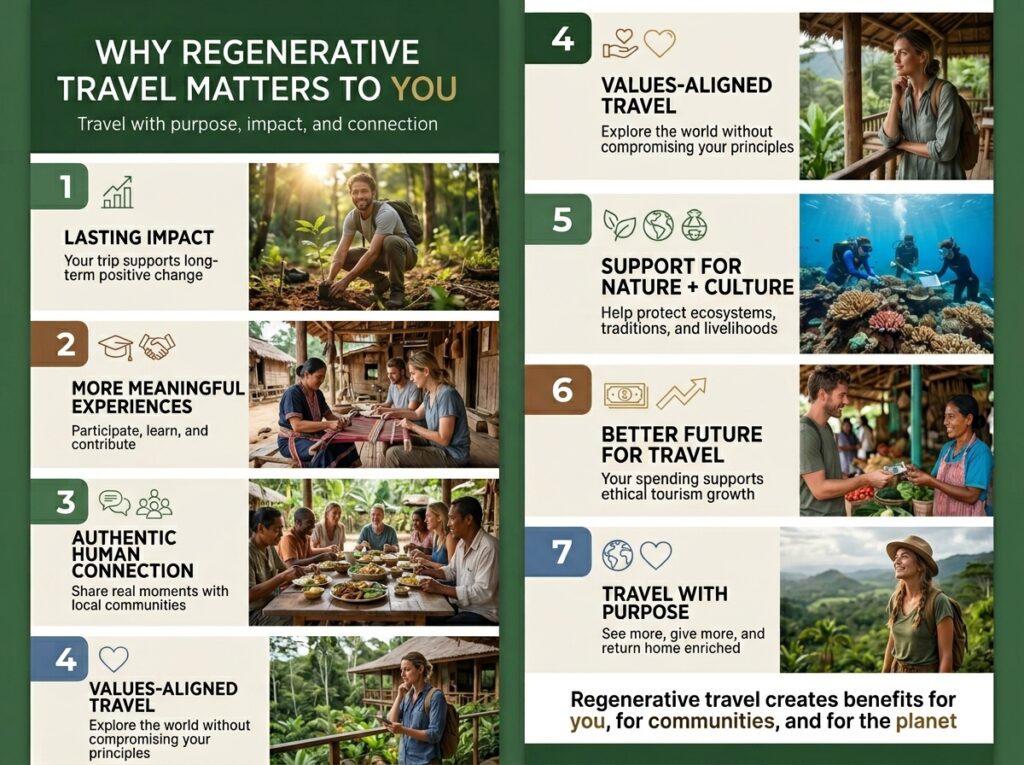
- Regenerative travel gives you personal benefits that go far beyond simple feel-good virtue signaling. It allows you to enjoy travel while knowing your choices support real people, real places, and real long-term change.
- Regenerative tourism helps you create a lasting impact that continues long after your trip ends. The trees you help plant can grow for decades, the artisan whose workshop you support can train the next generation, and the conservation project you fund can protect wildlife and natural habitats for years. While traditional tourism often offers temporary pleasure, regenerative travel creates permanent positive change.
- Regenerative travel experiences are usually more meaningful and memorable because they invite you to participate, learn, and contribute. Learning traditional weaving from an Indigenous grandmother can create a connection that no museum visit can match. Taking part in coral reef restoration lets you physically touch and support an ecosystem you are helping to protect. These hands-on, heart-open experiences transform travel from simple consumption into meaningful contribution.
- Regenerative tourism helps you connect more authentically with people and places. Instead of staying separated from local communities, you share meals, learn skills, and exchange stories with local people as equals. These real human connections often become the most treasured memories of the trip because they feel personal, respectful, and genuine.
- Regenerative travel allows you to align your values with your vacation. If you care about climate change, cultural preservation, environmental protection, and social justice in daily life, you do not have to abandon those values when travelling. Regenerative choices let you explore the world while staying true to your principles.
- Regenerative tourism also supports a better future for the travel industry itself. Every regenerative trip you choose sends a clear market signal that travelers want ethical, responsible, and community-focused tourism. In simple terms, you are voting with your wallet for the kind of tourism industry you want to see grow.
- The choice between conventional tourism and regenerative tourism is not just a travel decision; it is an opportunity. It gives you the chance to travel with purpose, create meaningful impact, support local communities, protect nature, and return home enriched by experiences that truly matter.
The choice between conventional and regenerative tourism isn’t really a choice at all—it’s an opportunity. An opportunity to travel with purpose, create meaningful impact, and return home enriched by experiences that matter.
FAQ
What is regenerative tourism news, and why is it trending?
Regenerative tourism news covers the latest developments, policies, and projects that go beyond sustainability and actively restore destinations. It focuses on how tourism can heal ecosystems, strengthen communities, and create long-term benefits. This trend is gaining attention because travelers and businesses want tourism to give back, not just reduce harm. Experts see it as the next evolution of responsible travel.
How is regenerative tourism different from sustainable travel solutions?
Sustainable travel solutions aim to minimize negative impacts, while regenerative tourism focuses on creating a positive impact in tourism. Instead of just reducing carbon footprints, regenerative travel restores nature, supports local economies, and revitalizes cultures. It shifts tourism from “less harm” to “net positive benefit.” This approach is why regenerative tourism is shaping future travel strategies.
Why is regenerative tourism important for the future of the travel industry?
Regenerative tourism is important because traditional tourism often damages ecosystems and local communities. By focusing on restoration and community empowerment, it helps destinations thrive long-term. Many experts believe it will become a core travel industry standard. As regenerative tourism news grows, more companies and governments are adopting this approach.
What are examples of regenerative tourism in real destinations?
Examples include destinations that restore coral reefs, rewild forests, and support indigenous communities through tourism revenue. Some regions use tourism funds to rebuild ecosystems and create local jobs. These projects show how travel can actively improve nature and society. Such success stories are frequently highlighted in regenerative tourism news worldwide.
How can travelers contribute to regenerative tourism?
Traveler’s can choose eco-conscious accommodations, support local businesses, and participate in conservation projects. Responsible spending and cultural respect also create a positive impact on tourism. By choosing regenerative-focused tours and experiences, travelers help restore destinations. This makes tourism a force for good rather than just consumption.