
Processing payments in the travel industry isn’t as simple as running a regular online store. From high-value bookings to international customers to complex refund scenarios, travel businesses face unique payment challenges that require specialized solutions.
What does travel payment processing mean?
Travel payment processing is the system that handles financial transactions for travel bookings—from the moment a customer enters their card details to when the money settles in your account. It involves managing everything from initial authorization to final settlement, while handling the complexities unique to travel: deposits, cancellations, supplier payments, and multi-currency transactions.
This guide is for travel agencies, online travel agencies (OTAs), ticket brokers, and tour operators who need reliable travel agency payment processing solutions and want to understand merchant services for travel agencies.
What’s the most significant difference between travel payments and regular ecommerce payments?
Unlike buying a t-shirt online, where payment and delivery happen quickly, travel bookings involve high transaction values, long gaps between payment and service delivery, frequent changes or cancellations, and payments to multiple suppliers. These factors make travel payment processing significantly more complex and risky than standard ecommerce.
What Is Travel Payment Processing and How Does It Work?
What is travel payment processing in simple terms?
Travel payment processing is the behind-the-scenes system that securely moves money from your customer’s account to yours when they book a trip. It involves multiple parties working together to authorize, capture, and settle funds while protecting against fraud and ensuring compliance.
How does a customer payment move from booking to settlement?
The travel booking payment workflow follows these steps:
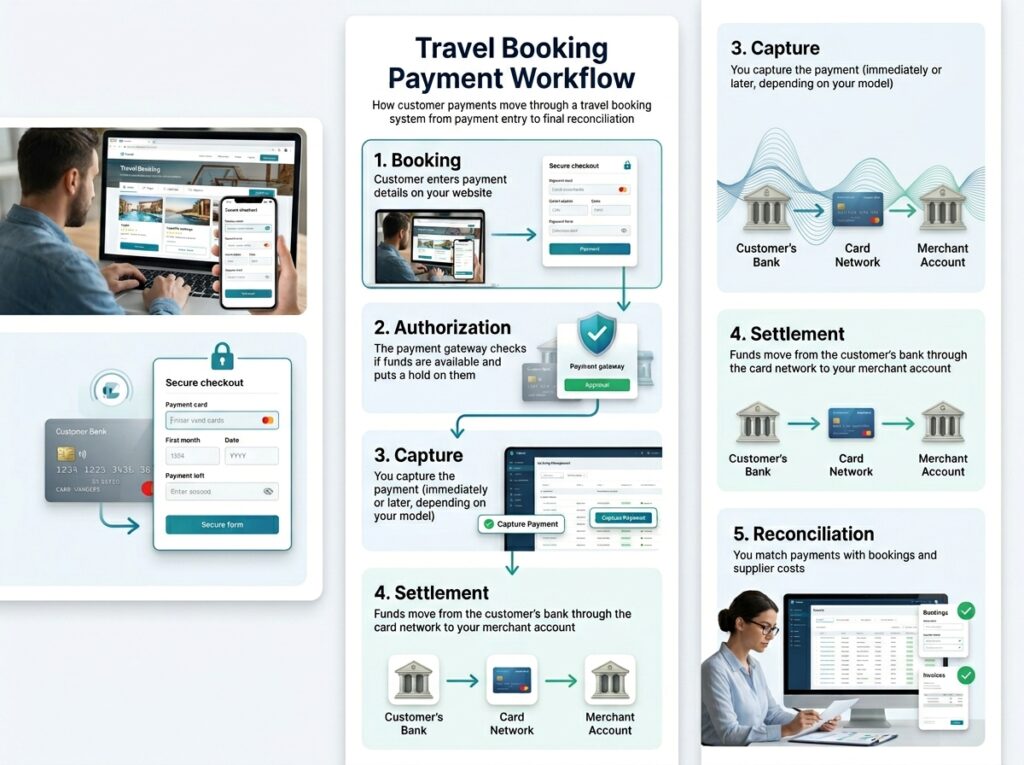
- Booking: Customer enters payment details on your website
- Authorization: The payment gateway checks if funds are available and puts a hold on them
- Capture: You capture the payment (immediately or later, depending on your model)
- Settlement: Funds move from the customer’s bank through the card network to your merchant account
- Reconciliation: You match payments with bookings and supplier costs
Who are the leading players in travel payments?
Four key players make payment processing for travel booking sites work:
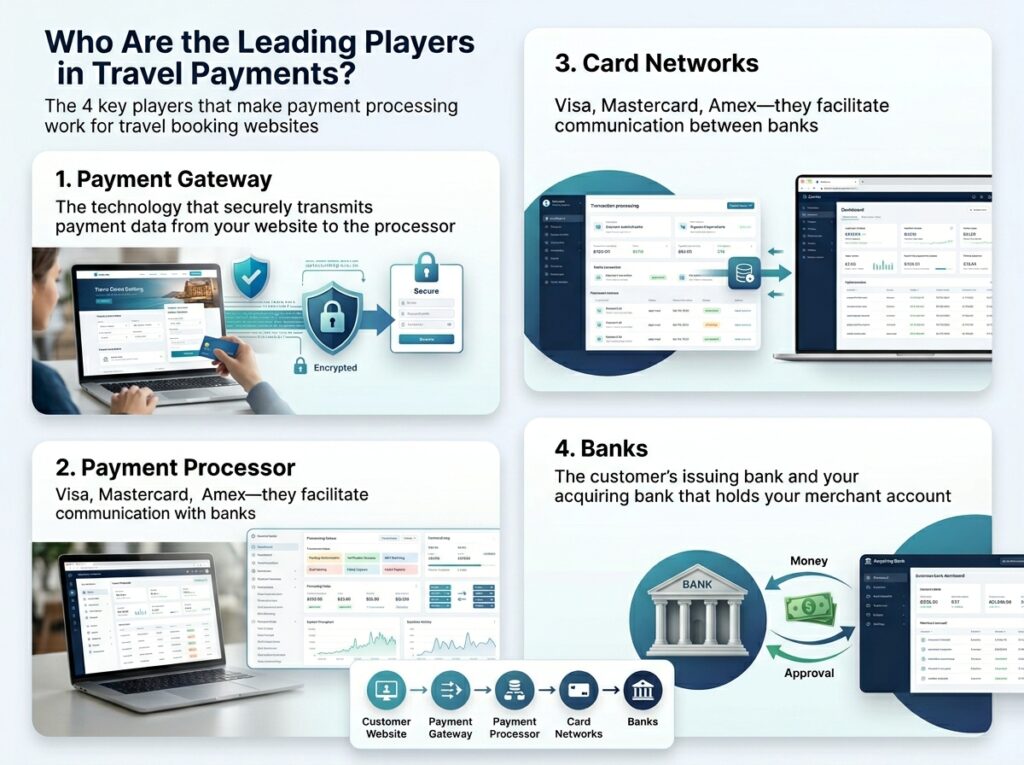
- Payment Gateway: The technology that securely transmits payment data from your website to the processor
- Payment Processor: Handles the actual transaction processing and communication with banks
- Card Networks: Visa, Mastercard, Amex—they facilitate communication between banks
- Banks: The customer’s issuing bank and your acquiring bank that holds your merchant account
Why Travel Payment Processing Is Unique (and Complex)
Why is payment processing for the travel industry more complex than other industries?
Travel businesses face distinct challenges that make payment processing for the travel industry uniquely complicated:
High Order Values: A family vacation booking might be $5,000-$15,000, far exceeding typical ecommerce transactions. Higher values trigger more fraud checks and increase chargeback risks.
Longer Fulfillment Cycles: Customers often book months in advance. This gap between payment and service delivery increases dispute risks and complicates refund handling.
Deposits and Partial Payments: Many bookings involve deposits upfront and balance payments later, requiring sophisticated payment capture workflows.
Supplier Payments: Tour operators and agencies must pay hotels, airlines, and guides—creating b2b travel payments complexity alongside customer transactions.
Multi-Country Customer Base: International travelers mean dealing with multiple currencies, cross-border regulations, and varying payment preferences—requiring robust merchant services for the travel industry and airline payment solutions.
Common Payment Challenges in the Travel Industry
What payment problems do travel agencies face most often?
Travel businesses encounter several recurring payment headaches:
Payment Failures and Declines: Travel bookings experience higher decline rates than other industries due to high transaction values, international cards, and strict fraud filters.
Fraud and Identity Mismatch: Fraudsters target travel bookings because of high values and the ability to resell tickets or accommodations.
Chargebacks: Customers dispute charges even after trips are completed, claiming services weren’t as promised or seeking refunds for cancellations.
FX Costs and Multi-Currency Complexity: Converting currencies adds costs and complexity, especially when customers, suppliers, and your business operate in different countries.
Operational Issues: Reconciling payments across multiple bookings, partial payments, refunds, and supplier costs creates administrative nightmares without proper systems.
Why do travel card payments fail more often?
Cards get declined in travel bookings for several reasons: high transaction amounts trigger fraud alerts, international cards face additional verification, bank spending limits get exceeded, and anti-fraud systems flag unusual travel purchases. These issues require strategies to reduce payment failures in travel bookings.
Why do chargebacks happen even after service is delivered?
Chargebacks in the travel industry occur when customers claim they didn’t receive promised services, weren’t satisfied with the quality, or experienced cancellations beyond their control. Even when services were delivered, documentation gaps make these disputes hard to contest.
Is Travel Payment Processing High-Risk?
Is travel considered high-risk in payment processing?
Yes, travel is typically classified as high-risk by payment processors. Understanding why helps you work with this classification rather than against it.
What does a “high-risk merchant” mean?
High-risk merchants face greater scrutiny from payment processors due to higher chargeback rates, fraud potential, or regulatory complexity. This classification affects your travel merchant account approval odds, processing fees, and reserve requirements.
Why is travel categorized as high-risk?
Travel payments are high risk because of delayed delivery (services provided months after payment), higher dispute rates, fraud vulnerability (stolen cards buying refundable tickets), and seasonal revenue fluctuations. These factors make processors cautious about travel agency credit card processing.
What can travel businesses do to lower their risk profile?
Reduce your risk classification by maintaining low chargeback rates (under 1%), implementing strong fraud prevention, providing detailed booking documentation, showing consistent revenue history, and being transparent about your business model when applying for travel merchant accounts or a ticket broker merchant account.
Best Payment Methods for Travel Agencies
What payment methods should travel agencies offer today?
The ideal mix depends on your customer base and booking types, but variety increases conversion. Smart travel agencies offer multiple payment methods to match customer preferences and reduce abandonment.
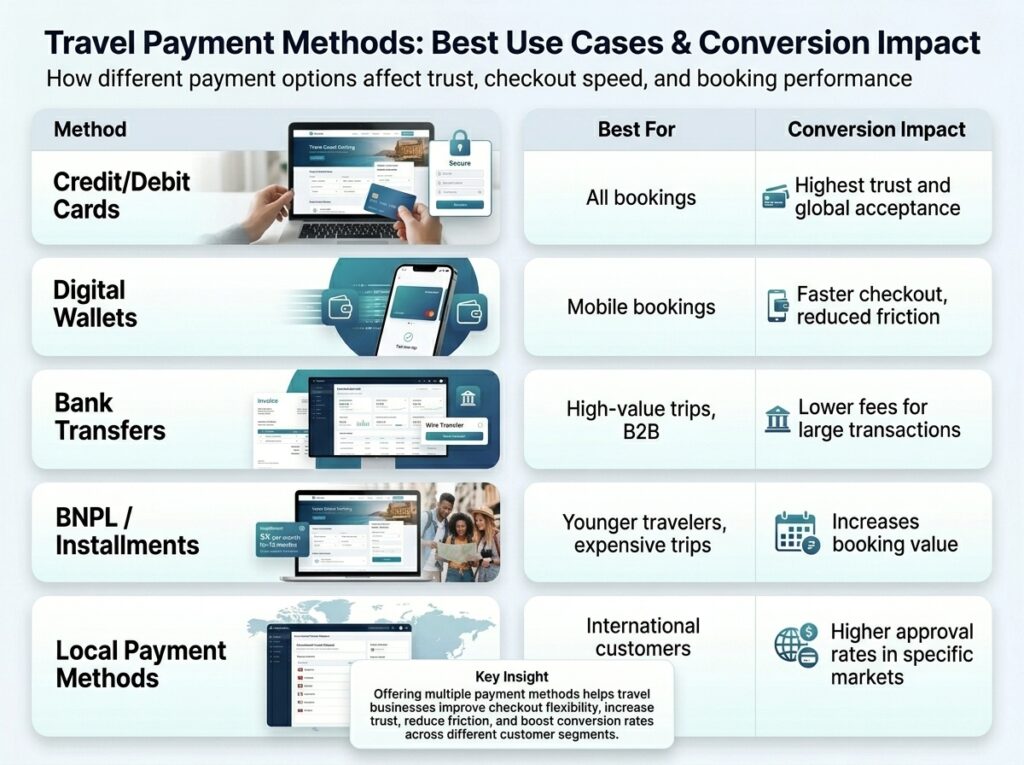
| Payment Method | Best For | Conversion Impact |
| Credit/Debit Cards | All bookings | Highest trust and global acceptance |
| Digital Wallets | Mobile bookings | Faster checkout, reduced friction |
| Bank Transfers | High-value trips, B2B | Lower fees for large transactions |
| BNPL/Installments | Younger travelers, expensive trips | Increases booking value |
| Local Payment Methods | International customers | Higher approval rates in specific markets |
Credit & Debit Card Payments for Travel Bookings
Why are cards still the #1 payment method for travel bookings?
Credit card payments for travel bookings dominate because customers trust them, they offer dispute protection, and they work globally. Cards also provide the highest approval rates when properly optimized through quality credit card processing for travel agencies.
To maximize approval rates: use 3D Secure selectively, provide complete booking details in transaction data, and work with processors experienced in travel agency credit card processing.
Digital Wallet Payments for Travel
How do digital wallets improve travel checkout conversions?
Digital wallet payments for travel, like Apple Pay, Google Pay, and PayPal reduce friction dramatically. Customers avoid typing card details, checkout happens with one click, and mobile booking becomes seamless—all contributing to better checkout optimization for travel bookings.
Bank Transfers and Direct Bank Payments
When should travel businesses offer bank transfers?
Bank transfers for travel payments work best for high-ticket corporate bookings or group travel where lower transaction fees offset slower settlement times. They’re particularly valuable for b2b travel payments and direct bank payments in the travel industry, where payment certainty matters more than speed.
Buy Now Pay Later (BNPL) and Installments for Travel
Is BNPL good for travel agencies?
BNPL travel payments appeal to younger travelers and increase booking values by making expensive trips more affordable. However, they add complexity around refunds and cancellations. Installment payments for travel bookings work best when you clearly communicate how cancellations affect payment plans.
Local Payment Methods for Travel Businesses
Why do local payment methods matter for international travelers?
Local payment methods for travel dramatically improve conversion in specific markets. German customers prefer So fort, Dutch travelers use ideal, and Chinese tourists expect Alipay or WeChat Pay. Offering these options reduces declines and builds trust through localization.
International and Multi-Currency Payment Processing
How do travel agencies accept payments globally?
International payments for travel agencies require strategic decisions about pricing display, currency conversion, and settlement. Successful global operations use multi-currency travel payments to show prices in customers’ local currencies while managing foreign exchange solutions for the travel industry to minimize conversion costs.
Cross-Border Travel Payments: What to Know
What makes cross-border payments harder in travel?
Cross-border travel payments face higher fraud scrutiny (international cards trigger more security checks), increased decline rates, complex compliance requirements (data handling varies by country), and currency conversion complications—all requiring specialized infrastructure.
How to Reduce Payment Failures and Declines
How can travel agencies reduce payment declines?
To reduce payment failures in travel bookings, implement smart retry logic that automatically retries failed transactions at optimal times, use local acquiring (processing cards in the customer’s country), ensure strong customer authentication without excessive friction, and maintain high data quality in checkout forms. These strategies, combined with a quality payment gateway for travel websites, significantly improve approval rates.
Fraud Prevention for Travel Payments
How do travel agencies prevent fraud without blocking real customers?
Fraud prevention for travel payments requires balancing security with conversion. Use fraud scoring systems that assess transaction risk, implement velocity checks (limiting bookings from the same card/IP), deploy device fingerprinting to identify suspicious patterns, and watch for travel-specific fraud signals like mismatched billing/destination addresses. Strong payment security for travel bookings protects revenue without frustrating legitimate customers.
Chargeback Prevention and Dispute Management
How can travel agencies reduce chargebacks?
Reduce travel chargebacks by maintaining detailed documentation (itineraries, invoices, booking confirmations), clearly communicating cancellation policies upfront, sending service reminders before trips, and responding quickly to customer concerns before they escalate to disputes. Fighting chargebacks in the travel industry succeeds when you have comprehensive evidence.
Travel Merchant Account: What It Is and Why It Matters
What is a travel merchant account?
A travel merchant account is a specialized bank account that lets you accept card payments. Unlike standard retail accounts, merchant accounts for travel undergo stricter underwriting due to industry risk factors. A ticket broker merchant account requires even more specialized approval, given resale market complexities.
Quality merchant services for travel agencies understand industry challenges and offer appropriate risk management tools, reasonable reserves, and experienced support.
Choosing the Best Payment Processor for Travel Agencies
What should you look for in a payment processor for travel?
Selecting the right payment processor for a travel agency requires evaluating several factors beyond just pricing. Look for high approval rates through smart routing, comprehensive risk management tools, experienced dispute handling support, robust multi-currency and FX solutions, and reasonable payout speed with fair reserve requirements.
The best travel payment solutions combine technology, industry expertise, and a partnership approach to help you maximize revenue while managing risk.
Best Practices Checklist for Travel Payment Processing
What are the best practices travel agencies should follow?
Successful travel payment operations follow these essential practices:
Maintain clear refund and cancellation policies displayed prominently at checkout • Use fraud prevention tools with selective 3D Secure application to balance security and conversion • Offer multi-currency pricing and local payment methods for international customers • Keep comprehensive chargeback evidence ready (itineraries, communications, confirmations) • Monitor payment declines and failures continuously to identify and fix issues quickly
Most Important Priority:
Prioritize optimizing approval rates before scaling advertising spend—it directly impacts revenue. Increasing approvals from 85% to 95% on $100,000 in attempted bookings generates an extra $10,000 in revenue without additional marketing costs.
FAQ
1) What is payment processing for the travel industry?
Payment processing for the travel industry means the systems that let travel agencies and booking websites accept customer payments (cards, wallets, bank transfers), confirm transactions securely, and settle funds into a travel merchant account. It also covers travel-specific needs like deposits, partial payments, refunds, and dispute handling.
2) Why is travel agency payment processing considered high-risk?
Travel agency payment processing is often labeled high-risk because travel services are delivered later, refund volumes can spike during disruptions, and chargebacks are more common than in standard ecommerce. This is why many agencies need specialized merchant services for travel agencies and strong fraud controls to maintain stable approvals and payouts.
3) What payment methods should travel agencies offer to increase conversions?
The best payment methods for travel agencies usually include credit/debit cards, digital wallets, bank transfers, and localized options for international customers. Offering digital wallet payments, travel, l and local payment methods often improves checkout success and reduces cart abandonment, especially for mobile travelers.
4) How can travel businesses reduce payment failures, declines, and chargebacks?
To reduce issues in travel payment processing, agencies should optimize checkout data quality, use local acquiring for cross-border bookings, and apply smart fraud checks. Tools like 3D Secure travel payments, CVV AVS verification travel, and strong documentation help reduce payment declines, travel bookings, and chargebacks in the travel industry while protecting genuine customers.
5) What is the difference between a payment gateway and a payment processor for travel agencies?
A payment gateway for a travel agency securely collects and transmits payment data from your website to the payment network. A payment processor for travel agency routes the transaction, gets authorization from the bank, and handles settlement. Understanding payment gateway vs payment processor helps travel businesses build a smoother, more reliable booking checkout.